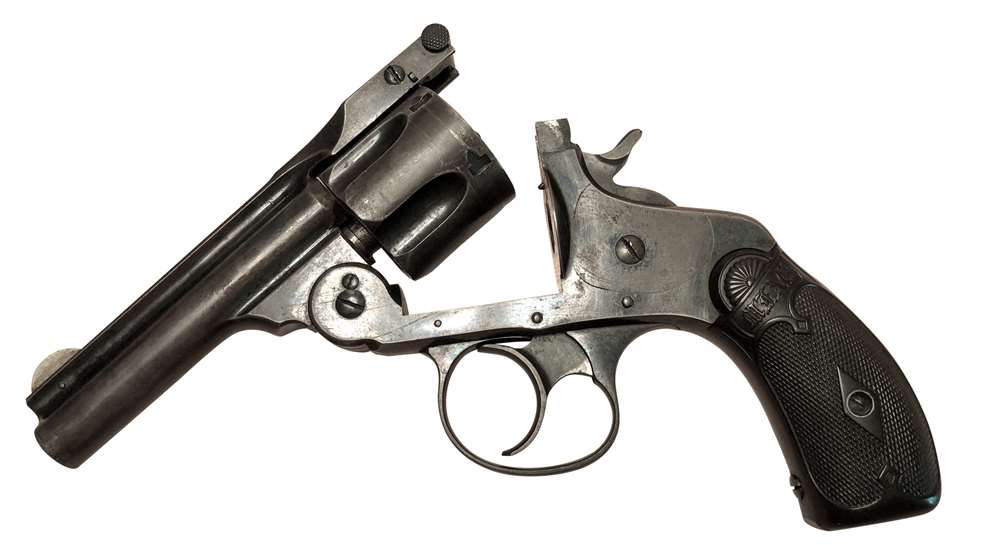
Q: I have an old revolver by Marlin that is a five-shot, top-break, .38-cal., pocket-size gun. It is said to have belonged to a railroad worker out of Fort Worth, Texas. It is 7" long and weighs about 17 ozs. There is a stamp on the back of the grip frame that reads “U.S. Ex. Co.,” and under the buttplate appears to be its serial number, “19024.” Molded into the stock are the letters “M F A C.” The barrel top is stamped “Marlin Fire Arms Co. New Haven, Conn. U.S.A. Patented August 9, 1887, August 9 1887.” What is this old Marlin?
A: Your revolver is the Model 1887 Double-Action. There were about 15,000 made between 1887 and 1889. The small screw that is just above the large screw upon which the barrel pivots identifies yours as the 2nd variation. It indicates that this model has an improved extraction system patented by D.H. Rice.
Marlin’s 1887 catalog states: “The style is identical with the Smith & Wesson revolver, and in no respect whatever is it inferior.” This is the only double-action revolver the company made, and then only for three years. Apparently, Marlin decided to concentrate on what it did best—rifle manufacture.
The fact that the original owner worked for the railroad out of Fort Worth is consistent with the “U.S. Ex. Co.” stamped on its backstrap. The U.S. Express Co. was founded in 1854; revolvers of this type were carried by those who guarded packages. The U.S. Post Office did not carry packages in the 19th century, so a number of express companies came into being to transport packages by rail. By 1890, the U.S. Express Co. was one of the top four carriers, handling 15 percent of the packages. For comparison, Wells Fargo had 20 percent, American Express had 21 percent, Adams Express had 23 percent and Southern Express had 7 percent.
—Michael F. Carrick, Contributing Editor
Most Popular