Rifleman Q & A: Civil War Import

by
posted on May 15, 2017
** When you buy products through the links on our site, we may earn a commission that supports NRA's mission to protect, preserve and defend the Second Amendment. **

civ.jpg

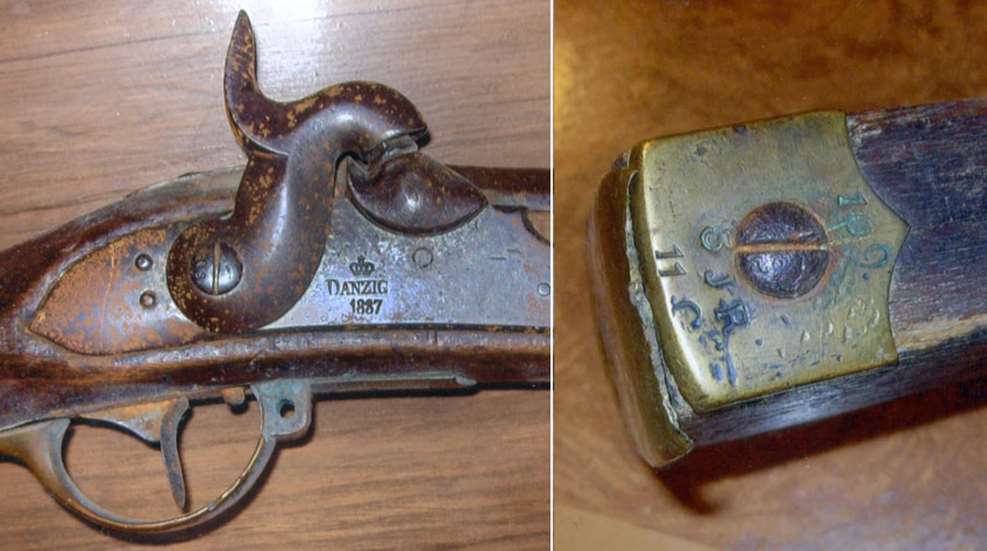
Q: I’ve acquired an interesting firearm and need help finding more information about it, since my library searches have yielded limited results. The lockplate is stamped “DANZIG 1837” with a crown marking above. It appears to be authentic, but the interesting part is that the gun is a sidelock, percussion musket. My research shows this to be an alteration from its original state. Is there more to know? 

A: Your gun is the Prussian Model 1809 flintlock musket made at the government armory in Danzig (now Gdansk, Poland). Beginning in 1839, almost all were converted to a percussion ignition system, as was yours.

The numbers stamped on the tang of the buttplate show its military use. The “3JR” below the screw probably indicates the 3rd Infantry Regiment. The other numbers may be the rack number of this gun or perhaps indicate its use by a different unit during its lifetime. The metal piece sticking out from the front of the stock fits into an opening at the base of a bayonet to lock it in place.

The U.S. Ordnance Dept. records show that the Union forces in the American Civil War imported 142,823 of these 1809/1839 muskets in 1861 and 1862 when sold as surplus by the Prussian army. As a result, these are quite available for Civil War ordnance collectors.

The collectors call the guns “Potsdam Muskets” because the great majority of them were made at the Potsdam Armory and have “POTSDAM” where “DANZIG” is on the lockplate. Several other armory names can be found, e.g., Suhl, Saarn, et al.

—Michael F. Carrick

Latest

Subsonic Ammo 101
Subsonic Ammo 101

Subsonic Ammo 101: Everything The Suppressor Shooter Should Know

Slower-than-sound rounds are an art as much as a science. For target shooting, bullet upset is not important, but if you’re using subsonic loads for hunting or self-defense, it becomes critical.

I Have This Old Gun: Model 1874 Gras Rifle

Following the Franco-Prussian War of 1870, the French military were in desperate need of a new service rifle. Their answer was the Model 1874 Gras, which was largely an update to the earlier Chassepot design.

Compact & Quiet: CMMG's ZEROED Banshee

CMMG has expanded its Banshee line of AR-style rifles with the ZEROED, a firearm that is optimized for suppressor use.

Making the A-Cut: Springfield Armory's COA-Ready Operator, TRP & DS Prodigy Pistols

Springfield has already released a COA-ready version of its Echelon earlier this year, and the new models will bring the A-Cut to the company’s hammer-fired handguns, including the 1911 Operator, 1911 TRP and 1911 DS Prodigy.

Skills Check: Snake-Eyes Drill

Our drill this month trains you to form a stable firing platform early enough to gain optimal control before the shot breaks. Timing is of the essence.

A Memorial Day Conversation With Grey Team

Grey Team was founded to help armed services members and veterans with the physiological impacts traumatic brain injuries, post-traumatic stress disorder, chronic pain and more.

Interests


Get the best of American Rifleman delivered to your inbox.