Q: I recently acquired a Luger Artillery Model made by DWM and dated 1917. Because of the British proofmarks, I believe the gun must have been a souvenir brought to England after World War I. There are a number of other questionable markings on the gun, and I was wondering what they might mean regarding the pistol’s past.
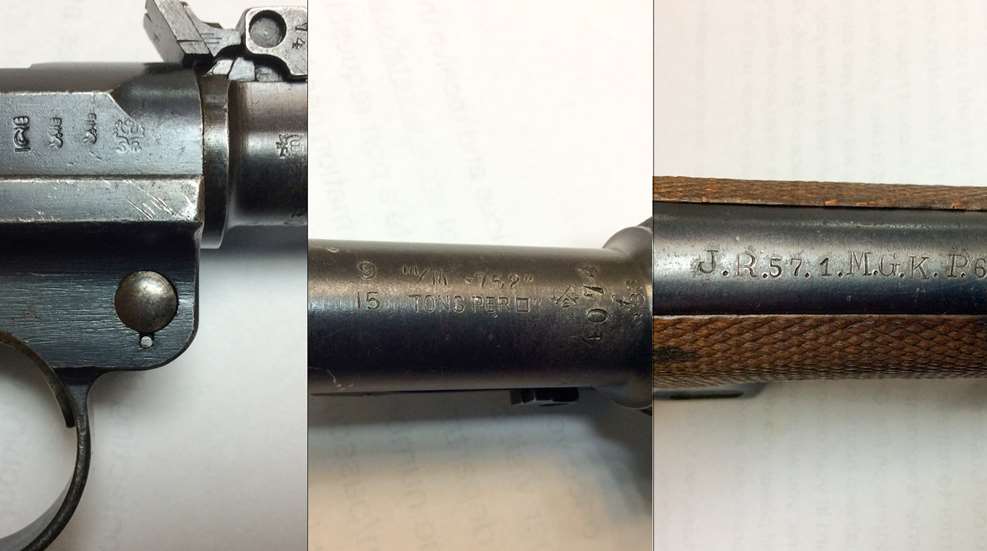
A: It is doubtful that your pistol’s history could be recovered with the information we have at hand. It does appear obvious that your pistol is well-traveled. Other than that, there are many potential, as well as colorful, scenarios that could be offered, but none that can be verified. As you have determined, the markings on the underside of the barrel represent that the pistol underwent proofing at the Birmingham Proof House during the 1954-1989 period. I suspect, but can’t prove, that your Luger probably came to the UK after (or during) World War II. World War I ended with the Armistice, so there was not the sort of souvenir-collecting that occurs after a participant’s defeat. The pistol probably remained in German service after the war, first with the Transitional Army, then the Reichswehr and finally the Wehrmacht. If that were the case, the gun may have been issued, or more likely kept in storage until circumstances allowed for its re-issuance. On the other hand, it could just as well have been “liberated” by a German soldier and kept hidden in a trunk until the opportunity came along for his family to sell it.
The rather inelegant and somewhat tedious style of British proof specifications (1954-1989) would indicate that it came to reside in the UK at some point prior to or within that time frame, but exactly when is impossible to say, as is the path taken to get there. It may have been brought to the UK as a war souvenir or by someone working within the “British Sector” long after the war was over. At that time, British law called for “compulsory testing” of German firearms made prior to 1955 before they could legally be offered for sale within the country. How the pistol made it to the United States is anyone’s guess.
Perhaps more interesting is the array of letters and numbers stamped on the grip’s frontstrap. For a period, usually given as 1910 to 1916, it was a requirement that each pistol be given a regimental identification marking representative to the company level. As the markings were applied at the unit level, the technique and quality of this treatment varied. The decoding and translation of these markings is subjective, although there are sources offering clues to interpret them. Based on what data I have been able to find, it is possible that your Luger’s designation is 57th Infantry Regiment, 1st Battalion, Machine Gun Company, Pistol No. 6. The long-barrel Lugers were typically issued to soldiers manning crew-served weaponry, which would include heavy machine guns and artillery pieces. While no Lange Pistole 08s were produced after 1918, stockpiled examples were again issued to artillery and other crew-served weapons soldiers during the later conflict.
The three stamped crowns over the gothic letters on the right side are military acceptance markings from the World War I period; the actual proofmark is the stylized spread-eagle found nearby, which is also located on the barrel and bolt.
—John W. Treakle
Most Popular