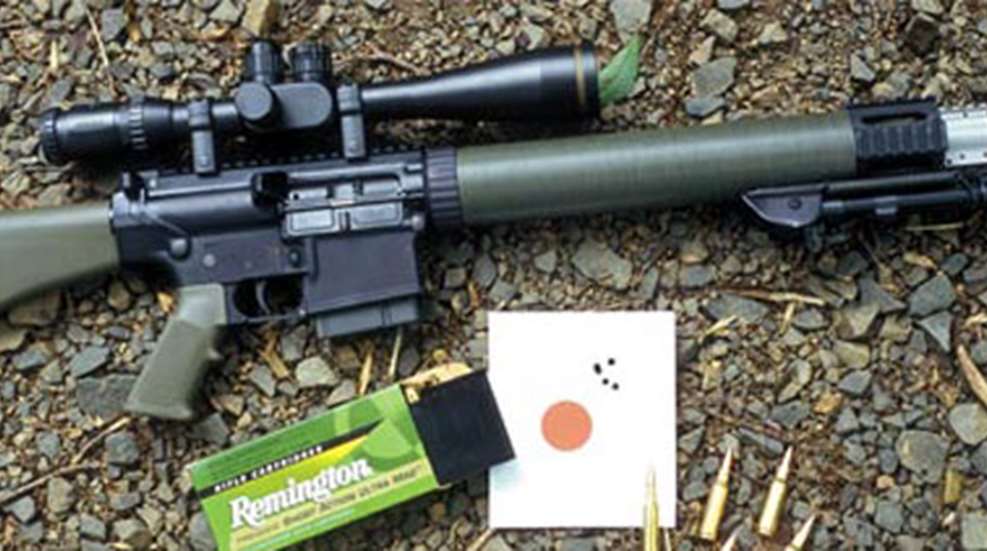
One measure of a great gun design is its adaptability to calibers and purposes not originally envisioned. Like Mauser’s bolt-action rifle and Browning’s M1911 pistol, Eugene Stoner’s AR-15/M16 rifle stands out as a timeless design that in new forms and chamberings — from 9 mm sub-guns to long-range .308 precision rifles—has come to dominate a broad range of shooting activities. The gun once vilified as a “Mattel toy” has evolved into a durable arm, capable of firing some of the most powerful rounds available, as exemplified by the rifle under review here, ArmaLite’s AR-10(T) Ultra in .300 Remington Short Action Ultra Mag. (RSAUM).
The AR-10(T) Ultra is the product of a collaboration between the Geneseo, Ill., firm and the United States Army Marksmanship Unit (USAMU) to develop an AR-10 rifle suited to long-range work. While the .308 Win. has a nominal muzzle velocity of around 2620 f.p.s. with a 180-gr. bullet, the .300 RSAUM can push the same projectile to 3000 f.p.s., yielding about 200 f.p.s. more velocity, at 1,000 yards, with significantly less drop and wind deflection. The .300 RSAUM’s flatter trajectory also allows the use of scopes with a smaller range of adjustment.
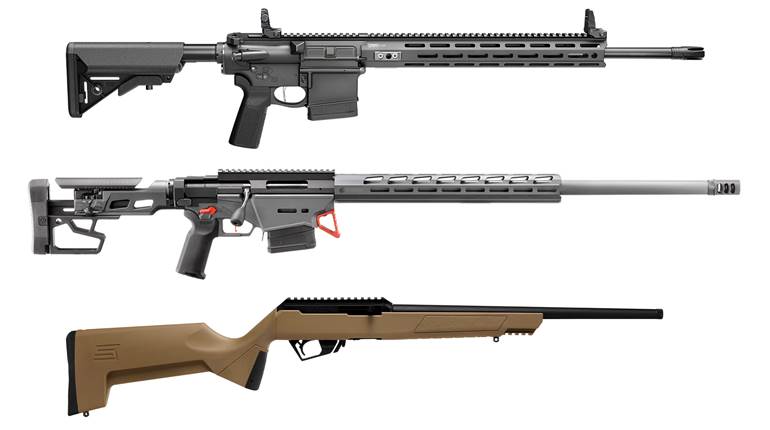
Based on the proven AR-10 platform, it is currently only available in .300 RSAUM with a free-floated, 24" heavy-profile, stainless-steel barrel; a flattop upper receiver with an integral Picatinny rail; aluminum-and-polymer tubular fore-end, with four short Picatinny rail segments for mounting lights, lasers or other accessories; and a detachable, five-round, steel box magazine. All carbon-steel parts are coated with a black-oxide finish, while the aluminum components are black anodized. The synthetic fore-end, pistol grip and buttstock are olive drab.
AR-10(T) Ultra follows established AR15/AR-10 operating principles, so all controls are identical. However, there are changes from the standard AR-10. The bolt face has been opened up to handle the larger 0.532" nominal head diameter of the .300 RSAUM, the ejection port in the upper receiver has been enlarged, and the gas port in the barrel is located 3" farther forward than in the .308 Win. version. The lower receiver remains unchanged, because the existing magazine well is large enough to accommodate the fat RSAUM cartridge case.
The target crown of the rifle’s 24" barrel is recessed, and the bore is button-rifled with a six-groove, 1:10" right-hand twist to stabilize even the heaviest .30-cal. bullets. The outer diameter of the stepped barrel measures 0.80" at the muzzle and 1.00" under the handguard.
We mounted a Springfield Armory 4-16x50 mm tactical scope on the AR-10(T) Ultra using Leupold Mk IV rings and tested the rifle for accuracy at 100 yds. off sandbags. Test ammunition included Remington loads with 150- and 165-gr. Core-Lokt and 180-gr. Nosler Partition bullets. Initially, there were some failures to fully eject brass with the 150-gr. Core-Lokt load. Quick disassembly revealed that the carrier and bolt were essentially bone-dry, and proper lubrication eliminated the problem. ArmaLite’s two-stage match trigger broke at 5 lbs., which felt even lighter due to its smooth take-up, crisp break and minimal overtravel. Thanks to the weight of the gun and the recoil-absorbing properties of its semi-automatic action, recoil was moderate with the 150- and 165-gr. bullets. The 180-gr. load proved to be fairly stout, generating recoil that was brisk, but manageable.
ArmaLite guarantees 1 m.o.a., three-shot groups at 100 yds., and our test rifle approached or achieved this with five-shot groups of all the loads we tested. The gun showed a slight preference for the 150-gr. Core-Lokt load. Even better accuracy would likely be achieved with target-grade ammunition loaded with match bullets, such as Sierra’s 168-, 175- or 180-gr. HPBTs.
The rifle proved to be slightly muzzle-heavy, which contributed to steadiness in off-hand and sitting shooting positions. Also a plus in such positions was the magazine, which only protrudes about 5/8" below the magazine well and did not interfere with the support hand position on the fore-end. With its 24" barrel, the rifle is not exactly handy, but it is comparable in length to a typical precision bolt-action rifle.
The AR-10(T) Ultra is a unique rifle that is produced on a limited semi-custom basis. With a list price of $2,340, it is not inexpensive. Even so, the accuracy, reliability and power of the AR-10(T) Ultra rifle will likely endear it to a diverse population of shooters—military and law enforcement precision riflemen, hunters, long-range target shooters and those who simply enjoy firing powerful semi-automatic rifles.
Most Popular