“…fits your palm like the hand of a friend.”
Thus read Remington’s advertising as the old-line gunmaker embarked on the promotion of a new pistol. It was 1918 and the bold pronouncement was no idle boast. The company’s new pistol was designed to compete with other guns from Colt, S&W, H&R and Savage, as well as many Europeans. Legendary designer John Pedersen applied his considerable skills to developing a pocketable defensive automatic pistol and the result was the Model 51. Long before gun writers began to bandy about the term “ergonomics,” Pedersen’s slick little .32/.380 had ergos for the ages. It was an all-steel, single-column, 7+1 with multiple safety features. Pedersen’s efforts produced a very useful pocket auto. It had a unique breech locking system and a shape that seemed to fit every hand. But it was an expensive gun to make and Remington discontinued the model in 1927. The company did not make a true repeating handgun until its recent introduction of a 1911 style pistol a couple of years ago.
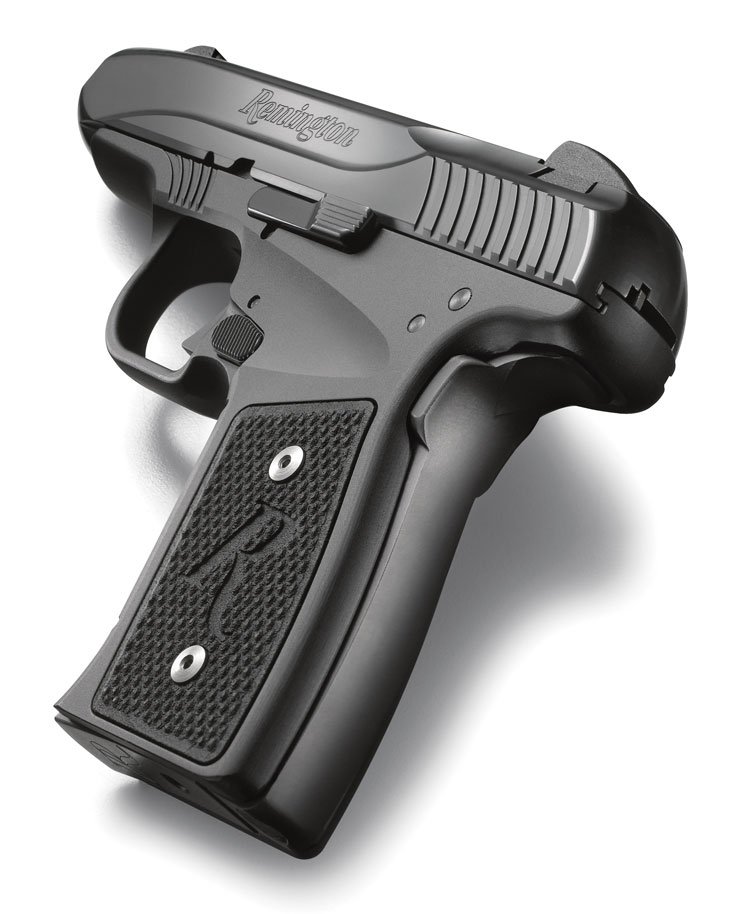
That is until Remington invited a group of gun writers to Gunsite just before Christmas of 2013. Many new products were introduced, but the highlight was a new version of that decades-old Model 51. It is called the Model R51 and there’s no doubt where the name originated. Although there are many changes, the R51 of 2014 bears a strong resemblance to the older gun. It has a very similar butt shape and grip angle. In the hand, it feels much the same. Inside, the locking system is also inspired by the earlier gun. Engineered from the beginning to take the .40 S&W cartridge, the R51 initially goes on sale as a 9 mm Luger. Understandably, it is slightly thicker.
In a marketplace loaded with many different kinds of trigger systems and safety arrangements, the R51 is different. It is an internal hammer single-action. The hammer has no spur and cannot be manually cocked. When the slide cycles, the hammer cocks and there is no means of decocking it. The trigger is of the pivoting type and has a relatively short reset. Trigger pull is about 5 ½ pounds. We were allowed to shoot the guns as much as we desired at Gunsite and I found the little R51 to handle well. It is decently accurate and malfunctions were few in this batch of pre-production prototypes. I am promised an early specimen for T&E as early as January. When it arrives, it will get the usual detailed examination and shooting evaluation. At this point, it looks very good.
Clearly, this pistol is an effort to penetrate the concealed-carry handgun market. It is a good-looking new gun with all the weight of a major gunmaker behind it. Bucking the trends, the R51 is a true single-action, is all metal and has no active safety to release before firing. I was guaranteed that the R51 will pass any drop test. It is priced “right at four hundred bucks.” Now that is interesting.
Most Popular