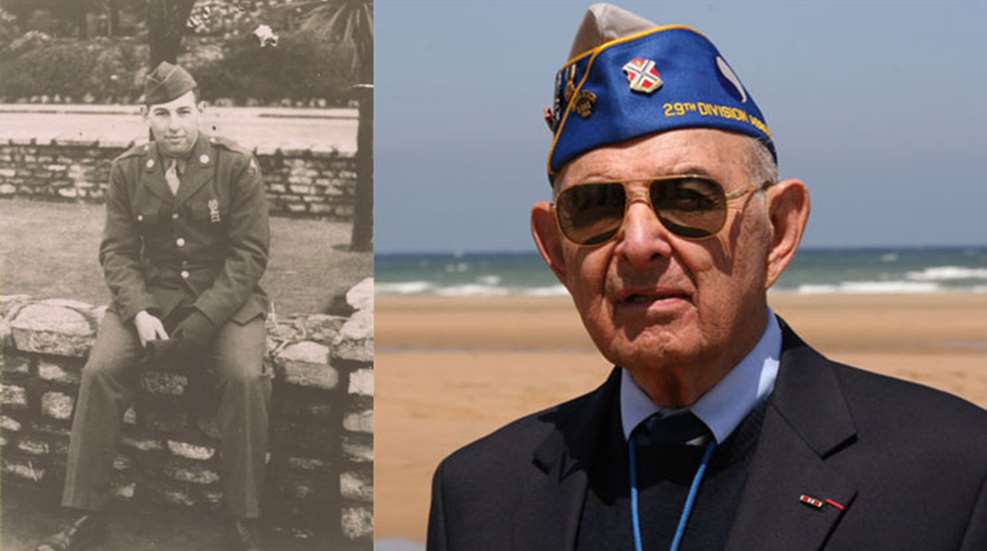
His was a life that almost ended 26,501 days sooner than it did. Instead though, he was given 3,785 more weeks—871 more months to raise a family, do good work, inspire and give back. When Harold Baumgarten passed away on Dec. 25, 2016, it was at the end of a life that extended well into old age, reaching into its ninth decade. Born in the Bronx on March 2, 1925, he was drafted into the U.S. Army the day he turned 18 in 1943. His service placed him in the 1st Battalion of the 116th Infantry Regiment, 29th Division and, during his brief time in uniform, he brought honor on himself on Tuesday, June 6, 1944 by landing at a French village named Vierville-sur-Mer on a beach that we now know as Omaha. 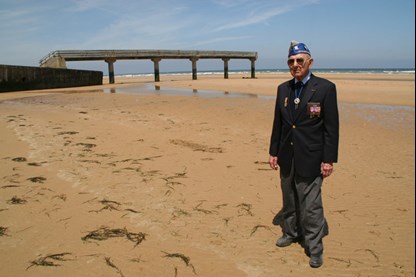
Harold Baumgarten was chosen by fate to represent us on that beach, and he did so by throwing his young body into the jaws of modern combat. As he waded toward the shore with the first wave on D-Day, he carried an M1 at port arms, but the rifle was hopelessly damaged when enemy fire struck it. A bullet penetrated the magazine and weakened the Garand to such a degree that it snapped in two when he fired a single shot shortly thereafter. That M1 stopped the bullet that would have otherwise ended Harold Baumgarten's life,
Taking up another weapon, he continued to move forward despite the fact that his company was being decimated by withering enemy automatic weapons and mortar fire. Thirty-two hours later, Baumgarten had been badly wounded five times and for him, the war was over.
Following a long recovery, he earned an undergraduate degree and a Master's, and he began teaching high school biology, chemistry and physics. He went on to complete medical school and thereafter established a private practice that would last for the next 40 years. In retirement, Dr. Baumgarten turned back to his experiences during the Second World War and chronicled what he survived in his first book Eyewitness on Omaha Beach (2000). With a remarkable vividness, he made combat on D-Day personal through compelling first-hand descriptions of the intensity of the battle for the Dog Green Sector. He also gave identity to men whose deaths had been previously been swept into the broad generalizations inevitable to the history of big events.
Thanks to Dr. Baumgarten's visceral account in Eyewitness on Omaha Beach, posterity now knows about the final moments of Clarius Riggs, Robert Dittmar, and other 29ers who made the ultimate sacrifice on D-Day. Because of its sincerity and authenticity, the book attracted so much praise and attention that Harold Baumgarten's name quickly came to be well-known to an ever-broadening audience.
By the 60th anniversary of June 6 in 2004, the retired doctor from Jacksonville was sharing company with celebrities, heads of state and thousands of admirers during his yearly visits to Normandy. He expanded on his first book by releasing an autobiography titled D-Day Survivor in 2006, but his health began to fail him soon thereafter and the yearly pilgrimages to France had to come to an end. 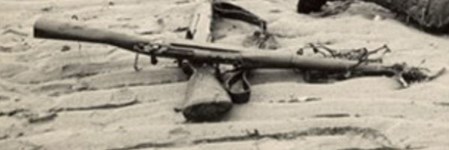
But thanks to an M1 Garand that acted as a shield, Harold Baumgarten lived well beyond D-Day. He was given the gift of a life stretching beyond Tuesday, June 6, 1944—26,501 days worth of life that was spent first recovering, then caring for others and memorializing the fallen. Although he may have only been an American rifleman for one day of combat, he was an American rifleman nevertheless and he will be missed.
Most Popular