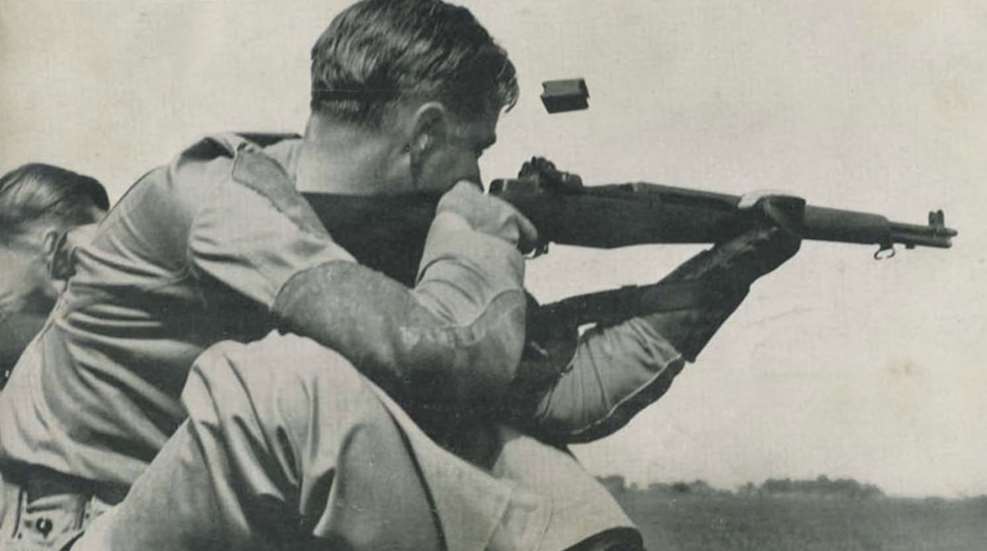
Top image: The American Rifleman cover photo by John Scofield, April 1941, of a student of the 1940 Small Arms Firing School at Camp Perry shooting the Garand rifle.
The “U.S. Rifle, Caliber .30 M1,” continues to fascinate and captivate new generations of Americans. Judging from the response we received from “Cold War Warrior” by Field Editor Bruce N. Canfield on the International Harvester Garand, that enthusiasm shows no signs of abating.
Our nation was not a world power when young boys from the streets of the Bronx, the docks of Baltimore, the ranches of Missoula and farms of Ottumwa boarded troopships heading for France in 1917 and 1918, but by the end of the Great War, the United States certainly was. After experience in the trenches of France, the U.S. Army Ordnance Dept. was committed to developing a semi-automatic infantry ri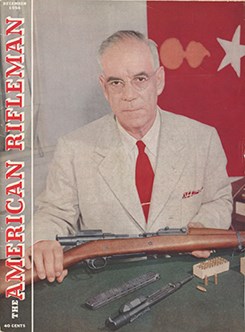 fle.
fle.
Interestingly, had the war progressed into 1919 there would have been a big “Spring Offensive” during which the Pedersen Device would have made its combat debut. The Pedersen Device replaced the bolt of a modified U.S. Model of 1903 Springfield rifle with a blowback-operated, magazine-fed mechanism that essentially turned the ’03 into a pistol-caliber carbine. But the war ended on the 11th hour of the 11th day of the 11th month. Nearly all the Pedersen Devices, a military secret weapon, went into the smelter. Then Maj. Julian S. Hatcher—later a major general and The American Rifleman technical editor, pictured here, saved some, including the two in the photo, from destruction.
In the interwar years, the Ordnance Dept. doubled down on its commitment to the development of a reliable semi-automatic, full-power autoloading rifle. A young inventor by the name of John C. Garand, first at the Bureau of Standards and then as an employee of the Springfield Armory, toiled for decadeson that task. And in the 1920s and ‘30s, the young inventor, as a simple civil servant, competed against notable inventor John D. Pedersen for the rifle that would become the M1.
Part of the M1’s appeal today, of course, has to do with the Civilian Marksmanship Program still making M1s available at reasonable prices to American marksman and veterans. Yes, you can indeed get an M1 Garand—and that is where most of the IHCs out there originated—from the CMP delivered to your door via the U.S. Postal Service. You can find the full details at thecmp.org.
One of the things you need to do, though, is join a CMP-affiliated organization. And one of those—the Garand Collector’s Ass’n (thegca.org)—is another reason why the Garand continues to be iconic amongst shooters and collectors. The mission of the GCA is “To exchange information and expand knowledge of the U.S. Rifle, Caliber .30, M1; to preserve and publicize the history of the rifle and its inventor John C. Garand; to assist and encourage new collectors; to assist authors in writing new reference works; to assist members in their collecting; and to encourage competitive and recreational safe shooting of the rifle.”
In the article written by Canfield regarding the IHC Garands, we were fortunate to be able to use some imagery provided by the organization’s excellent GCA Journal. Somehow, the photo credit was knocked out, and I would like to thank the GCA and David McLain for helping to tell the story of the IHC Garands.
John C. Garand himself said, “She is a pretty good gun, I think.” Indeed, it is a good gun, perhaps the single most important rifle of the American Century.
Most Popular