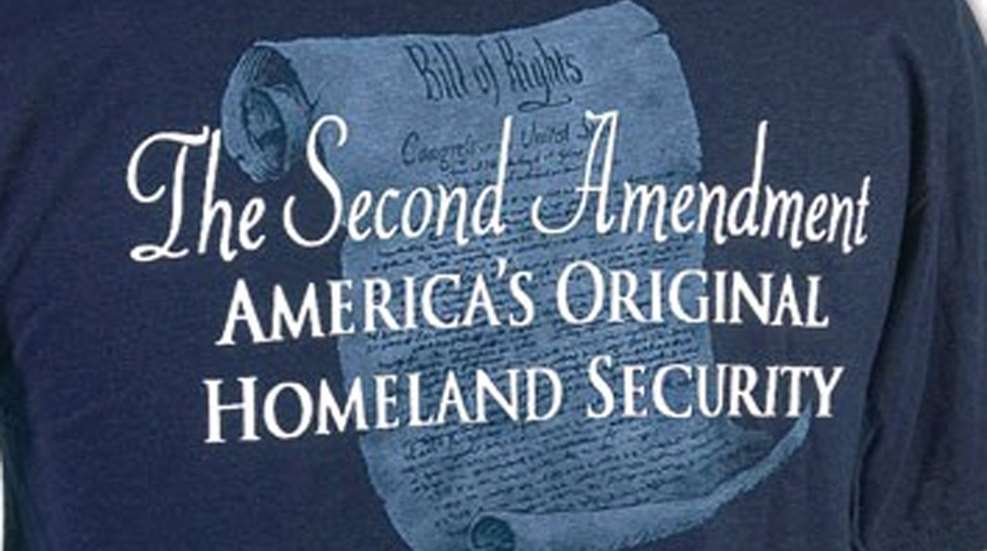
“The Second Amendment: America’s Original Homeland Security.” These are more than mere words emblazoned on a T-shirt offered by the NRA Store. But like many slogans and soundbites rendered on cotton/poly blend knit, there is a deep, underlying, often unspoken, truth to it. Americans are different than the people of other nations. The United States has citizens, not subjects. Americans can and do use their personal firearms for the protection of themselves (and at times in our past, the state)—as they have since the first settlers stepped off a boat onto a swampy Virginia landscape in 1609. And the right to armed self-defense actually began well before the creation of the United States of America. In fact, it was this right, among others, that pushed the colonies to split with England in 1776.
When the inhabitants of the 13 colonies stood up to the might of the British Empire, it wasn't just due to the Townshend Acts. It wasn't just due to the Stamp Act. And it wasn't just due to the Boston Massacre. The Boston Massacre occurred in 1770, and it was followed up by perhaps one of the greatest uprisings in the history of our nation or any other. But tossing tea into a harbor or burning figures of King George III in effigy are a far cry from armed conflict.
No, the decision to take up arms by the colonists was ultimately provoked when British soldiers, under the command of Lt. Col. Smith, were ordered by Gen. Thomas Gage to “March with a Corps of Grenadiers and Light Infantry, put under your Command, with the utmost expedition and Secrecy to Concord, where you will seize and distroy [sic] all Artillery, Ammunition, Provisions, Tents, Small Arms, and all Military Stores whatever.” They were coming for the Colonists' guns.
When British troops under Maj. John Pitcairn approached Lexington Green, it was there that they faced Massachusetts militiamen led by Capt. John Parker. Parker reportedly said, "Stand your ground; don't fire unless fired upon, but if they mean to have a war, let it begin here." And Parker's men went to Lexington Green with their own muskets. Their own personal property.
What had been a somewhat smoldering political rebellion turned into a shooting war when British troops came to take guns from the colonists. Those men, we call them Patriots and Founding Fathers now, were then Englishman. They believed in liberty. They knew they had certain inalienable rights that were being trod upon by the crown. The Crown’s confiscation of arms was the final straw.
While in the end the Revolutionary War was won principally by “line” troops or regulars from the various states (and by French sea power), American militiamen with their own firearms contributed heavily to critical early victories by the colonists. They performed admirably in armed conflict, including a pivotal battle for the South, Cowpens in South Carolina.
And while the United States of today is very different from the colonies of the American Revolution, there are things that unite us to our ancestors, in particular the Right to Keep and Bear Arms. It was important enough to spark armed insurrection and was affirmed in the Bill of Rights.
This is, after all, a nation of liberty. This is a nation of laws that protect the natural rights of its citizens. If you look at some of the early state constitutions, it is clear what they had in mind. Kentucky’s state constitution stands out as one that sums up what the men who fought and won the Revolutionary War had in mind. As written in 1792 it said, “That the right of the citizens to bear arms in defense of themselves and the State shall not be questioned.” (And NRA, by the way, shall be in Louisville this year for its Annual Meetings & Exhibits).
Even though we have the most technologically advanced military force in the history of mankind, the instruments of government, be they military or police, cannot be everywhere. And while our national interests and society as a whole are protected, by the men and women of our armed forces and by police officers that go to work every day, they are there to protect our collective society. There is no right to police protection for an individual American. Under Warren v. District of Columbia, it is clearly not their obligation to protect individual citizens. In the end, the responsibility to protect yourself from criminals or terrorists lies with no one but you. It is a decision you have to make for yourself.
As an individual citizen, you have the choice to carry the means of armed self-defense with you. This is a right that is denied individuals throughout most of the world—and in some areas in the United States—but the law-biding citizen throughout the overwhelming majority of this country can decide to carry a firearm to secure defense of themselves and others It is one of things that sets us apart, that makes America and Americans different in an increasingly dangerous world.