Though today the name “Webley” is the one that most often comes to mind when discussing British revolvers, James and Philip Webley’s premier revolver offering, their single-action “Longspur” percussion repeater first seen in 1853—while a creditable design—was largely eclipsed at the time by the double-actions of Robert Adams and William Tranter.
The Longspur went through three variants, at least selling in enough numbers to keep the firm afloat. Subsequently, the brothers Webley came out with a line of durable, reliable, percussion-fired double-actions, adding to the company’s solvency and cachet and allowing it to expand its line into the self-contained-cartridge field.
Accordingly, Webley hit pay dirt with an excellent, robust, medium-size, .442-cal., six-shot, centerfire double-action with a 4½" barrel, christened the Royal Irish Constabulary (RIC) Model after the agency that adopted it in 1867. The piece proved to be so versatile that it soon transmogrified into variants of different sizes and calibers—many of which were of the “bulldog” style, that slang term, along with “barkers” and “snappers,” reaching back into the 18th century to denote large-caliber, short-barreled self-defense pistols.
To Webley’s advantage, one model caught the eye of London’s Metropolitan Police. This famed law-enforcement organization was founded in 1829 by Home Secretary Sir Robert Peel, with its constables eponymously being nicknamed “Peelers” and “Bobbys” by an appreciative public. Initially armed with such things as pikes, truncheons and swords, flintlock pistols and carbines were also seen in some numbers, usually issued on a sporadic or as-needed basis.
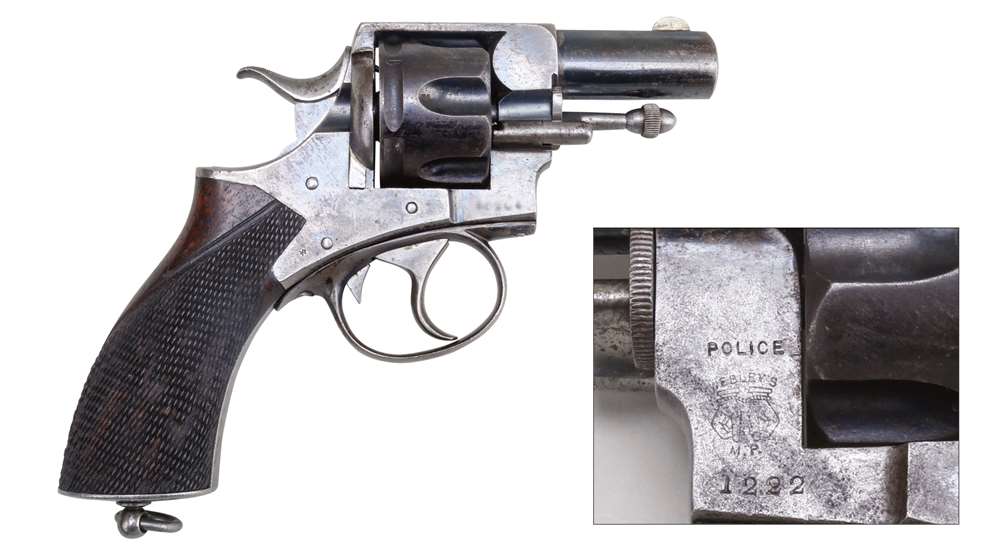
In 1884, following the deaths of several policemen in London’s outlying areas, the home office contacted Webley and ordered about 1,000 variants of the company’s RIC Model 82 revolver. Of a bulldog appearance, first versions had smooth cylinders and swing-out ejector rods with flattened tips. Later types sported fluted cylinders and acorn-tipped rods.
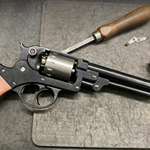
They were solid-frame, double-action, six-shot guns, with rounds being loaded singly through a downward-opening loading gate. Frames of the Metropolitan Police (MP) revolvers were full-size, though barrels were bobbed to 2½" for ease of carry. Chambering was .450 centerfire, which had previously been Britain’s principal military revolver service round. Fixed sights involved a simple rounded blade front and topstrap-groove rear. Generous stocks were one-piece checkered walnut with flat steel buttcaps and lanyard rings. Finish was normally blue. Transitional variations were produced, so occasionally, specimens will be seen with markings and features of the two basic types mixed and matched in one gun.
MP revolvers were normally stamped on their topstraps “P. WEBLEY & SON/LONDON and BIRMINGHAM.” The handgun’s most interesting distinction, however, was an evocative rendering of a pair of manacled hands and “WEBLEY’S MP,” surmounted with “POLICE” appearing on the front, left side of the frame. Issue numbers are often seen beneath. Caliber was usually indicated on the frame above the logo.
In short order, Adams revolvers, which had been distributed in limited numbers as a stopgap measure, were withdrawn and Metropolitan Police revolvers began to be issued at the discretion of division officers. They were only given to policemen who desired them and had exhibited an aptitude in their use.
Webley Metropolitan Police revolvers were manufactured from 1883 to 1911, with serial numbers running between 500 and 98,000. In recent years, partially due, I’ve been given to understand, to an article, “The Guns of Sherlock Holmes,” written by me and Scott McMillan, which first appeared in the April 1975 Guns & Ammo magazine, the MP revolver has been closely associated by Sherlockians with Sir Arthur Conan Doyle’s master consulting detective. Perhaps this crossover interest may account, somewhat, for the relatively stiff prices they seem to bring. It is not unusual for a seller to ask in the mid-$2,000s for a particularly nice example. The one seen here, a second type in NRA Very Good condition, however, would be very fairly priced at $1,750.
Gun: Webley Metropolitan Police
Manufacturer: P. Webley & Son, London and Birmingham
Caliber: .450
Manufactured: c. 1905
Condition: NRA Very Good (Antique Gun Standards)
Value: $1,750