Double-action handguns have been available since at least the 1830s, though in the “pepperbox” form. Pulling the trigger on such a pistol typically rotated an entire cluster of barrels, which fired in succession as a bar-type hammer struck individual percussion nipples.
Though popular, pepperboxes—either single- or double-action—had a few problems. Chain firing of multiple barrels was common because the nipples usually had no protective partitions between them, and it was virtually impossible to aim one adequately over its centrally mounted hammer and rotating barrels.
Even when Samuel Colt’s improved single-barrel revolvers appeared, pepperboxes retained a degree of popularity because of their lower cost. Despite the superiority of his product, Colt had a few fits and starts, but the California Gold Rush and his Model 1849 Pocket Revolver finally put him in the black. Colts were single-action, requiring them to be manually cocked each time a chamber was to be fired.
In 1851, English designer Robert Adams offered his “improved” repeater. Like the Colt, it had a cylinder and single barrel, but the shooter had merely to pull the trigger in one smooth action to cock the piece, rotate its cylinder and fire it. In fact, the revolver could only be fired double-action and lacked a hammer spur.
Adams formed a partnership with the father-and-son team of George and John Deane, and established a London manufacturing facility and salesroom. His guns received their first widespread exposure at the Great Exhibition Of The Industry Of All Nations, 1851, in Hyde Park, London, where they were displayed alongside the wares of Colt and other makers.
Almost immediately a controversy about which was most efficient, single- or double-action, began. Colt and Adams revolvers were tested by the British Committee on Small Arms, and, while a few Colts were issued provisionally, neither were adopted by the military on a wholesale basis. This caused Colt to eventually close up his London factory in 1856 and forced Deane, Adams & Deane to arrange some fancy refinancing to keep things going.
While Adams revolvers were generally put together at the company’s manufacturing location, demand and economics forced them to have parts and even whole guns produced by other British and Belgian makers.
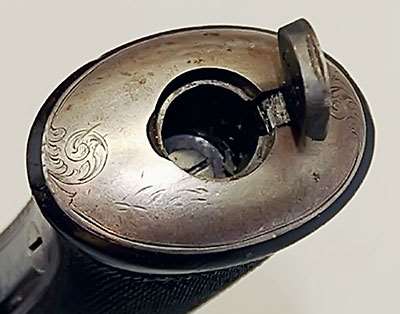
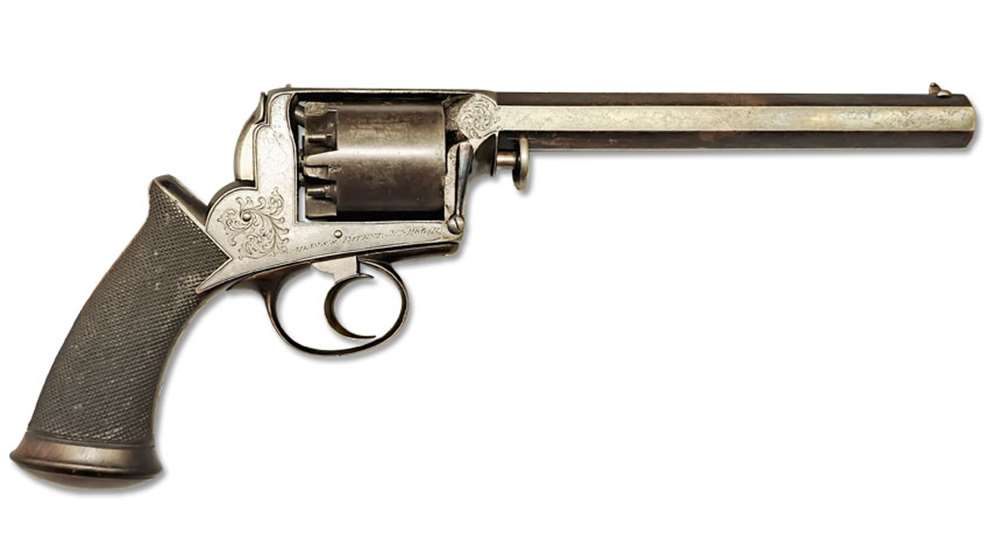
Adams’ self-cocking mechanism was smooth and robust. Cylinder locking was positive, and the guns felt good in the hand. The Model 1851s did have a drawback or two, though. As noted above, they were double-action-only and could not be manually thumb-cocked. They also had no loading levers, and the shooter had to use his fingers to push felt-based bullets into the chambers. This was not particularly positive, as the relatively loose fit was responsible for bullets having a tendency to move forward under recoil. Later revolvers would be fitted with different types of patent rammers to help rectify the problem. Frame styles were also changed slightly during the gun’s production years, and all of them have some degree of engraving. Cylinders had five chambers. Sights involved a fixed-notch rear and drift-adjustable blade front.
The Model 1851 would eventually be offered in pocket, holster and belt models with calibers ranging from 120 bore (0.338") to 38 bore (0.497") Some custom guns were also produced. The Deane, Adams & Deane saw service in the Crimean War and the American Civil War, among others. The ’51 was replaced by the improved, more sophisticated single-action/double-action “Beaumont” Adams. Adams and the Deanes terminated their relationship in 1856.
The gun we’re looking at here is one of the large (13" overall) .38-bore variants, often called the “Dragoon Model” by modern collectors. Condition is fine, with the gun displaying a considerable degree of original finish, though some pitting is evident externally and in the bore. The action is superb and functions beautifully.
It is not uncommon to find these guns cased, but uncased versions are sought-after as well. The .38 bore is the most popular, making this specimen worth $2,750. If it were cased, the value would be at least two-and-a-half times greater.
Gun: Model 1851 Deane, Adams & Deane Revolver
Manufacturer: Deane, Adams & Deane
Caliber: .38 bore (0.497")
Manufactured: c. 1853
Condition: NRA Fine (Antique Gun Standards)
Value: $2,750
Most Popular