It’s unfortunate that Hugo Schmeisser’s renown comes from having his surname erroneously appended to the superb World War II German MP38/40 submachine gun, a firearm he really had nothing to do with. Sadly, this subordinates the inventor’s more important achievements, which includes the development of the superb Great War-vintage Maschinenpistole 18 and, on a lesser scale, a handy little (this time, correctly attributed) namesake .25 ACP pistol that he devised along with his brother, Hans.
Hugo, who had been working with Theodor Bergmann before and during World War I, at the cessation of the conflict, along with Hans, established a company in Suhl, Germany. Restrictions of the Versailles Treaty forbade Germans from the development of certain types of materiel, so the Schmeissers prudently concentrated their efforts on non-proscribed arms, such as submachine guns and semi-automatic pistols.
Because Hugo and Hans had cleverly secured their patents, when their company experienced difficulty and merged with C.G. Haenel, they brought with them the plans for a handy little pocket piece the pair had previously devised. Some of the handgun’s innards relied on a 1910 patent taken out by their father, Louis, though a good deal of its features were solely the work of the brothers.
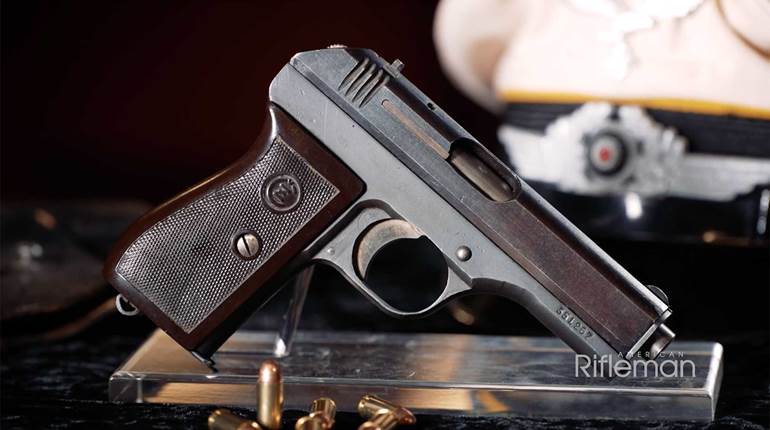
Introduced in 1920, this 6.35 mm Browning (.25 ACP), seven-shot (6+1), striker-fired, blowback handgun had some characteristics reminiscent of FN Browning designs. Many were not, though, and the gun included a barrel that was secured by the recoil spring guide, which passed through a stud on the barrel’s underside. The gun employed “safety features” fashioned so that its magazine could not be removed unless the pistol was put on safe, nor could the gun be fired with the magazine removed. A convenient loaded-chamber indicator protruded from the rear of the slide.
Fieldstripping the “Schmeisser,” the name by which it was marketed by Haenel, was relatively simple. One first checked and made sure it was unloaded. Then the magazine was extracted, and the slide withdrawn to a point where it could be secured slightly to the rear by the safety lever. This exposed the end of the recoil spring rod, which, as it did not protrude beyond the end of the frame, had to be pulled forward using a recessed lip on the magazine as a tool to engage a groove in the end of the rod. The rod could then be drawn out until it was secured in a slanting position. This allowed the barrel to be lifted out of the frame and permitted the slide, rod, recoil spring, firing pin, firing pin spring and recoil spring and other bits and pieces to be removed.
The pistol, later known as the Schmeisser Modell I after a completely divergent Modell II was introduced in 1927, was offered in two slightly different styles, the first type having a more substantial rear-sight shape than the second.
Markings on the Schmeisser varied depending upon when the gun was made and whether or not it was intended for export, the latter normally—but not always—being marked “Made in Germany.” All versions carried the gun’s title, as well as the maker’s name. Stocks were of checkered hard rubber and decorated with an intertwined “SH” monogram. Blue and nickel finishes were standard.
The export Modell I Type I we see here is in excellent condition (NRA Modern Gun Standards) and shows little use. It is complete with its original box and instruction manual. These extras add to the pistol’s worth and appeal, thus the package’s value is reckoned at a solid $675.
Gun: Schmeisser Modell I
Manufacturer: C.G. Haenel
Chambering: .25 ACP
Manufactured: c. 1925
Condition: NRA Excellent (Modern Gun Standards)
Value: $675
Most Popular