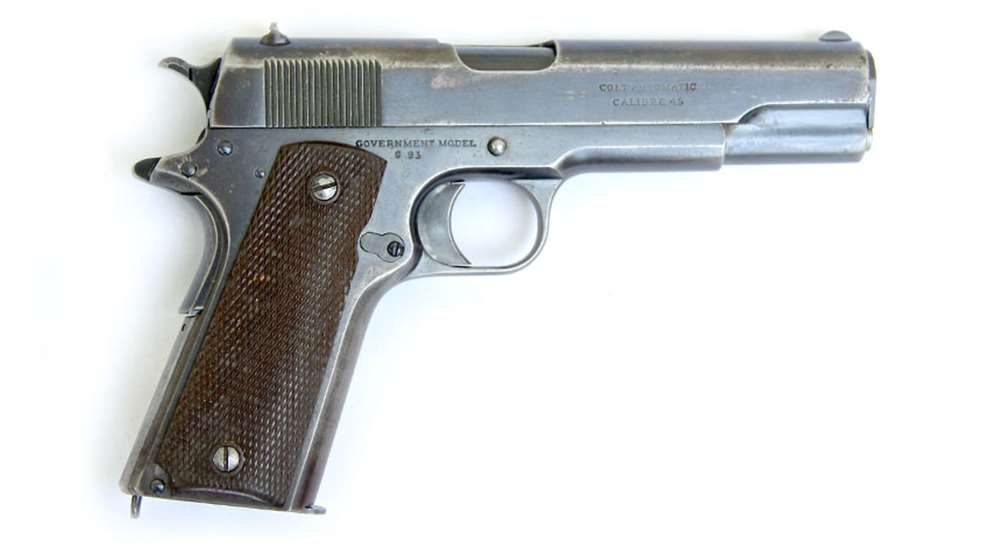
Through the years, countless articles have been written heralding the many attributes of the U.S. Model of 1911 pistol. But the focus has mainly been on military versions of this slab-sided warhorse. There was also a civilian counterpart to the M1911, and, while not as widely produced, it represents an important variation. In fact, slightly more than 336,000 were made before the advent of the Series 70 (compared to the 2.7 million M1911s made for Uncle Sam).
Referred to as both the “Commercial Model”—or in Colt’s catalogs as the “Government Model”—the civilian version of the M1911 was introduced in 1912 with a run of 1,899 guns. By 1916 the yearly production of Commercial Models had jumped to 47,400, a clear indication of the pistol’s non-military popularity for home defense and recreational shooting. The Commercial Model also found favor with various law enforcement agencies, including the Texas Rangers and the U.S. Border Patrol.
Unlike the coarser bluing of the military M1911s (changed to Parkerizing during World War II), the civilian versions sported a highly polished, lustrous blue. Of course, when the M1911A1 introduced new features in 1924, those changes also migrated to the Commercial Model. In addition, until 1950—around Serial No. 240,000—civilian model serial numbers had a “C” prefix. In 1950, around Serial No. 240288, the “C” became a suffix until 1970 when it was dropped altogether, with the start of the “Series 70” 1911A1s.
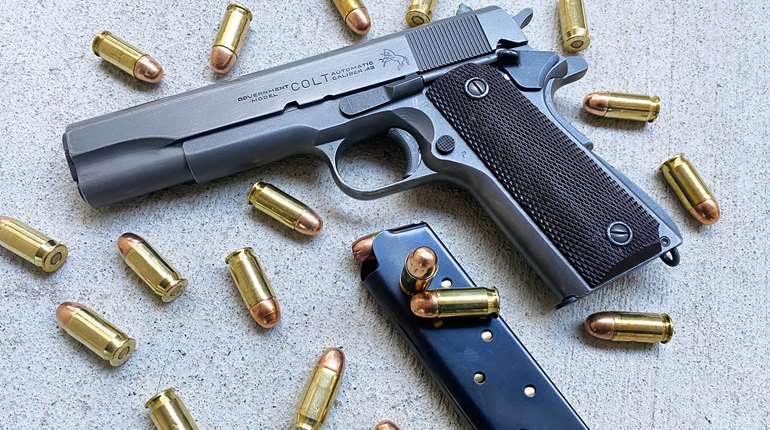
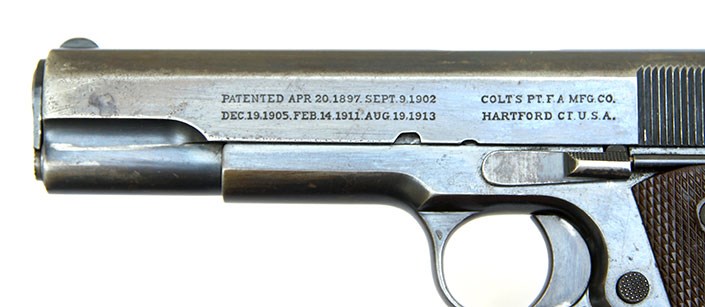
There was no “United States Property“ stamped on the Commercial guns, which instead were initially stamped “Government Model” on the right side of the frame above the serial number. After 1938 this stamping was moved to the slide. By comparison, the military guns were stamped “Model of 1911 U.S. Army” on the right side of the slide. Commercial guns simply had “Colt Automatic, Calibre 45” in that area. The left side of the slide on early military and civilian versions was stamped with a two-line patent date.
During World War I, a number of Commercial Models were purchased by officers and NCOs of the American Expeditionary Force to offset shortages of military M1911s. In addition, during this period, approximately 5,000 Commercial guns were shipped to Canada. Commercial Model production was halted from 1943 through 1945 due to World War II, but interestingly, a number of Commercial Models were re-stamped with military markings to help fill the military’s sidearm needs.
This Commercial Model was one of 50 guns shipped to Baker, Hamilton & Pacific Co. in San Francisco, Calif., in 1917. Although it doesn’t have its original diamond-checkered stocks, it retains its two-tone magazine, the markings are crisp, and, in 75 percent condition, it is worth $2,000 to $2,250.
Gun: Commercial Model
Manufacturer: Colt’s Mfg. Co.
Chambering: .45 ACP
Serial No.: C93XXX
Manufactured: 1917
Condition: NRA Very Good (Modern Gun Standards)
Value: $2,000 to $2,250
Most Popular