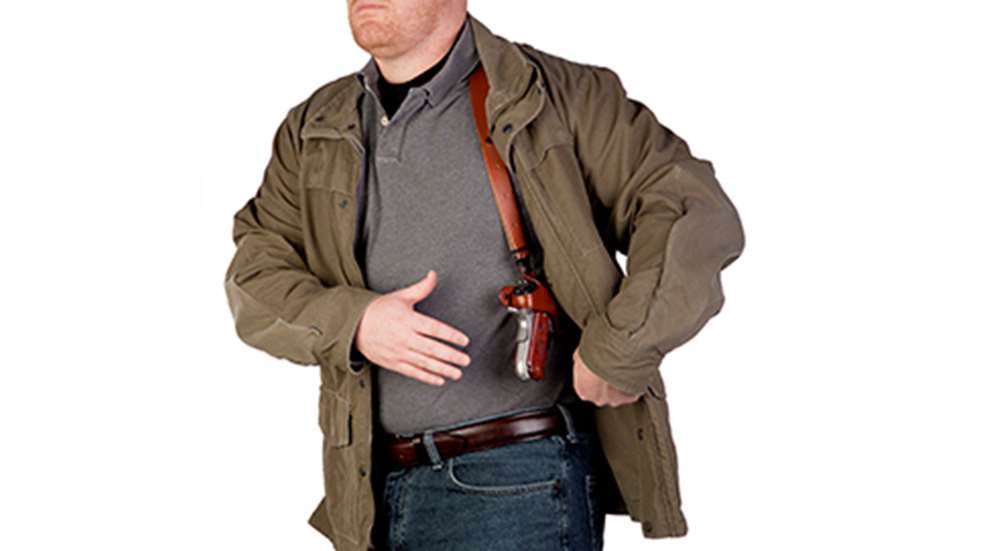
There was a time when the shoulder holster seemed to be required equipment for all police detectives, P.I.’s, sleuths and all sorts of plainclothes operatives. In recent times it has taken a back seat to the various other carry methods. In truth, the shoulder rig is not as fast as a good holster worn on the strong-side hip, and the straps of the unit can often cause fatigue to the shoulder muscles after a long day of wearing a heavy handgun. However, it should not be overlooked by today’s handgunners, as it may be just the ticket for certain defensive carry situations.
A person who spends most of his day sitting may find the shoulder holster to be much handier, not to mention more comfortable, than the hip holster. I often wear one when driving on a long trip because it makes my defensive handgun easier to get to while I'm seated in my vehicle. I also find it is not as fatiguing as the hip holster that seems to be jammed between my hip and the car seat.
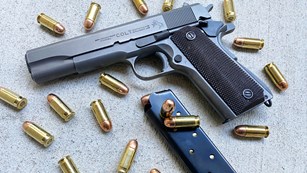
While in law enforcement, I generally carried a Colt Commander on my right hip. But, in addition to that pistol, I had an identical Colt Commander in a shoulder holster stowed under the seat of my vehicle. In the case of a serious incident, I could quickly slip on the shoulder rig and have two identical handguns to deal with any dangerous situation that might present itself.
Whether you use a horizontal shoulder holster or one of the traditional vertical rigs is entirely a matter of personal preference. Just remember that you will need a covering garment that opens to the front, such as a sport coat or a zippered jacket. A pull-over garment is effective cover, but it will really slow down the pistol presentation.
Keep in mind that it is important to practice presenting the pistol from the shoulder holster. The position of your support hand will be different than it is in the strong-side presentation. This is because the support hand and arm must be out of the way during the presentation to avoid covering yourself with the muzzle of your own handgun.
As with all other defensive carry methods, the shoulder holster is not for everyone. However, it should be a consideration for many concealed-carry permit holders, because it just might meet your personal defense needs as no other carry method can.
Most Popular