We are a society that spends a lot of time in our cars. We know that bad things can happen to us while driving, such as carjacking and the like. However, most of us really don't spend much time considering how we will access and deploy our defensive handguns from inside the vehicle.
Most defensive shooters carry on their strong-side hip. This is a solid, proven technique that works very well for most situations. However, it really is less than adequate when you are belted in with your seat belt. Just go sit in your car and give it a try. I suspect that your cool, 1.5-second speed presentation will turn into a 4- to 6-second fumble. Obviously, carrying in your vehicle requires some serious thought and practice if you are going to be able to address a criminal attack with any speed.
One solution is to reconsider your carry location when spending time in the vehicle. I'm usually not a big fan of shoulder holsters or cross-draw rigs. However, both have some positive application for drivers. Using either carry method makes it a lot easier to access a defensive handgun while belted in. I find that the shoulder holster is a lot more comfortable than the hip carry in a car, especially on long road trips.
If you are simply stuck on strong-side hip carry, it is important to make releasing the seat belt a part of your firearms presentation. Right-handed shooters should use their support hand to release the belt. The support hand goes behind the seat belt, at chest level, with the palm out. Run the hand down to the buckle, maintaining contact with the belt all the way. As the buckle is released, the support hand sweeps the belt to the left and out of the way, as your right hand takes the shooting grip and draws the handgun.
Some folks simply unholster their defensive handgun when getting in their vehicle and place it close by. While this is not a bad idea, one should really be careful that the handgun is placed in a secure location and that this is legal in the region of travel. Simply sticking it under your thigh, as some folks do, can be a serious mistake.
One of the FBI agents that was involved in the Miami Massacre of the 1980s did that very thing. Later, when he rammed the bad guys' car, his gun went flying and he didn't find it until the resulting gunfight was over. The same thing can happen to you if your vehicle is rammed during a carjacking attempt.
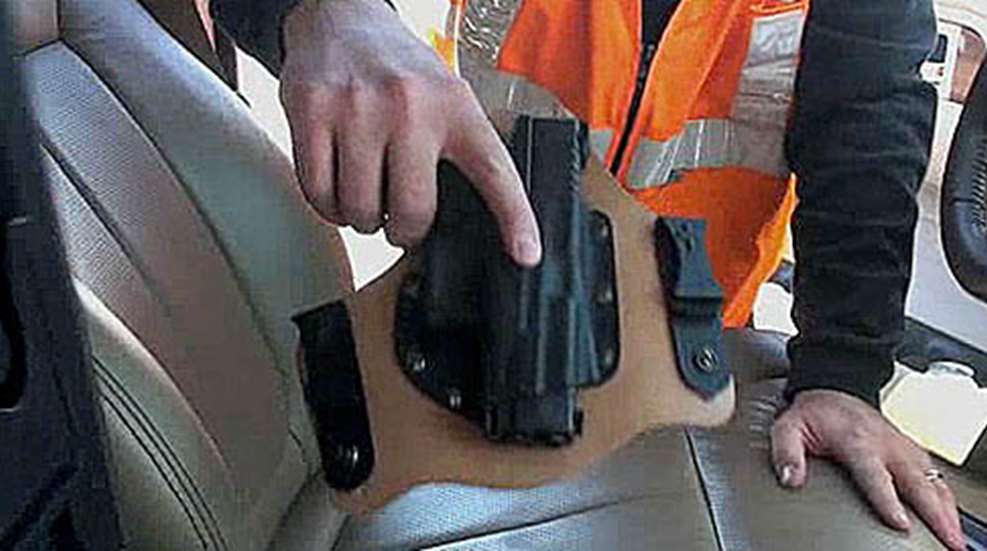
If you choose to unholster your handgun, you should have a secure place to keep it. That secure location should also be out of sight for anyone who might look into the car. A holster located on the front face of the driver's seat would be a good location. A holster, especially one made of Kydex, fastened to the side of the console would also make sense. Just make sure that it is low enough to be concealed from view.
As with your regular firearms presentation, vehicle carry should be practiced too. Take the time to go sit in your car, buckle up and work on your presentation. Try it from various locations, on your person and secured in the vehicle. Based upon your personal situation and the physical aspects of your individual vehicle, you should be able to find a secure and relatively quick method for defensive carry. Once you've got an idea of how to carry, have someone give you the command and time your vehicle presentation. When you can present the handgun from a secure location in about 2 seconds, you know that you are on the right track.
Prior planning for vehicle carry might just save your life. Work on it!
Most Popular