by
Support NRA American Rifleman
DONATE
** When you buy products through the links on our site, we may earn a commission that supports NRA's mission to protect, preserve and defend the Second Amendment. **
In this week's episode of American Rifleman TV, we near the end of our picks for the top 10 machine guns of all time. At No. 2 is a John Browning .30 cal. design that started with the M1917 and evolved into the M1919A6 machine gun. On "Rifleman Review," we take a look at the Smith & Wesson M&P9 M2.0 Combat Optic Ready handgun with a 4" barrel. On "I Have This Old Gun," we examine the Vietnam-era XM177E2 CAR-15.
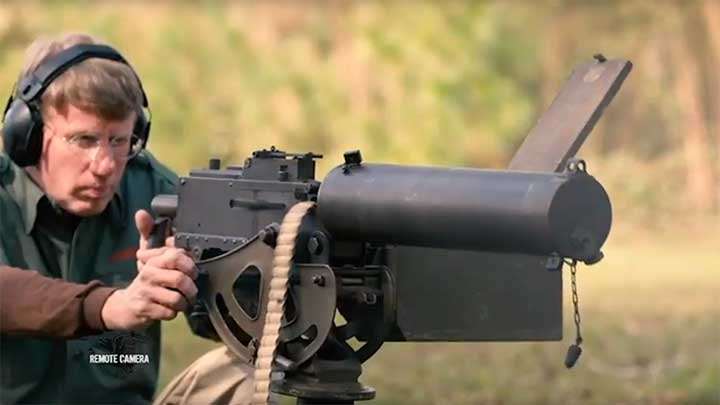
Continuing with American Rifleman picks for the top 10 machine guns of all time, at No. 2 is the Browning Model 1917, and later Model 1919, family of belt-fed machine guns. John Moses Browning filed the patent for a recoil-operated machine gun at the turn of the 20th century but did not work on it further until 1910. Browning added a water-cooling jacket to the barrel, but largely left his initial design untouched. This design was adopted by the U.S. in 1917 as the Browning M1917 heavy machine gun chambered in .30-'06 Sprg. and saw use in the last year of World War I.
The design was lightened with an air-cooled barrel after the war, resulting in the Browning Model 1919 medium machine gun. This variant, in turn, had several sub-variants that were developed off of it, including the bipod and stock adapted M1919A6 squad machine gun. Both the M1917 and M1919 machine gun family was used extensively in World War I, World War II, Korea, Vietnam and beyond in roles for air, land and sea. They were also made it several different calibers for contracts for numerous nations around the world, and the M1919 is still in use with some militaries today. It was also the design from which the larger M2 was developed, earning it the No.2 spot on the list.
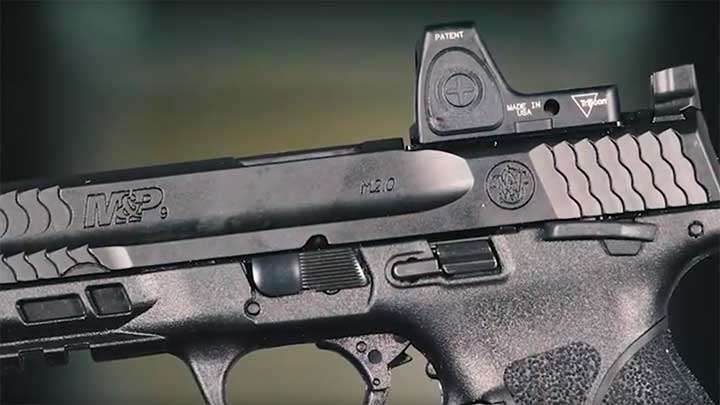
One of the largest trends growing in today's semi-automatic handgun market are optic-ready options. Smith & Wesson has been one of the companies at the forefront of this movement through offering several variations of its striker fired pistols made ready to accept optics from the factory. The newest addition to this lineup from Smith & Wesson is the M&P9 M2.0 4" Combat Optic Ready, which comes with a Crimson Trace red-dot optic already mounted to the slide.
During the Vietnam War, the U.S. Military experimented with shortened versions of the M-16 5.56x45 mm NATO rifle that would be easier to use in confined spaces and for special operations. The earlier versions, under the designation CAR-15 Model 607, had a number of issues which Colt addressed with a new version, the CAR-15 XM177, which incorporated improved hand guards with a telescoping stock. The design also incorporated a 4" moderator to the end of the barrel to aid in function and decrease the report of the shortened barrel.

In 1967, the U.S. Army purchased a few hundred of the new carbines under the designation of CAR-15 XM177E2 for use by the Military Assistance Command, Vietnam Studies and Observation Group, or MACV-SOG. These carbines were shipped with the existing 20-round M16 magazines despite the request for 30 round magazines. According to retired U.S. Army 5th Special Forces Group officer Maj. John Plaster, SOG operators resorted to pooling their money in order to purchase commercial 30-round magazines from the U.S. civilian market to use in Vietnam.
To watch complete segments of past episodes of American Rifleman TV, go to americanrifleman.org/artv. For all-new episodes of ARTV, tune in Wednesday nights to Outdoor Channel 8:30 p.m. and 11:30 p.m. EST.
Shooting the Browning Model 1917 water-cooled heavy machine gun.
Continuing with American Rifleman picks for the top 10 machine guns of all time, at No. 2 is the Browning Model 1917, and later Model 1919, family of belt-fed machine guns. John Moses Browning filed the patent for a recoil-operated machine gun at the turn of the 20th century but did not work on it further until 1910. Browning added a water-cooling jacket to the barrel, but largely left his initial design untouched. This design was adopted by the U.S. in 1917 as the Browning M1917 heavy machine gun chambered in .30-'06 Sprg. and saw use in the last year of World War I.
The design was lightened with an air-cooled barrel after the war, resulting in the Browning Model 1919 medium machine gun. This variant, in turn, had several sub-variants that were developed off of it, including the bipod and stock adapted M1919A6 squad machine gun. Both the M1917 and M1919 machine gun family was used extensively in World War I, World War II, Korea, Vietnam and beyond in roles for air, land and sea. They were also made it several different calibers for contracts for numerous nations around the world, and the M1919 is still in use with some militaries today. It was also the design from which the larger M2 was developed, earning it the No.2 spot on the list.
The Smith & Wesson M&P9 M2.0 4" Combat Optic Ready handgun.
One of the largest trends growing in today's semi-automatic handgun market are optic-ready options. Smith & Wesson has been one of the companies at the forefront of this movement through offering several variations of its striker fired pistols made ready to accept optics from the factory. The newest addition to this lineup from Smith & Wesson is the M&P9 M2.0 4" Combat Optic Ready, which comes with a Crimson Trace red-dot optic already mounted to the slide.
During the Vietnam War, the U.S. Military experimented with shortened versions of the M-16 5.56x45 mm NATO rifle that would be easier to use in confined spaces and for special operations. The earlier versions, under the designation CAR-15 Model 607, had a number of issues which Colt addressed with a new version, the CAR-15 XM177, which incorporated improved hand guards with a telescoping stock. The design also incorporated a 4" moderator to the end of the barrel to aid in function and decrease the report of the shortened barrel.
Shooting the CAR-15 XM177E2 carbine.
In 1967, the U.S. Army purchased a few hundred of the new carbines under the designation of CAR-15 XM177E2 for use by the Military Assistance Command, Vietnam Studies and Observation Group, or MACV-SOG. These carbines were shipped with the existing 20-round M16 magazines despite the request for 30 round magazines. According to retired U.S. Army 5th Special Forces Group officer Maj. John Plaster, SOG operators resorted to pooling their money in order to purchase commercial 30-round magazines from the U.S. civilian market to use in Vietnam.
To watch complete segments of past episodes of American Rifleman TV, go to americanrifleman.org/artv. For all-new episodes of ARTV, tune in Wednesday nights to Outdoor Channel 8:30 p.m. and 11:30 p.m. EST.