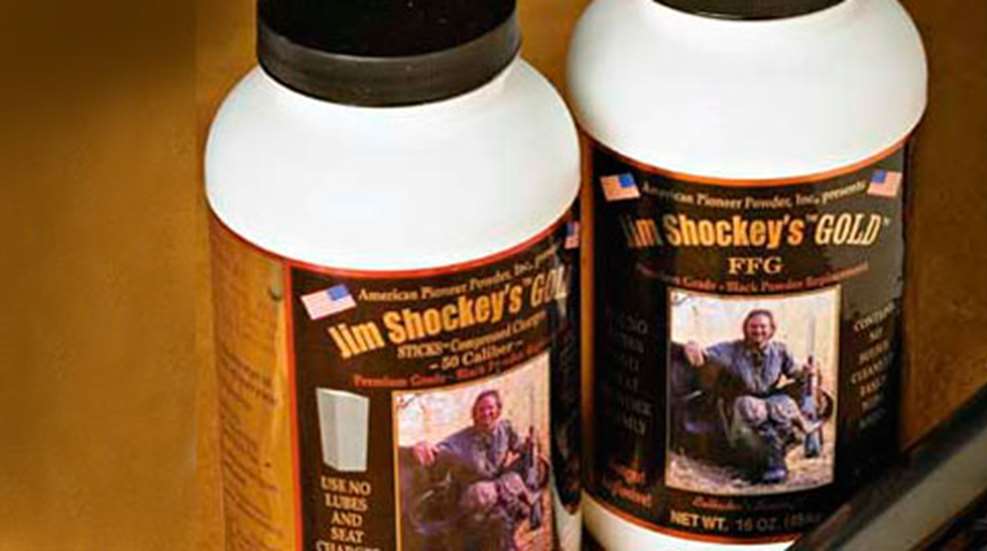
Every now and then, a company makes an exceptionally bold claim concerning the performance of its products. For example, American Pioneer Powder claims to have fired 5,562 consecutive shots through a muzzleloader over a 90-day period without ever cleaning its bore.
Intrigued, we ordered American Pioneer Powder's Jim Shokey's Gold .50-cal. Sticks. The compressed charges have a tapered, rectangular shape. The small end of the tapered stick is inserted first into the bore, then the larger end is pressed in with the thumb. This larger end was slightly larger than the bore of the .50-cal. Knight Disc Extreme used for testing, so powder granules were shaved from the stick as it was forced into the bore. Although we detected no problems with loading, we wondered if this would affect shot-to-shot consistency. Even though the majority of the shaved powder trickled down the bore, a small percentage was lost.
Shooting a 240-gr. XTP bullet, the 100-gr. charge averaged 1,516 f.p.s. The maximum spread was approximately 180 f.p.s., which is slightly higher than some other blackpowder substitutes we have tested before. We attribute this to the inconsistency we found in the actual charge weights. Weighed on an RCBS digital powder scale, individual sticks varied by as much as 5 to 6 grs.
To further explore the effects of the different stick weights, we paired high- and low-end weight sticks together and shot for velocity. For example, shot No. 7 had a combined stick weight of 92 grs., while shot No. 8 had a combined stick weight of 87 grs. Predictably, the velocities reflected the charge weights with speeds of 1,634 and 1,505 f.p.s., respectively. Of course, other considerations factor into any muzzleloader's velocity, such as sabot integrity, primer ignition, fouling and tamping pressure. The more consistent each of these variables is kept, the higher the potential for greater shot-to-shot pressure, velocity and accuracy.
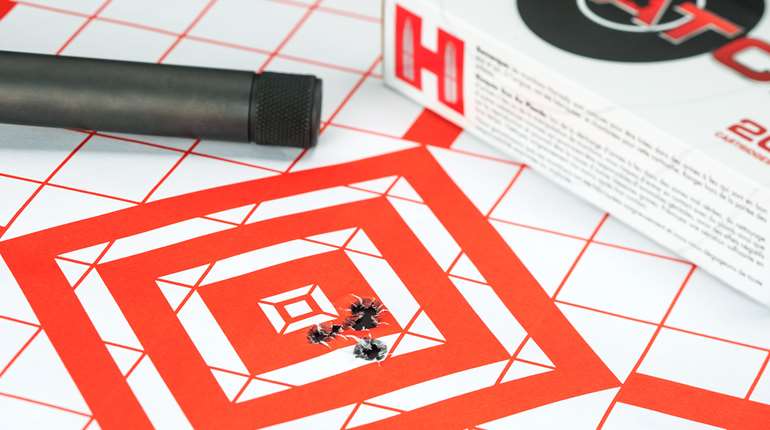
Despite these inconsistencies, accuracy results were better than expected. When cleaning between shots, groups measured no larger than 1 1/2 inches, even though we were shooting with iron sights. While we certainly weren't able to put 5,500 rounds downrange, we did test for accuracy on a fouled barrel. Without cleaning between shots, and with an admittedly hot barrel, the shot groups opened up to a still respectable 3 inches or less.
Following the range session, American Pioneer Powder's clean-burningqualities became immediately evident. Dark deposits of partially burned powder were virtually nonexistent. More impressive, after a full day of shooting, the final cleanup was just as advertised. A few passes with Traditions' pre-soaked cleaning patches left the barrel completely unfouled. After soaking the breechplug, the fouling practically dripped away after a pass with a soft-bristle brush. We were done cleaning in a matter of minutes.
For those who demand the most consistency possible with their charge weights, the easy fix is to use American Pioneer's loose powder, available in FFg and FFFg. A powder measure can be much more precise with charge weights. But most blackpowder shooters will find that a cleaner-burning charge, without the burden of a powder measure, is more than acceptable for hunting and practice. American Pioneer's Jim Shockey's Gold is certainly worth a look.
Most Popular