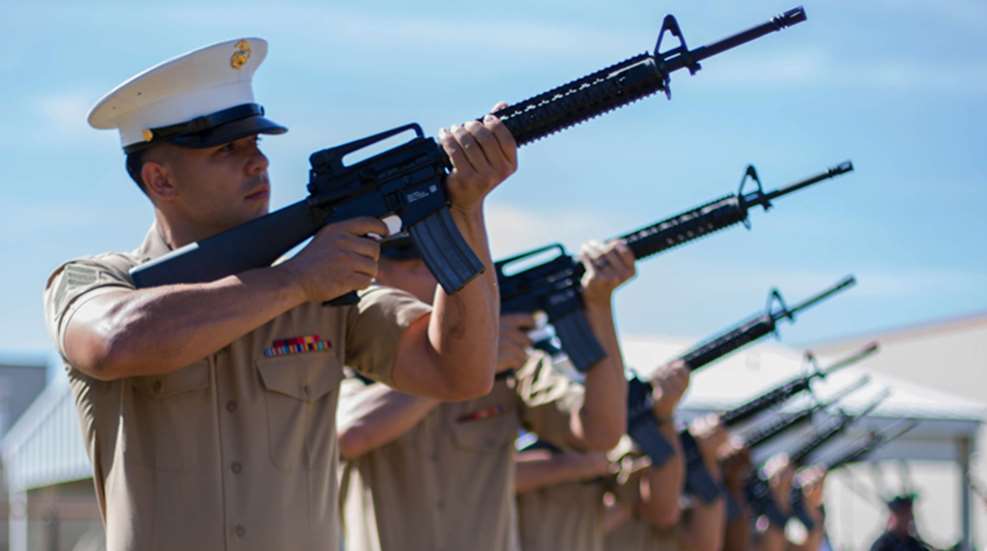
U.S. military salutes are steeped in tradition, some dating back hundreds of years. However, there are misconceptions about military salutes—understandable, considering the number of salutes that exist for various occasions. Some have even changed over the years, sometimes through acts of Congress. All of them, however, are intended to demonstrate great honor to those for whom they are conducted. This includes fallen members of the military, presidents, heads of state and even the nation.
Three-Volley Salute
Calling the shots fired at a military funeral a 21-gun salute is incorrect. Even if there are seven soldiers firing three rounds each, this is not considered a 21-gun salute. The shots fired during a military funeral are called the firing of three volleys in honor of the fallen.
The firing of three volleys dates back to the custom of ceasing hostilities to remove the dead from the battlefield. Once finished, both sides would fire three volleys to signal that they were ready to resume the battle.
During the firing of three volleys, the rifles are fired three times simultaneously by the honor guard. Any service member who died on active duty, as well as honorably discharged veterans and military retirees, can receive a military funeral, which includes the three volleys, the playing of "Taps" along with a United States flag presented to the next of kin. Three spent cases are usually inserted into the folded flag, one representing each volley fired.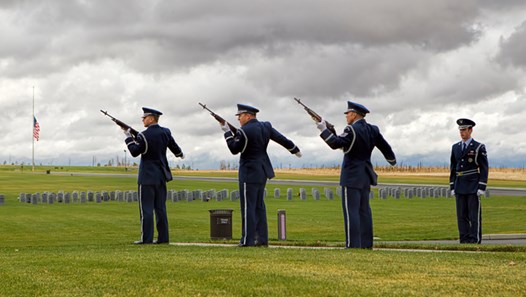
21-Gun Salute
The 21-Gun Salute hails from naval tradition where a warship would fire its cannons, rendering them unloaded, to signify its lack of hostile intentions. Ships would typically fire seven shots. Whether this is because that was the traditional number of guns on a British warship or because it is of biblical significance is unknown. Forts, having more ammunition, would fire three shots for every shot by a ship. Of course, this wasn’t set in stone, and the number of shots fired differed greatly depending on the country.
Today, the 21-Gun Salute is fired by artillery batteries in honor of the U.S. President, former presidents, the President-elect and heads of foreign states upon their arrival and departure of a military installation. “Hail to the Chief” or the national anthem of the visiting dignitary is also played. The salute is also fired at noon on the day of a funeral of the President, former presidents and the President-elect, as well as Memorial Day in honor of America’s fallen, and on Washington’s Birthday.
In addition, a 19-Gun Salute is fired in honor of other dignitaries such as the vice president, the speaker of the House, president pro tempore of the Senate, chief justice of the United States, state governors, chiefs of staff and 5-Star generals. There is a ranking system for salutes to lower-ranking generals and other dignitaries consisting of dropping two guns for each flag rank junior to a 5-Star general.
Salute to the Nation
The practice of firing one shot for each state was officially established in 1810, which at the time was only 17 guns. This tradition continued until 1841 when it was established as 21 guns. Current tradition has the Salute to the Nation as 50 shots by capable military bases, one for each state in the union, fired at noon on Independence Day, with naval vessels firing a 21-gun salute.
Veteran’s Day
While there isn’t a gun salute dedicated to veterans, November 11 is a day when the U.S. and many World War I allied countries commemorate the sacrifices made by the men and women who served in the armed forces. Veteran’s Day is often confused with Memorial Day, which is when we honor those who have fallen in service of our country. Veteran’s Day celebrates all military service members, not just those who died. 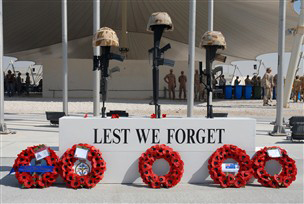
Veteran’s Day was first created as Armistice Day by President Woodrow Wilson in 1919 to mark the end of World War I. In 1938, Congress made November 11 a national holiday. Then, on June 1, 1954, President Eisenhower signed legislation that changed the name to Veteran’s Day to celebrate all military veterans. The exact day of celebration changed a couple more times over the years before being permanently established as November 11 due to popular sentiment.
This November 11, please remember the veterans who have served, and often died, to preserve the freedoms that we cherish. And thank a member of America’s military, past or present.
U.S. Department of Defense images