World War I started out as a conflict fought with Victorian-era arms and strategies, but technology soon jerked the combatants abruptly into the 20th century. Such things as poison gas, tanks, and improved artillery and small arms turned what was expected to be a war lasting just a few weeks into a four-year slugfest.
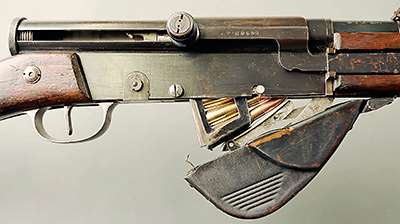
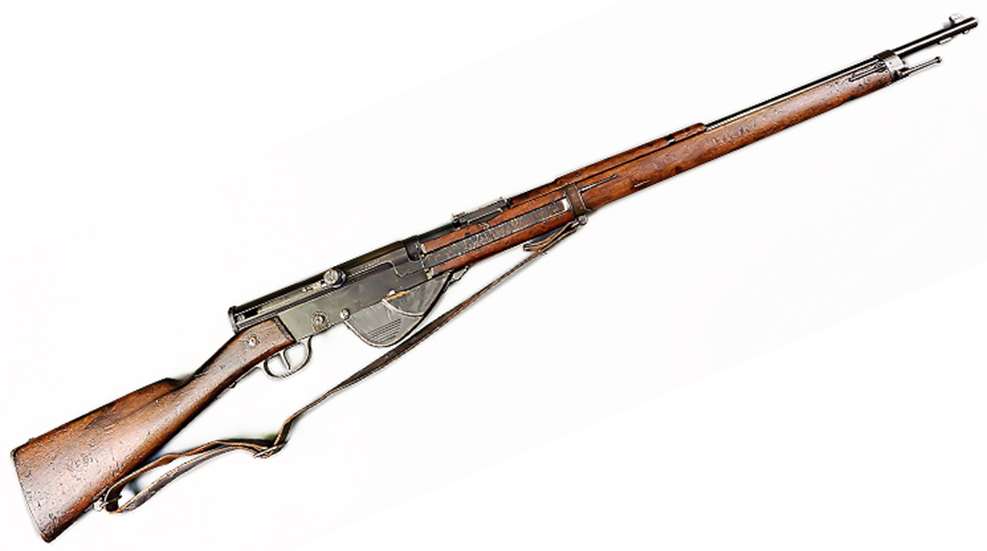
In the early months of the war, the French fielded troops of cavalry dressed in breastplates and plumed helmets that would not have been out of place back in 1815 at the Battle of Waterloo, but three years later they introduced a revolutionary arm that, despite its growing pains, would prove to be a harbinger of infantry rifles to come—the gas-operated RSC Fusile Automatique Modele 1917.
The French had begun semi-automatic rifle experiments as early as 1894. Most examples were built around rimless cartridges totally unlike the 8x50 mm R Lebel service round then being issued for use in the Model 1886/96 “Lebel” rifle and various model Mannlicher-Berthiers.
French inventors continued their work to find a practical semi-automatic battle rifle and eventually came up with an arm they felt would stir things up in the trenches—the RSC 1917. Its quasi-official designation came from the first initials of the surnames of the three men most involved in its design—Ribeyrolles, Sutter and Chauchat. Modele 1917 components were fabricated at three separate sites and assembled at Tulle, St-Etienne and Chatellerault.
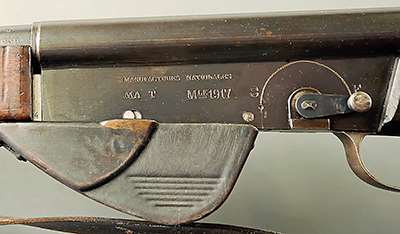
Ammunition was loaded into the rifle via a five-round en-bloc clip, which looked much like the Mannlicher-Berthier accessory but was less curved. To charge the piece, the shooter first lowered a semi-circular magazine cover that also contained the follower assembly. The clip was inserted into a channel on the underside of the action and the cover was closed, the follower pushing up on the cartridges.
Next, the bolt handle was pulled to the rear—cocking an internal hammer—and released, stripping off and chambering a cartridge. When the trigger was pulled and the round discharged, gas was tapped off from a hole in the bottom of the barrel 8" behind the muzzle; the action operating similarly to that of the M1 Garand. RSCs even utilized a rotating bolt. When empty, the Modele 1917’s clip had to be manually removed after opening the magazine cover.
Some 85,000 RSC 1917s were built and issued on a selective basis, given to those poilus who were deemed slightly higher in intelligence and mechanical ability than their friends since, from the beginning the rifles were plagued with operating problems. The design’s gaping ejection port, formative gas system, complicated maintenance routine and rimmed, tapered cartridge rendered the gun ill-suited for reliable semi-automatic function.
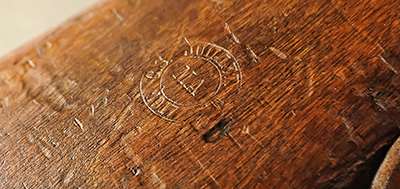
Though seeing reasonable service, RSC 1917s in the field at the time of the Armistice were withdrawn, and a good number of them (along with improved Model 1918s) were eventually made into manually operated repeaters by plugging the gas vent hole, and then issued to reserve troops.
The RSC shown here is in excellent, unaltered condition, and as such is worth $5,000. Clips are even scarcer than the rifles and can bring a minimum of $200 each.
Gun: RSC Fusile Automatique Modele 1917
Manufacturer: Manufacture d’Armes de Tulle
Caliber: 8x50 mm R Lebel
Condition: NRA Excellent (Modern Gun Standards)
Manufactured: 1917
Value: $5,000