Of Hornady’s new 6 mm ARC—which stands for Advanced Rifle Cartridge—Field Editor Jeff Johnston wrote, “[D]o I think the 6 mm ARC is the end-all cartridge? No … I do, however, think it’s the best all-around cartridge for the AR to date; better than the .223 Rem., 6.5 mm Grendel, 6.8 mm SPC and .300 Blackout, and evidently Hornady and I aren’t the only ones who think so.” You can, and should, read Jeff’s full report on the new cartridge, its origins and performance.
From a bigger picture perspective, in one sentence Jeff listed five decidedly different cartridges with five different bullet diameters chambered in AR rifles. Excluding wildcats, ARs have been chambered in at least 60 center-fire cartridges. But for about half the rifle’s existence, and I date that back to 1963 with the introduction of the semi-automatic-only Colt AR-15 (what we call the SP1 these days), it has been chambered nearly exclusively for .223 Rem. or 5.56x45 mm NATO.
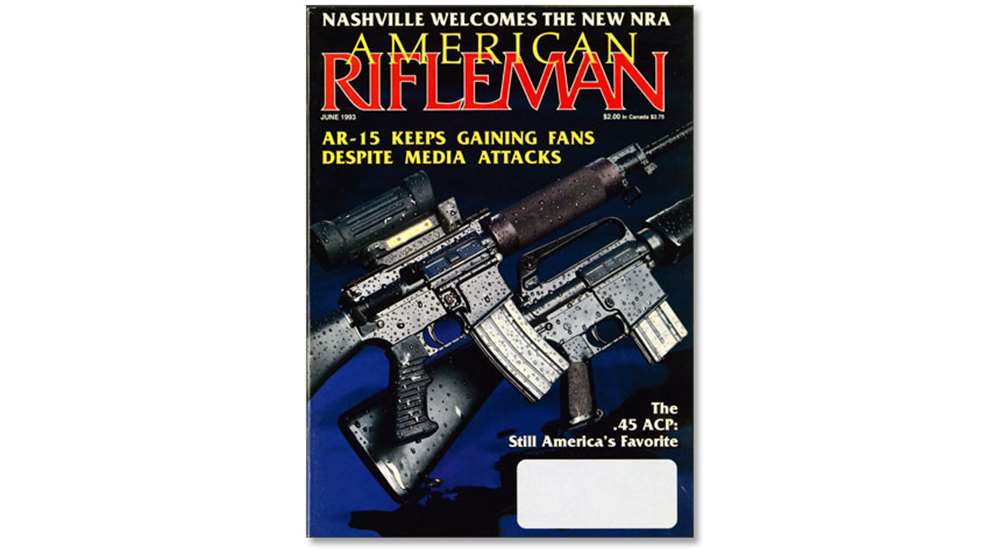
With rare exception, until the early 1990s, you could have your AR in any color you wanted, so long as it was black, and in any chambering, so long as it was .223. But that began to change in 1992 when Colt introduced a pistol-caliber carbine in 9 mm Luger—albeit with blowback operation and a magazine well to accommodate double-stack 9 mm magazines.
The next cartridge milestone for the AR was, of all things, the cheap and plentiful 7.62x39 mm Russian; Colt rolled out its R6830 in 1992. AR owners, too, were looking for .30-30 Win.-type performance from their rifles, and the 7.62x39 mm with hunting bullets was just the ticket. J.D. Jones’ .300 Whisper dates to 1992 as well, although it’s now overshadowed by .300 Blackout.
Note that I am talking about cartridges with a maximum cartridge overall length (COL) of about 2.26"—matching that of the .223 Rem. The dimensions of the gun’s magazine and its well, both front to back and side to side, determined the box to which gun and cartridge designers were constrained. The AR-10 platform, based on a larger receiver and bolt built around the .308 Win. cartridge is in a completely different class—although thanks to improvements in bullet design and propellants, that gap seems to be narrowing.
Starting in the early 2000s, Bill Alexander, a brilliant British engineer and founder of Alexander Arms, gave us the middle- and large-bore cartridges that defined other-than-5.56 mm ARs: the 6.5 mm Grendel and .50 Beowulf.
With potential widespread adoption by the U.S. military possible, the next landmark was the 6.8 mm SPC, which I became aware of in 2002. Although Uncle Sam didn’t bite on it, LWRC notched a prestigious foreign military contract for its guns and the cartridge. The SPC parent case led to a serious increase in performance on the long-range side with the .224 Valkyrie as developed in 2018 by Federal being an example of taking the AR platform out to 1,000 yds.
Just last year, Winchester introduced the 350 Legend, and we have an upcoming story on Wilson Combat’s .300 HAM’R by Managing Editor Kelly Young. Obviously, I have to leave dozens of others out, but no doubt you get the point. Hornady’s 6 mm ARC might be the latest AR cartridge, but it certainly shall not be the last.
Most Popular