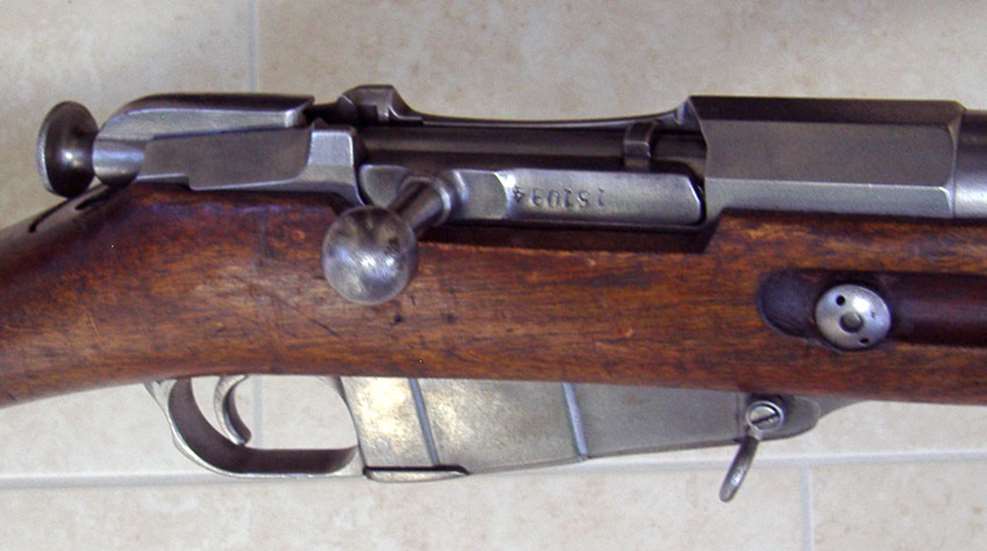
Q: I have a Mosin-Nagant rifle with a date of 1894. All of the stampings are in Russian. I’m not able to find any information on this model of Mosin, can you please help?
A: You have a relatively rare variant of the Russian Model 1891 rifle in that yours was made under contract for the Russian government by the French government armory Manufacture d’armes de Châtellerault in 1894.
The words in the Russian Cyrillic script on the receiver of your rifle translate to “Ordnance Factory Chatellerault 1894.” Your serial number below those words is N3281XX. The Russian alphabet does not contain the letter “N,” so we know the French used the abbreviation N for the French word for number.

The French delivered about 503,000 rifles during the period of 1892 to 1895. At least 9,350,000 were made by the Russian armories from 1892 to 1922. So you can see by comparison that the half-million French-made rifles are pretty rare. If you compare your rifle to the Russian-made rifles, the most noticeable feature you can see is that your rifle has sling swivels.
In 1910, the Russians eliminated standard sling swivels and substituted two rectangular holes in the stock through which they attached a sling with short leather straps. There are other minor difference in the French-contract rifles, as well.
—Michael F. Carrick, Contributing Editor
In his 2018 article, "A Look Back at the Mosin-Nagant 91/30," Dave Campbell highlights the rich history of this ubiquitous rifle. As with many of its firearms, the Soviet Union used the Model 1891 as a sort of currency to help pay for its ambitious desire to acquire more nations under its fold. Many such as Tula, Izhevsk, Sestroryetsk, Manufacture Nationale d’Armes de Châtellerault, Remington and New England Westinghouse, alongside others, have produced some 37 million-plus copies of the Model 1891 during its 129-year existence.
With that many produced and the number of companies building it, the Model 1891 has had numerous variations. In the Soviet Union alone, no less than 10 variations are known. Estonia has cataloged another four, and Finland added an additional fourteen. The Czechs had three variations, and the Chinese, Hungarians, Romanians, Polish, and even the American added another fourteen variants, all told. The most common variation seen is the 1891/30, produced in the Soviet Union from 1930 to 1945. It has seen service in no less than 38 wars and conflicts, dating from its origin to today.
Here in the U.S., the Mosin-Nagant has been a popular surplus rifle. Typically, the Model 1891/30 is the most prevalent, and it has earned the nickname of being a “poor man’s sniper rifle.” After World War II, examples could be found stacked in barrels at surplus outlets for less than 20 bucks. Today however, a shooter grade will lighten your wallet by at least $250, and pristine collector examples can fetch more than a grand. The Mosin-Nagant is like a lot of Russian firearms: somewhat crude in design, but very well made—especially those made in Tula and Izhevsk—and very dependable. If you are a beginning collector looking for a relatively easy way to get into collecting, a Mosin-Nagant is worth considering.
Most Popular