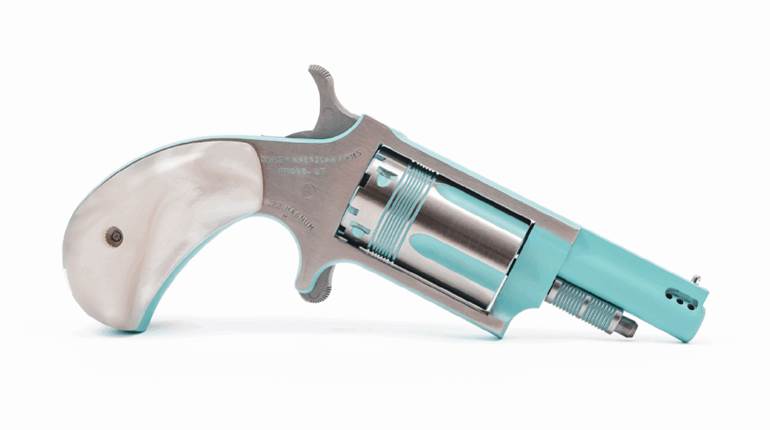
North American Arms (NAA) of Provo, Utah, has been manufacturing its signature single-action, rimfire Mini revolvers since the mid-1970s. The standard version of this five-shot, pocket-size, stainless steel wheelgun is loaded by pulling the cylinder pin and removing the cylinder completely from the frame. In 2011, the company broke with tradition when it introduced the Ranger Mini.
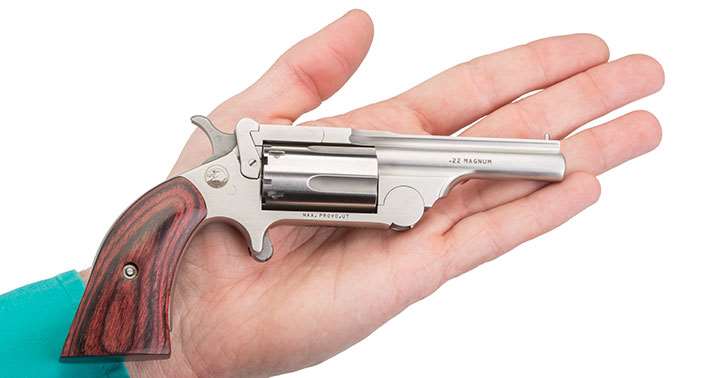
The Ranger was an exceptionally small break-top .22 WMR-chambered single-action which bore a striking resemblance to the Smith & Wesson Model No. 3 Schofield. It exhibited Swiss-watch-like precision in its manufacturing, with fine craftsmanship and attention to detail. Although this revolver was greeted with enthusiasm by media members and NAA customers alike, it ultimately proved to be too expensive to produce at prices the market would support. It was discontinued with less than 500 units completed.
Not long after the Ranger project was cancelled, work began on the Ranger II. While it would offer the same operational benefits of the first Ranger, the simplified new version sacrificed some of the original’s aesthetics in order to reduce production costs. Prototypes of the Ranger II were on display at trade shows as early as October 2015, but the revolver did not start shipping out to distributors until the beginning of 2018.
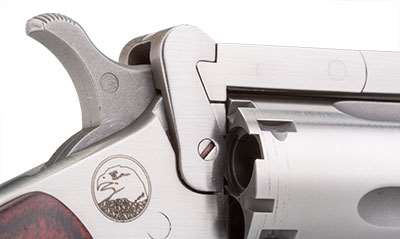
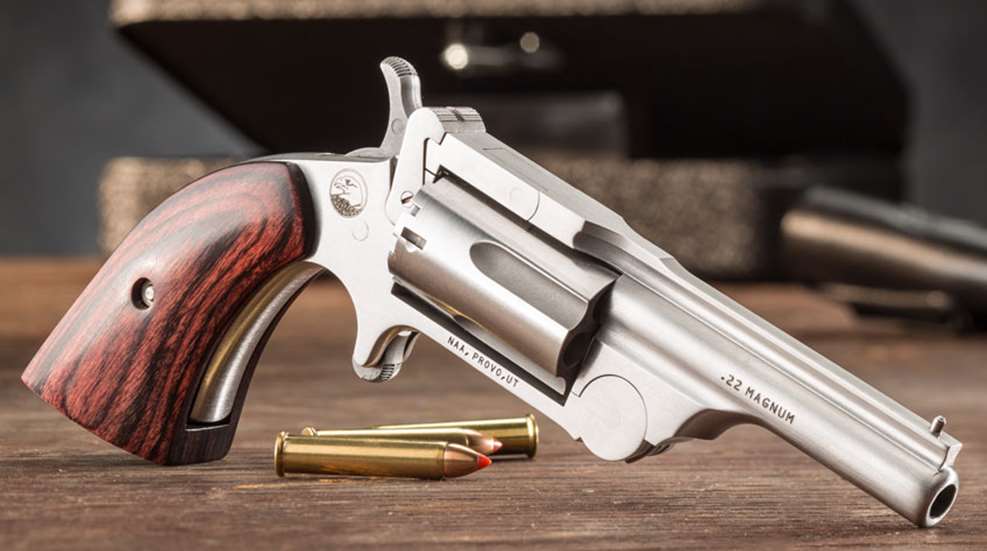
The Ranger II is a single-action revolver with an exposed hammer that must be manually cocked for each shot. The hammer spur, the release lever and the trigger stud feature fine-line texturing to make them easier to operate. Unlike other Minis, which have satin-polished flats and bead-blasted rounds, every surface of the Ranger II has been given a satin finish.
The rib along the top of the barrel dovetails into the hinged topstrap. This hinged portion at the top of the frame holds the cylinder assembly in place and can be pressed up to release the cylinder for cleaning. The standard front sight blade has been replaced with a polished steel bead that is paired with a notch milled into the top of the release lever to form the rear sight.
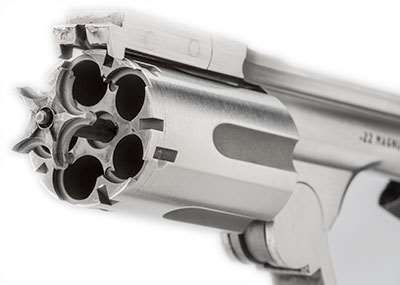
The hammer can be manually set in a forward, partially cocked or fully cocked position, which is important to know for proper operation of the revolver. With the hammer partially cocked, the hooked release lever is pulled back to allow the barrel and cylinder assembly to swing up from the frame. As the barrel swings down, an extractor star presses spent cartridge cases about a third of the way out of the chambers. Each case is manually removed from the cylinder before loading fresh cartridges. The barrel assembly is then pressed back down into the lower frame until the release lever is re-engaged. The action will not open if the hammer is in the forward position, nor will it close if the hammer is fully cocked.
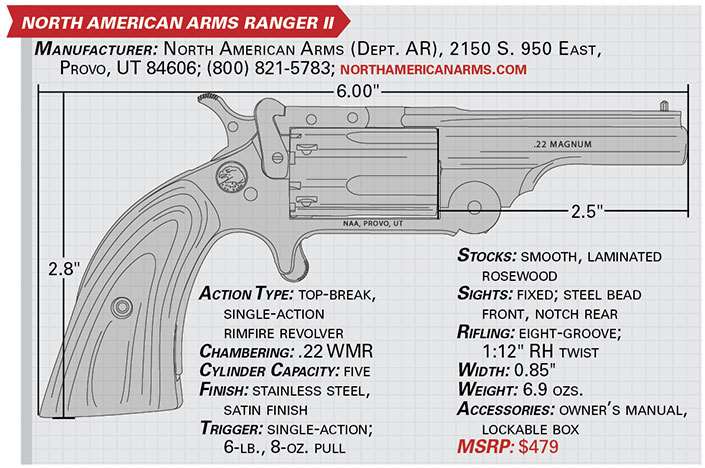
The diminutive, stud-shaped trigger exhibited a crisp single-action pull that broke cleanly at 6 lbs., 8 ozs., of pressure. The gun is fitted with rounded, smooth, laminated rosewood stock panels. The Ranger II’s grip frame is identical to that of the company’s other .22 WMR-chambered Minis. This means the revolver is fully compatible with the company’s existing selection of stock panels and the LaserLyte NAA-VC laser sight grip. The frame shape is compatible with most existing NAA holsters. Like other magnum-chambered Minis, the Ranger II can be ordered from the factory with a second cylinder chambered for .22 Long Rifle ammunition.
The Ranger II’s safety system consists of a set of notches cut between each of the cylinder chambers. The hammer is pulled back just enough to allow the cylinder to rotate until one of the safety notches is under the hatchet-shaped blade of the hammer. The hammer is then slowly released fully forward into the cylinder notch. With the hammer in this safe position, any shock or pressure applied to the hammer will travel harmlessly into the steel of the cylinder, instead of the primed rim of a loaded cartridge. This makes the revolver safe to carry with all chambers loaded.
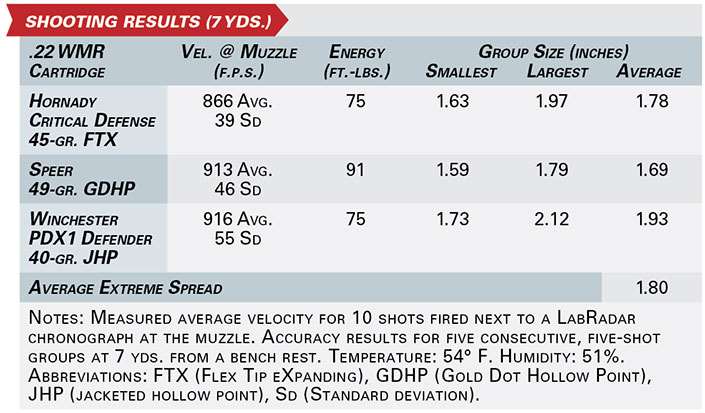
At the range, the Ranger II exhibited a level of operational reliability on par with standard NAA Minis. Its overall fit and finish was excellent, and the revolver successfully chambered, fired and extracted all of the .22 WMR ammunition tested. Shooting such a small revolver from a bench rest is challenging but informative. Once the owner has become familiar with the ergonomics of the trigger stud and the one-and-a-half-finger grip frame, bench testing confirmed that the Ranger II is capable of placing solid center-of-mass strikes on a target at reasonable ranges.
The NAA Ranger II is a sleek, precision-made miniature that harkens back to the all-but-forgotten break-top design. It is more convenient to operate at the range than standard Minis due to the fact that it does not need to be disassembled in order to place fresh cartridges in the cylinder. Nevertheless, reloading this particular wheelgun is not a high-speed, low-drag process due to the small controls and the need to manually remove each spent case. For those seeking an exceptionally compact, deep-concealment or backup handgun, the Ranger II demonstrated the same levels of craftsmanship and reliability as the standard models North American Arms has offered for decades.
Most Popular