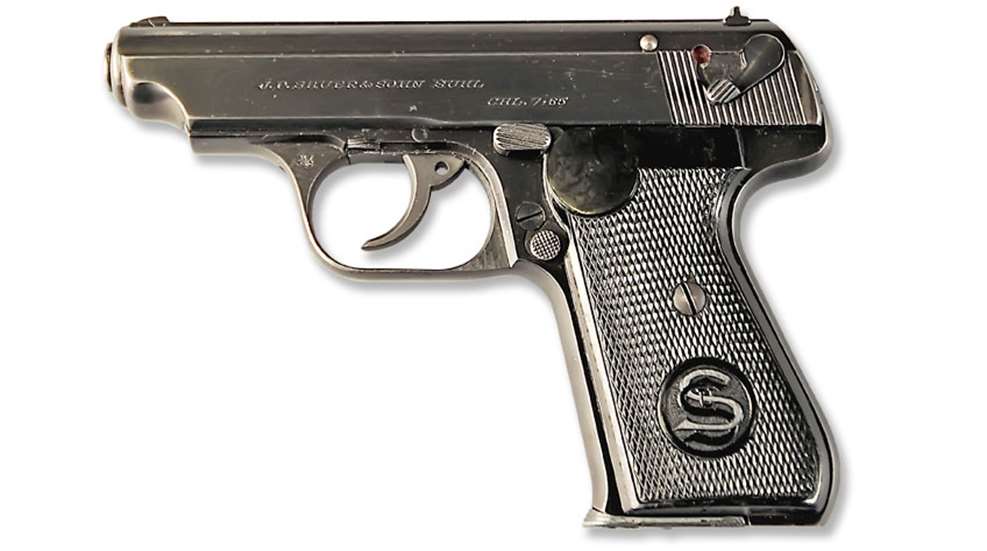
When one thinks of ground-breaking double-action pocket pistols, those that probably come to mind are examples from the superb Walther PP series. They were the first guns of their type to achieve a real foothold in the marketplace, and, even though introduced in 1929/30, they continue to be strong sellers today. The Walthers were so good that they have a tendency to overshadow other early, small, quality double-actions, including the one we’re looking at here, the Sauer 38H.
There are many who consider the Sauer 38H to be at least equal to the Walthers in style and efficiency—in fact, some feel it is actually superior. Sauer & Sohn’s handy new pistol was introduced in 1938, and because of the things going on in Germany at the time—and the drying up of foreign markets—the firm was unable to take full advantage of civilian sales before and after World War II, hence the fact that it’s somewhat forgotten today.
A considerable departure from Sauer’s earlier Model 1913 and 1930 7.65 mm Browning (.32 ACP) pistols, the 38H was a double-action design with an internal hammer—the “H” in the gun’s model designation stood for hahn. It featured a fixed barrel around which was wrapped a stout recoil spring. The breechblock was a dedicated unit secured to the slide by a pin. Model 38Hs employed a unique de-cocking lever. Lowering the lever cocked the hammer, but one could also safely release the hammer with the same lever when the gun was on full-cock by slightly pushing down then easing it upward. As well, most had a safety sited on the left rear of the slide. In the “on-safe” position, it blocked the hammer and secured the trigger. A magazine safety prevented operation when the magazine was removed.
The eight-round magazine was released by means of a button positioned below the de-cocking lever on the left side of the frame behind the trigger. A cocking indicator protruded from the rear of the slide, allowing the user to determine by sight or feel if the pistol was ready to fire. Stocks were of checkered Bakelite—normally black, but other colors are seen—emblazoned on the left panel with an intertwined Sauer und Sohn “SuS” logo. A few 38Hs were also chambered for .22 Long Rifle and 9 mm Kurz (.380 ACP), but these are quite scarce.
Early 38Hs were superbly finished with a high-luster blue, though as World War II progressed finish declined apace. Still, general quality of the guns never lagged. Markings changed as production continued. A small number toward the end of World War II were made with Duralumin frames. During the pistol’s brief lifespan between 1938 and 1945, a high percentage went to the German army, air force, police and the Nazi party. Some 250,000 were built in total.
Values on 38Hs vary according to chambering, finish and usage. The most expensive variants are those in .22 Long Rifle or .380 ACP, and guns with alloy frames. High-polish pistols bring a premium, as do those with various military, party and police markings. The example seen here is in excellent condition with minimal wear. It has an “Eagle C” police stamping on the front part of the left side of the trigger guard. As such, it’s worth $950. Other things being equal, a pistol without this mark would be valued at about 20 percent less.
Gun: Sauer 38H
Manufacturer: J.P. Sauer & Sohn, Suhl, Germany
Chambering: 7.65 mm Browning (.32 ACP)
Condition: NRA Excellent (Modern Gun Standards)
Value: $950
Most Popular