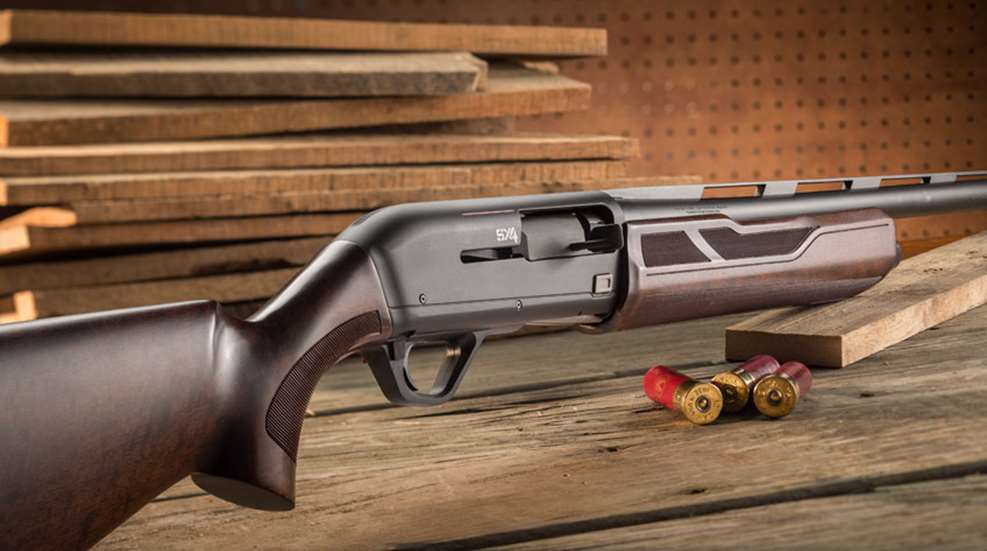
In 1974, Winchester announced its Super X Model 1 semi-automatic shotgun. Advertised as the successor to the legendary Model 12 pump-action in feel and balance, it stands among the best semi-automatic shotgun designs ever made. Reliable in function and made with milled steel parts, the Super X seemed to have it all, yet was never able to make a profit due to the high cost of production. The model finally disappeared from the catalog in 1981—save for some high-grade trap guns from Winchester’s Custom Shop that survived until 1991.
The gas-operated Super X2 was introduced in 1999, which was followed up with the Super X3 or SX3 in 2006. Both the Browning Arms Co. and the Winchester Repeating Arms Co. are owned by the Herstal Group (as is Fabrique Nationale). With both brands under one umbrella, the technology developed by one company could be shared with the other.
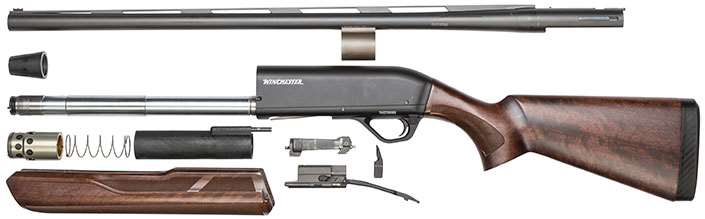
Winchester’s newest SX4 semi-automatic is a continuation of the shared technology of Browning and Winchester, specifically the gas piston, which is the heart of this shotgun. The Active Valve system uses a self-adjusting piston that regulates the gas pressure when operating the action. The waterfowl and turkey models are made to shoot 2¾" through 3½" magnums without adjustment; the Field version tested here is built for 2¾", 1 1⁄8-oz. target loads through 3" magnums. In the case of the 3½" chambered guns, the pressure generated by heavy loads is vented both upward through conventional slots in the fore-end and forward through the SX4’s Quadra-Vent ports. Venting these gases is inherently cleaner on the action, and has been proven to aid reliability.
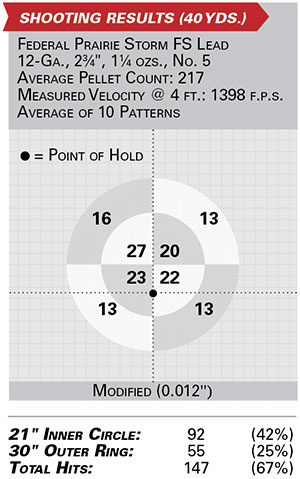
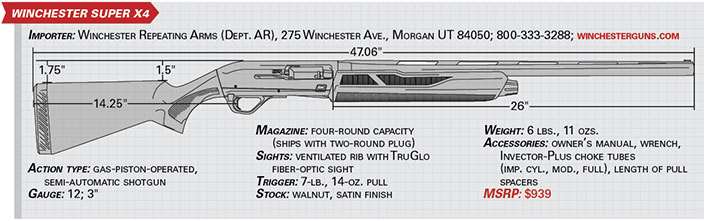
The SX4 has been redesigned for better ergonomic feel, and is lightened overall, including through the use of a high-strength, black-anodized aluminum receiver. The SX4 Field we tested weighed 6 lbs., 11 ozs., with a wooden buttstock and fore-end. In testing, using Federal Premium’s Prairie Storm FS Lead 2¾" pheasant load of 1¼ oz. of No. 5 shot, shooting patterns from the bench with a Caldwell Lead Sled, recoil was not a factor. However, shooting clays with Prairie Storm, the recoil was heavy, although not likely to affect a hunter at the flush of a cackling rooster.
The SX4 attenuates recoil somewhat with its back-bored barrel and soft Inflex recoil pad, which has a wide contact area that spreads out recoil to the shoulder and directs the stock down and away from the shooter’s cheek. The stock dimensions are fairly straight, and the stock can be lengthened or shortened with the use of 1/4" spacers. The SX4 includes one spacer, and others can be purchased separately. All of these factors help reduce recoil somewhat, but the test load’s calculated recoil energy of 46.97 ft.-lbs. is still stiff.
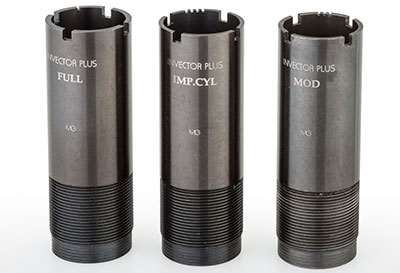
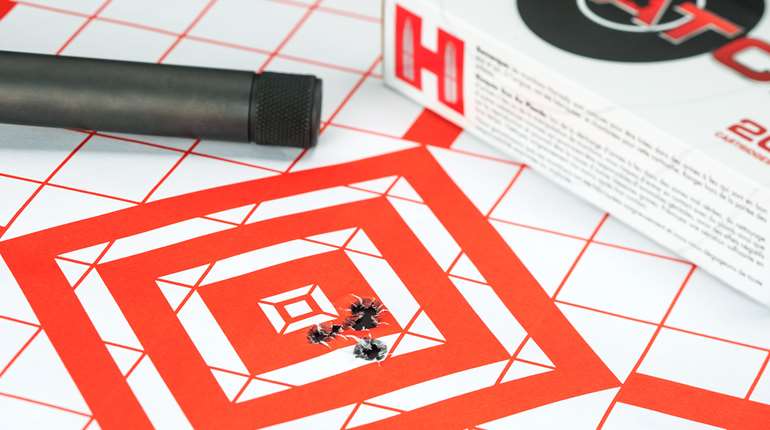
The SX4 comes with three Invector-Plus choke tubes—improved cylinder (0.0035"), modified (0.012") and full (0.030")—with only the full tube coming close to specification. However, when a series of patterns were shot using the modified tube and Prairie Storm ammunition, the results were nearly full choke, with 147 of a counted 217 pellets within the 30" circle, revealing a 67 percent pattern (midway between improved modified and full choke).
The excellent patterning can be attributed to the SX4’s barrel technology of a long chamber forcing cone. Such designs more gently guide the shot into the bore, causing less deformation. It is no secret that the technology of back-boring 12-ga. barrels to 0.740" or thereabouts—developed in the early 1920s by former American Rifleman contributor Maj. Charles Askins and Boise, Idaho, attorney E. M. Sweeley—produces superior patterns, as is borne out with our testing. In addition, the chamber and bore are chrome-plated to resist abrasion by hard steel shot and to protect against rust and corrosion.
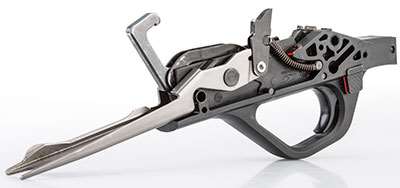
The SX4 is built for cold weather use with an enlarged bolt handle and release, a big safety button that can be easily switched for left-handed use and a larger trigger guard for gloved hands. Another feature is the self-aligning, drop-out trigger group. Easily removed for cleaning and light lubrication by tapping out two pins, it slips back into alignment in the receiver with ease. There is some spring tension, so the pins are best started by hand, ensuring proper alignment, and then pushed or lightly tapped home.
The trigger guard itself is of synthetic material, pretty much industry standard, and adds to the overall lightness of the gun. The SX4’s self-aligning bolt carrier link—the connection between the bolt assembly and the action-return spring in the buttstock—slips easily into the extended action-return-spring follower, which protrudes into the receiver about an inch or so.
 In the field, this semi-automatic was an easy, well-balanced carry. The top of the sculpted wooden fore-end slopes down about a 1/4" for a distance of 4" forward of the receiver junction, saving a bit of weight while giving the SX4 a racy look. Chambered only for 3" magnums, the gun’s fore-end does not have the Quadra-Vent ports, which are unnecessary. Handling was very good on clays, with no malfunctions shooting 1 1⁄8-oz. target loads.
The satin-finished walnut stock and fore-end use cut curvilinear lines in place of traditional checkering, which is confined to the lower half of the slim pistol grip. The fore-end also has the same style of serration on both sides and the bottom, creating a pleasing appearance and a fairly good gripping surface. In order to accommodate the various stock-lengthening spacers, the recoil pad is cut square and does not follow the line of the toe of the stock—somewhat of a minor turn-off for the traditionalist. Too, the magazine cap is recessed down into the tip of the fore-end, making it a little hard to turn with the barrel in place.
The SX4 is a fine branch of the Super X Model 1’s family tree, and, on the moderate side of semi-automatic shotgun prices, a good choice for value-conscious buyers.
Most Popular