Images courtesy Gunsite.com
The first experience that I had with a two-handed shooting stance was the isosceles stance as taught by the FBI at our police academy. The shooter stood erect and shot with both arms extended and elbows locked. This was also the same stance that we used in department qualifications and PPC matches. 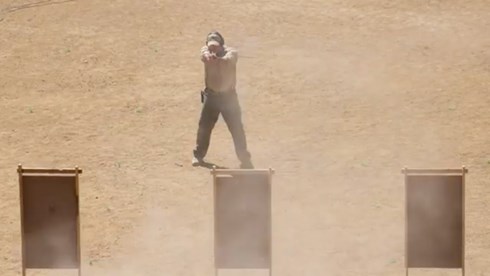
This stance worked pretty well as long as we were firing .38 Spl. wadcutter ammo out of our revolvers. Where it got weak was when we were trying to make multiple hits with .357 Mag. ammo, or even .38 Spl. +P. We simply could not do a good job of managing the extra recoil of the fighting ammunition.
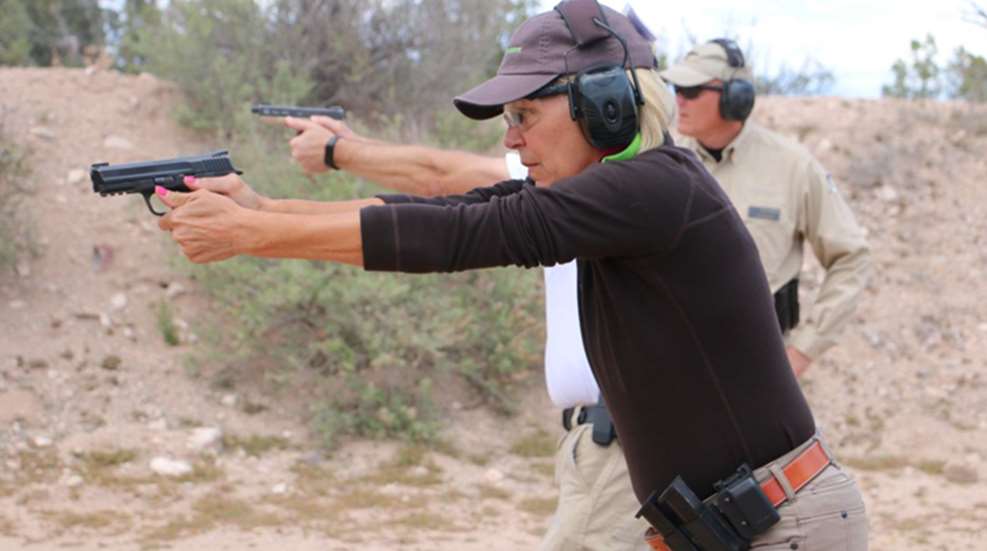
It was this same need to manage recoil when firing more than one shot that caused Jack Weaver, a California peace officer, to develop a slightly different technique. Weaver bent his elbows and made sure that his support elbow was pointed down towards the ground. He also exerted an isometric hold on the pistol, pushing forward with his shooting hand and pulling back with his support hand. Using this technique, Weaver's arms absorbed most of the recoil and made the gun more manageable under rapid fire. Col. Jeff Cooper quickly noticed that Weaver's technique was helping him to win quite a few matches and incorporated it into the Modern Technique of the Pistol.
For quite some time, a healthy argument ensued as to which technique was really the best to use in actual gunfights. The Weaver camp often suggested that the Isosceles was best used in target shooting, while the Isosceles crowd quickly pointed to the number of actual gunfights won by people using the Isosceles method. As it turns out, what the arms are doing may not be nearly as important as what the rest of the body is doing.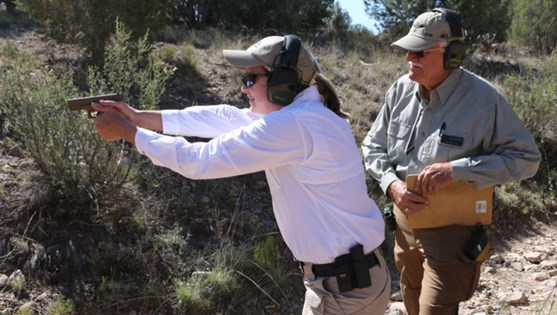
The defensive shooter should use an athletic body position. He should be squared to his target. The feet should be about shoulder width apart, with the support foot just slightly ahead of the strong-side foot. By that I mean that the ball of the support foot should be about even with the tip of the toes on the strong-side foot. The knees should be slightly bent and the shooter's weight should be on the balls of his feet. The shoulders should be slightly forward of the feet.
In this kind of position, the shooter can manage the pistol's recoil better. And it also puts the shooter in a good physical stance that allows him to move quickly in just about any direction. And, depending upon body size, the shooter may adjust this position a bit in order to be most effective.
Whether one shoots with both arms straight or arms bent, he or she can exert a firm grip on his pistol and somewhat of an isometric, push-pull, hold. The key is to be in an aggressive, athletic body stance without getting into a crouch. As Richard Mann puts it, “Do it like you are killing snakes!” A firm stance and a firm grip are what is needed to manage recoil and allow for multiple, accurate hits.
Many of us older shooters well remember the magazine articles by Col. Cooper and Massad Ayoob as they argued back and forth on the merits of the Weaver vs. the Isosceles. I am told that, later in life, Col. Cooper made the statement that he wished he hadn't made such as issue of the two stances. Whichever one a person chooses to use, his success will be noted in his ability to deliver quick, accurate shots with full-power defensive ammunition.
It may even be that a good defensive shooter should be well versed in both techniques. Depending upon the available cover, whether he is shooting over or around something, and the angle in which he may have to deliver his shots (we can't always plant our feet and assume a classic stance when under a surprise attack) one or the other technique might work best.
I have come to the conclusion that arguing the Weaver vs. the Isosceles is about as productive as arguing .45 vs. 9 mm. I have better ways to spend my time and the guys who want to argue these issues might spend their time more productively in good training and practice.
Additional Reading:
Understanding the Flash Sight Picture
Defensive Handgun Choices
The .40 Is a Better Choice Than the 9 mm
.40 S&W is STILL Better Than 9 mm