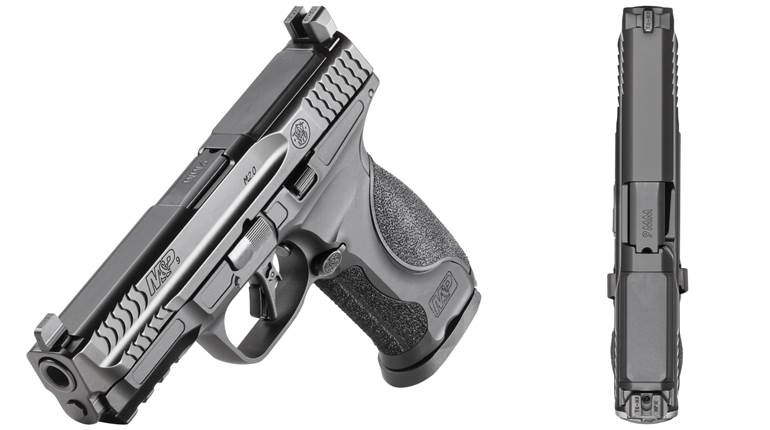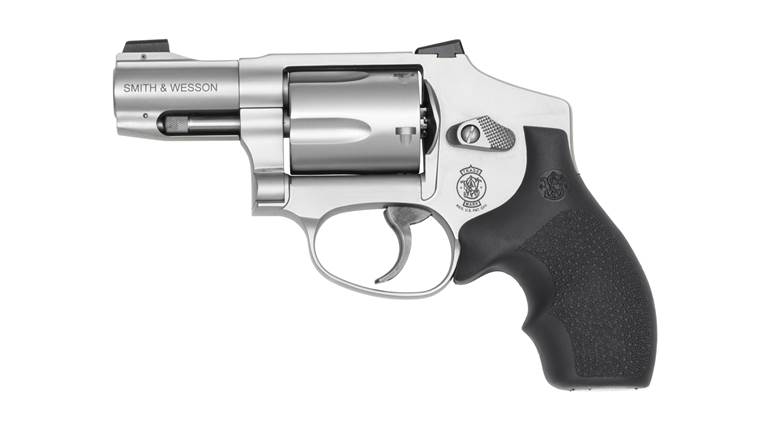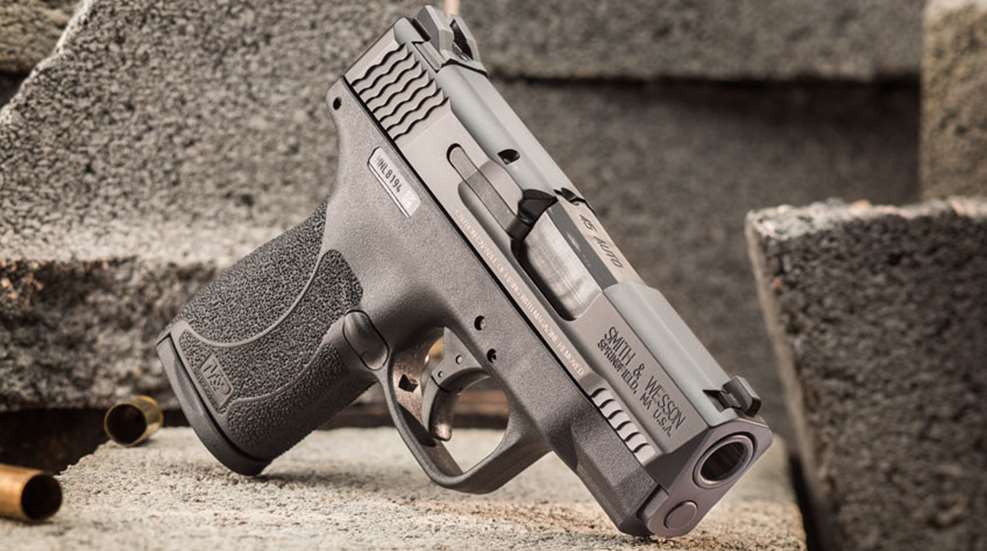
Ten years ago, Smith & Wesson introduced a line of defensive semi-automatic pistols that carried the firm’s long-used “Military & Police” model identification. Not like the familiar Model 10 revolver that armed Americans since the last decade of the 19th century, the new M&Ps were 21st century striker-fired, polymer-frame autoloaders with a full range of today’s essential features. The first models were full-size service pistols with double-column magazines. And the first examples were chambered in .40 S&W, although 9 mm Lugers and .45 ACPs followed quickly. Undeniably a successful product line, the M&P has been made in countless variations—from compacts to long slides and, for a while, even in .357 SIG. But of all the variations that have come from the Springfield, Mass., plant, one that stands out is the recently released M&P45 Shield.
The Shield line is a reflection of the current interest in medium-to-small, single-stack, semi-automatic pistols set up for concealed carry or police backup roles. High-capacity magazines are not essential, but serious terminal performance is. The first gun in the Shield line was a 9 mm (July 2012, p. 42), followed closely by a .40 S&W. It took a while longer for S&W engineers to adapt the Shield concept to the .45 ACP cartridge, but that gun is now a reality.
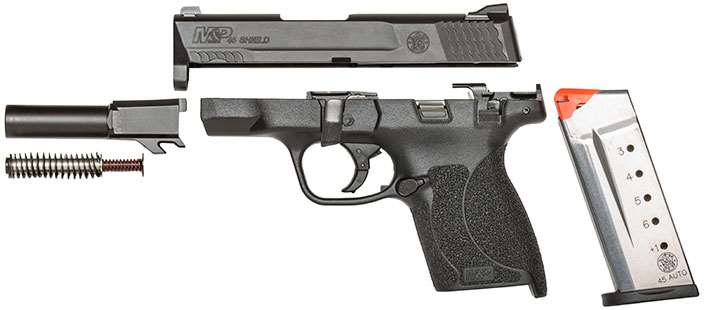
With a steel slide riding a polymer frame, the M&P45 Shield is recoil-operated, locking by way of the barrel’s hood engaging the ejection port and unlocking by way of its underlug camming downward after firing as it comes into contact with a steel block in the frame. A captive, dual recoil spring assembly returns the slide to battery.
The gun’s substantial .45 ACP chambering and scant 22-oz. weight combine to create a pistol that might be a bit difficult to manage were it not for its superior ergonomic design, which makes the pistol eminently shootable. Most shooters, including those with smaller hands, generally take to the Shield grip shape very well. In fact, it is probably the most appealing of the little pistol’s virtues. The frame is angled for natural pointability and has a deep pocket for the web of the shooting hand.
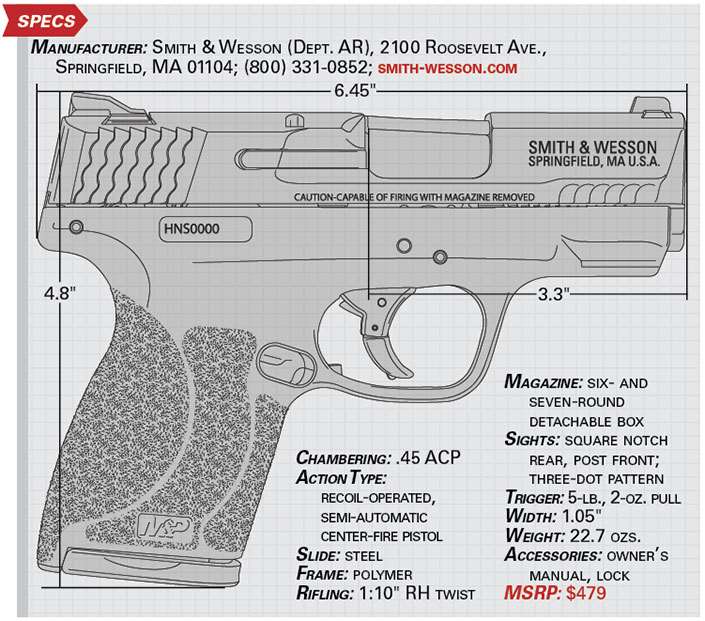
Looking at the gun in profile, note that the curve of the trigger is well below the curve of the pocket on the backstrap. This simply means that the pistol is nicely shaped for the “back and up” sweep movement of the trigger, which has an action that is consistent from shot to shot. The trigger pull is around 5 lbs., and seems to vary just a bit, though it may level out with time. There is a minimal amount of take-up before trigger pressure actually begins. Trigger reset is reasonably short.
With regard to safety features, the M&P45 Shield has an articulated trigger safety and an internal drop safety. Our sample gun also featured a manual thumb safety mounted on the left side of the frame for use by right-handed shooters, although Smith & Wesson does make a variant without the manual safety.
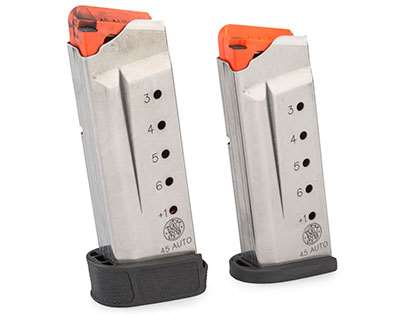
Each pistol comes with one six-round magazine and one seven-rounder—the difference being only in the height of the baseplates. As is the custom with service pistols, most shooters will load the pistol by retracting the slide, inserting a fully loaded magazine and depressing the slide release to chamber the top round. They then remove the magazine to top it off with a single round and replace it in the pistol. For this reason, pistols are commonly described as having a capacity of “six-plus-one”—the magazine carries only six rounds, but after topping off, the gun has a total of seven cartridges onboard. Yet curiously, both M&P45 Shield magazines (the six-rounder and the seven-rounder) feature witness holes marked “3, 4, 5, 6 and +1.” Not only is the “+1” denotation nonsensical, it is incredibly frustrating when one unsuccessfully attempts to load the “additional” round into the six-round magazine.
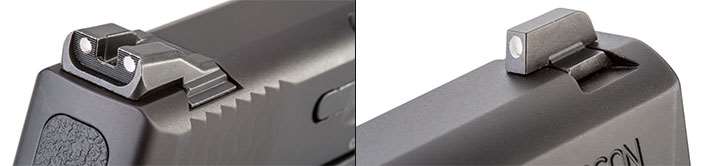
Finished in a businesslike black color, the Shield is an impressive little package. The square-notch rear and post front sights feature a three-dot pattern and are drift-adjustable. At the time of the M&P45 Shield’s introduction, the maker pointed out the improved (over earlier Shields) texturing on the gun’s gripping surfaces. S&W has gone to panels of a slightly more aggressive version of what was once termed a “crackle” finish. It works like a charm, serving to anchor the pistol firmly in the hand. This is a very light little pistol that recoils sharply when firing the larger .45 ACP cartridge.
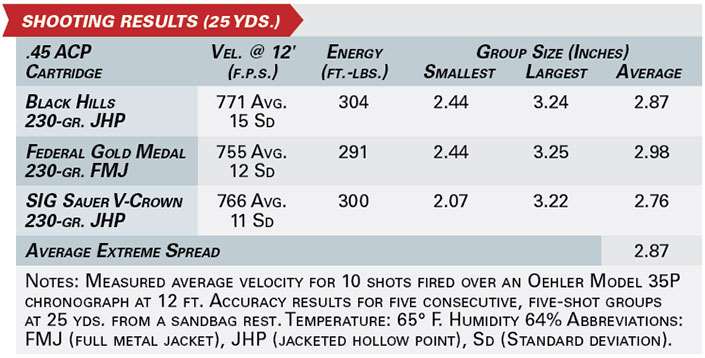
In range testing with a variety of commercial ammunition, there were no malfunctions of any kind. In the absence of proper Ransom Rest inserts, accuracy shooting was done over sandbags on a solid bench. Results are tabulated above and are surprisingly good. Note the reduced velocities of typical 230-gr. ammunition, due to the pistol’s shorter barrel.
The Smith & Wesson M&P45 Shield is a good choice as a daily carry gun. At 22.7 ozs., it isn’t particularly heavy, and would be a good choice as a police backup gun, as well; it is flat and could nicely fit into a pocket or seam in body armor. The Shield chambered in .45 ACP is quick into action, simple to manage and about as powerful as carry guns get.