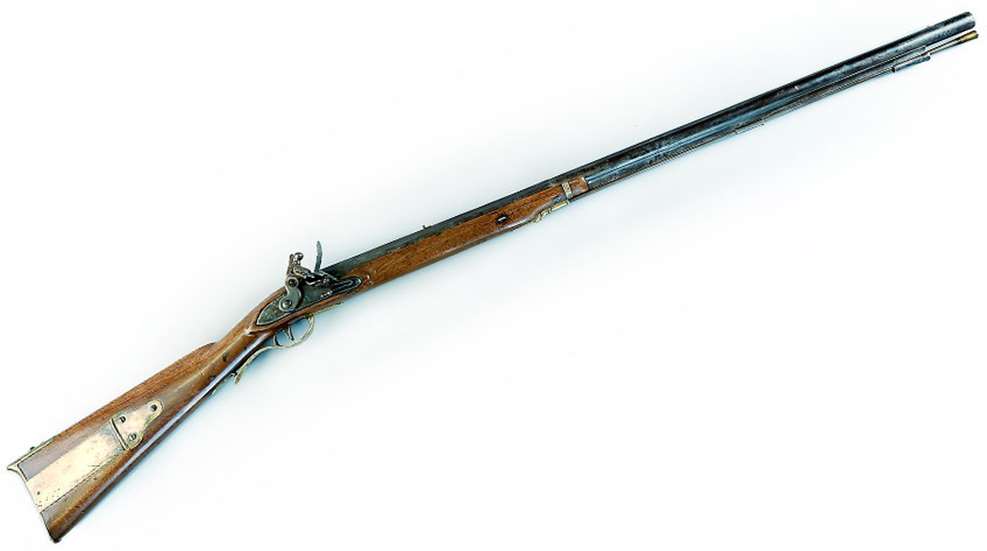
Many consider the Model 1803 flintlock rifle to be the most beautiful long gun ever produced for the U.S. military. It’s easy to see why. Sporting a 33" (later 36") half-round, half-octagon barrel mated to a svelte half-stock and set off with elegant brass furniture, it looks and handles more like a sporting arm than a military one.
Following the lead of British and European militaries at the end of the 18th century, America decided it would be prudent to approve a rifle of her own. Unlike the examples seen across the Atlantic, which largely followed the design of the stubby Teutonic Jägerbüsche, the Yankees decided to model their piece more along the lines of the elegant Pennsylvania longrifle, which had served them so well during the Revolution—the most notable departures being the adoption of a half-stock and under-barrel rib.
Interestingly enough, the longrifle evolved from the Jäger rifles introduced into America by German and Swiss gunmakers. As well, the United States had provided its small army with a number Pennsylvania-style rifles built by contractors as early as 1792, and these too possibly had some influence over the new arm. They were certainly in service concurrently.
Adopted in 1803, this premier rifle (and the only flintlock rifle) built by a national armory at Harpers Ferry was, as stated earlier, a handsome gun, measuring some 49" overall. Caliber was .54, and the 33" barrel was rifled with seven lands and grooves. Hardware, to include a generous patchbox, was of brass, as was the tip of the iron ramrod. The lockplate was flat and incorporated a reinforced cock. Markings involved a federal eagle, “HARPERS FERRY” and the date of manufacture. Model 1803s were not set up to take bayonets.
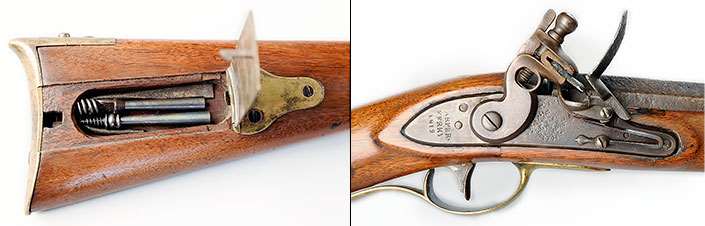
Some 4,015 of these “Type I” rifles, as they are now called by collectors, were made between late 1803 and 1807. Production was resumed in 1814 and continued until 1820, though the majority of these “Type II” rifles were slightly different from their predecessors in having 36" barrels and slightly longer stocks. The lockplate, lockplate markings and a few parts were also somewhat altered. Records indicate 15,707 were built.
While there are some who feel 1803s accompanied Lewis and Clark on their epic journey to explore the American West, it has been fairly well substantiated that the guns had not been manufactured in time to be taken along on the expedition. Still, a good number of 1803s were used during the War of 1812, and subsequently by federal and state troops.
Many of both types of 1803 rifles were later converted to percussion ignition, and some were also smooth-bored to a larger caliber, possibly for the use by militia as muskets. There is some conjecture that these arms were actually manufactured sans rifling, but to date there is no evidence supporting this theory one way or the other.
Model 1803s, either Type I or Type II, in good, unaltered condition can easily bring prices in the low five figures, however, such is not the case with the example seen here. At some point in its lifetime it was converted to percussion operation and then reconfigured back to flintlock operation. The ramrod has been replaced, and its barrel—probably smoothbore at one time—has been rifled with 10 lands and grooves and the caliber upped to .60. Still, it is sound and attractive, the brassware in good shape, and an inspector’s cartouche can still be discerned on the intact stock. As such, it’s valued on the low end, at $3,500.
Gun: U.S. Model 1803 Rifle, Type II
Manufacturer: Harpers Ferry
Caliber: .60
Manufactured: 1819
Condition: NRA Fair (Antique Gun Standards)
Value: $3,500
Most Popular