Frontier Americans often chose to carry a handgun as a defensive tool. When it comes to portable weaponry, nothing equals a handgun and there is no better way of packing it than a proper holster. For this reason, the many styles of holsters used in the westward expansion have become part of our heritage. Stories of westerners and their feats of derring-do were—and are—treasured by latter-day Americans to the point that special holsters exist as part of the Western tale. Many contemporary historians have done great research into old catalogs and with surviving samples. Several things seem to be clear. The real outdoorsmen who pushed the American frontier westward carried their guns in holsters that were, above all else, practical. But they also loved to decorate a simple leather sheath with carving that is very artistic.
My personal experience with holsters extends back to my military service in the late 1950s. There were no choices about how I carried my service 1911A1 pistol—the issued, flapped GI holster. I briefly fooled with a shoulder rig in Vietnam (never again, the cross strap drove me nuts). As a police officer, I was somewhat restricted in my options. However, I was allowed to use a Jordan Border Patrol type and stayed happy for many years with the Don Hume brand. I also began to work with autos and had occasion to undertake combat pistol training at Gunsite with 1911 guns in Bruce Nelson and Milt Sparks rigs. From what I have thus far mentioned, one fact stands out—everything was leather. Sometime in the 1970s, we began to see a shift to less expensive synthetics as the basic material with which to craft holsters. It happened around the same time that the police service began to shift from the traditional revolver to the high-capacity auto. As far as I can see, the nylon and Kydex-like materials have worked out just fine and have clearly supplanted leather as material of choice.
That does not mean that leather is not still useful and therefore often used. A lot of leather holsters are made and sold every year and that is not all nostalgia. Personal-defense and concealed-carry shooters often find the tendency of leather to “wear in” favors their lifestyles and shooting techniques. Therefore, while most utilitarian holsters are currently synthetic, many are still the old-fashioned cowhide. It is interesting to explore why this can be true.
I believe that the more expensive cowhide leather is still in use for holster making simply for nostalgic reasons. There are few things that leather can do better than the synthetics, but the traditional material just plain looks better. It looks like what we have come to believe a holster is supposed to look like. Things have evolved to the point that some leather holster companies and individual craftsmen are researching holster history in great depth. This is done to provide their customers with products of precise historical accuracy. Others are applying old techniques to modern holster designs.
Particularly in the case of western and southwestern artisans, leather carving and stamping is available. Not so many years ago, these skills were more often found on fancy parade saddles than belts and holsters. Among gun people of the mid-20th century, the old S.D. Myers company of El Paso was the best-known maker of ornamented belts and holsters. For the more conservative policemen that formed much of their customer base, Myers offered precise basket stamping. This famous pattern simulates the intersecting lines of a woven straw basket. It is clearly attractive, but is also practical in that the pattern tends to hide the scratches and dings that are characteristic of police service. More opulent patterns were reserved for the guys that liked it a bit more fanciful. Much of this was floral carved, usually dyed to emphasize the sweeping curves of lush flowers. I have seen some of this work that is beautiful.
Today, there fewer craftsmen capable of fancy leather work. But when I want to talk about holsters, I prefer to go to the best possible information source. For me, that's John Bianchi, the man who founded an iconic company and coined the term “gunleather.” In a recent, all-too-brief conversation, Bianchi had definite opinions about the state-of-the-art of fancy leather work in the 21st century. He said “It's better than it ever was in the old days—much better.” Apparently, the demand is there, along with the wherewith-all to make it happen. Bianchi's Frontier Gunleather shop stays busy with hand-made and historically accurate rigs that manage to elevate the term “high-end” to new heights.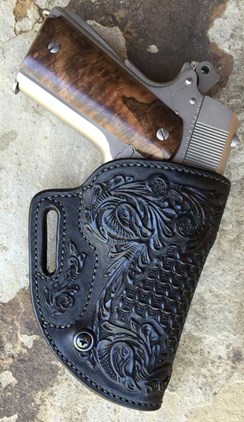
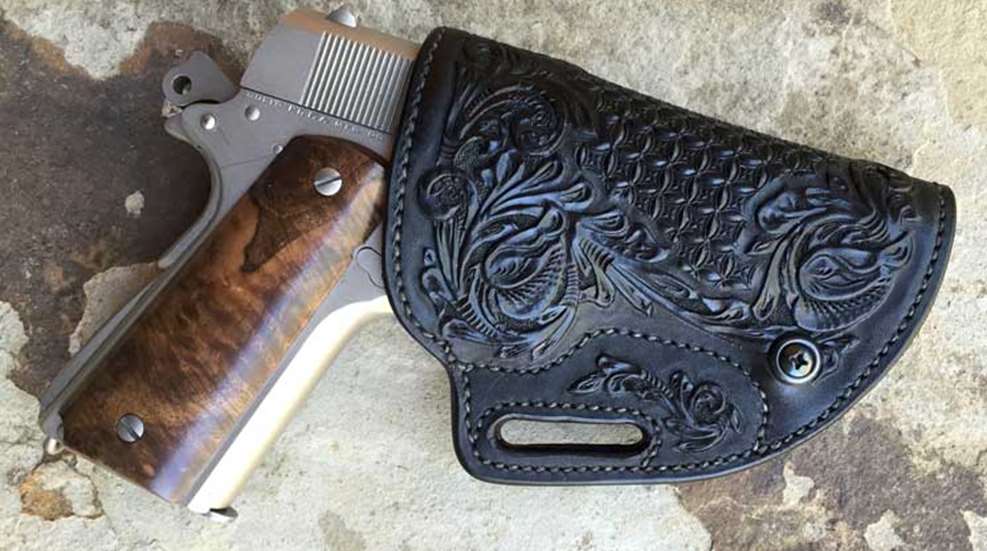
But when it comes to the crafting of the really fancy stuff in today's handgunning world, I know of no artist any better than Karla Van Horn out of Jasper, Ga. Her website (purdygear.com) is a pistolero's delight and shows both traditional and modern holster designs. The woman is willing to discuss your ideas to develop a custom holster that suits your needs and preferences. Pictured is one of her Liberty Holsters for a Colt Commander, built to my liking. This is a pancake style rig that presents an expanse of smooth facade. Fitted onto a proper belt (she makes those, too), this clean-lined rig rides high on the right hip. It would be a first-class working holster for a guy who works armed, but the beauty of this rig is elsewhere. It is in the carved leather facade, which combines old-fashioned basketweave with an open scroll pattern on the edges. In plain black, it is opulent but unobtrusive, a masterpiece of leathercraft. I commend to you the work of this talented woman.
Most Popular