Few firearm introductions have generated the buzz and demand of the Kel-Tec CNC Industries, Inc., PMR-30 pistol. That’s unsurprising, though, as a lightweight, .22 WMR-chambered, semi-automatic, full-size handgun utilizing a 30-round-capacity magazine is sure to be appreciated by a large segment of the shooting public. Smartly, the company has subsequently re-commissioned the efficacious delayed-blowback PMR-30 as the foundation for a carbine counterpart—enter the autoloading CMR-30.
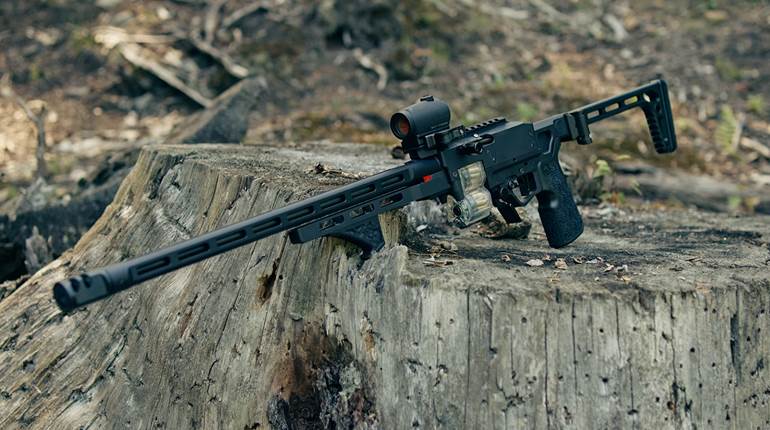
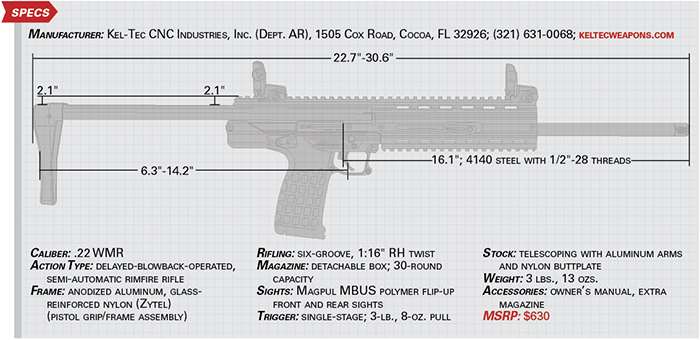
A blowback-operated arm, the CMR-30 has a steel, 10 3⁄8"-long, 0.628"-diameter bolt top rod that’s attached to the steel bolt block. During firing, the assembly travels rearward, extracting and ejecting the spent cartridge case, compressing the recoil spring—inside of the bolt’s top rod—and cocking the hammer. Then it comes to an abrupt stop against a urethane recoil buffer. During its forward movement, a round is stripped from the magazine and pushed into the chamber, after which lockup is completed. After the last round from the magazine is fired, the action automatically locks open.
Because of its blowback operation, the CMR-30 can be fickle about the ammunition it will digest. According to the owner’s manual, “the CMR-30 functions best with high-power ammunition, often with bullets of 40 grain[s] and up. Low-power ammunition and/or lightweight bullets may cause failure-to-feed problems due to the lack of energy to cycle the action all the way back.” This is consistent with other .22 WMR-chambered, semi-automatic firearms evaluated in these pages, most are designed around older, hunting-type loads with heavier bullets. Seldom are the newer, faster and leadless .22 WMR offerings 40 grs. or heavier.
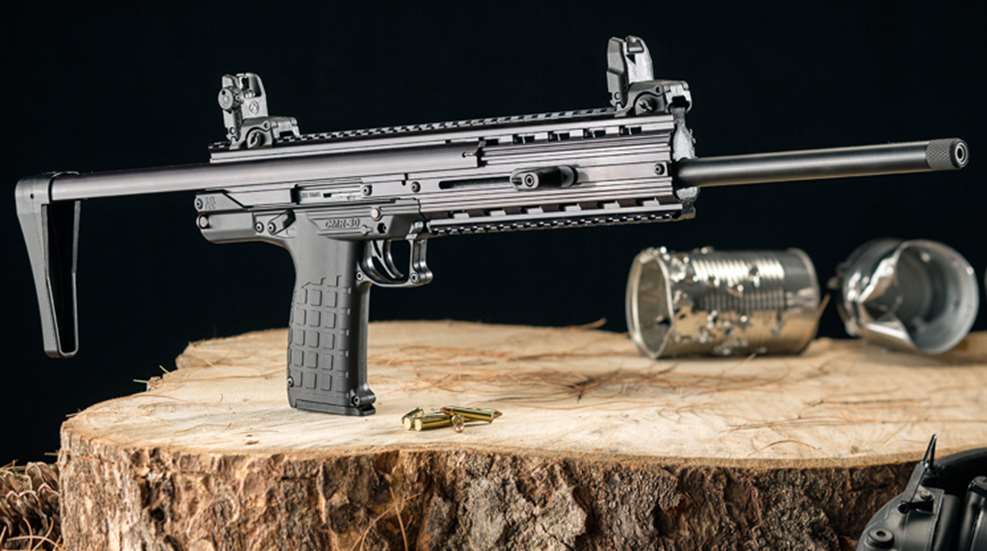
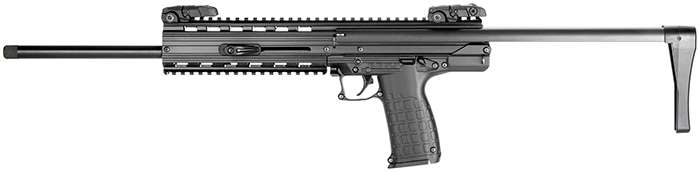
Identical to the PMR-30, the CMR-30 has an impact-resistant, glass-reinforced nylon (Zytel) grip assembly. Although there is no purchase-enhancing treatment on the frontstrap or backstrap, the sides of the pistol grip have a grid pattern of raised rectangles. At the bottom of the grip is the magazine catch. Because of the catch’s location and sensitivity, it’s possible for a shooter with sizeable hands to drop the magazine inadvertently. Steel sling attachment loops are at the rear of the grip frame.
The only nonbilateral fire control, the bolt catch, is located at the top of the pistol grip. Directly behind it is the two-position safety. In the “safe” mode, the red “fire” indicator is covered and the trigger mechanism is disconnected. As for the single-stage trigger, the sample gun’s broke consistently with a 3-lb., 8-oz. pull. Although there was no discernible overtravel, there was considerable creep.
Forward of the trigger guard is the spring-loaded, stock-latch button that secures the telescoping stock in one of five positions. Featuring aluminum arms and a Zytel buttplate, the stock enables the gun’s overall length to adjust from 22.7" to 30.6". As the arms follow quasi-dovetail cutouts in the 7075 hard-anodized aluminum upper frame, it’s nigh impossible to have it inadvertently “jump track.” At the front of the receiver, below the telescoping stock’s arms, is the bilateral, non-reciprocating charging handle. Measuring 2.945" from tip to tip, it’s the widest point of the CMR-30 by far; in fact, in most places the gun is less than 1¼" in width. Attached to the bottom of the aluminum frame is a removable, 7"-long Picatinny rail, and at the top of the carbine is a strip of rail that spans the entire length. A nice addition, the CMR-30 comes equipped with Magpul’s adjustable, polymer, flip-up MBUS front and rear sights.
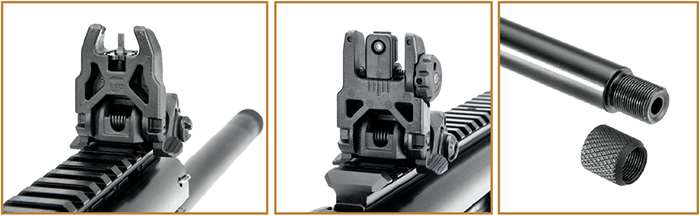
Extending 7 1⁄16" from the front of the receiver, the 4140 steel barrel is 16.1" in total length and 0.625" wide. The extra barrel length afforded by the carbine gives decidedly better external (and thus terminal) ballistics when compared to the PMR-30’s 4.3" barrel. The six-groove, 1:16" RH-twist barrel is threaded 1/2"-28 to accept a suppressor or muzzle accessory, and a checkered steel cap is provided, as well.
Lastly, what made the PMR-30 a hit was its 30-round-capacity magazine, and the CMR-30 utilizes the same one. Made from Zytel and impregnated with molybdenum for improved reliability, the staggered-column magazine has witness holes to confirm the number of rounds remaining. The Zytel follower is also treated with molybdenum.
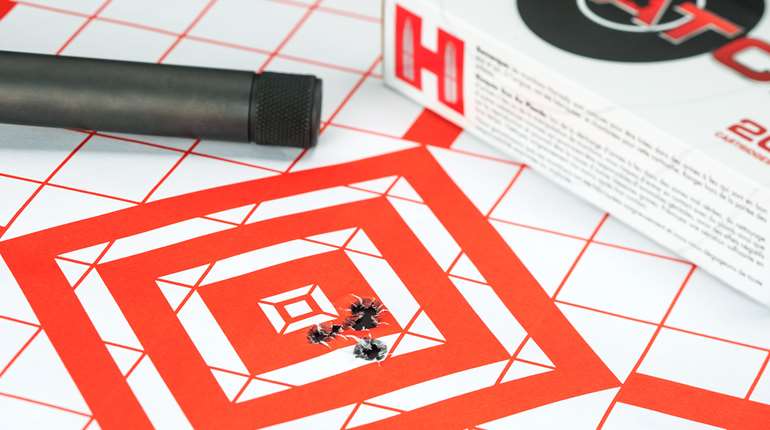
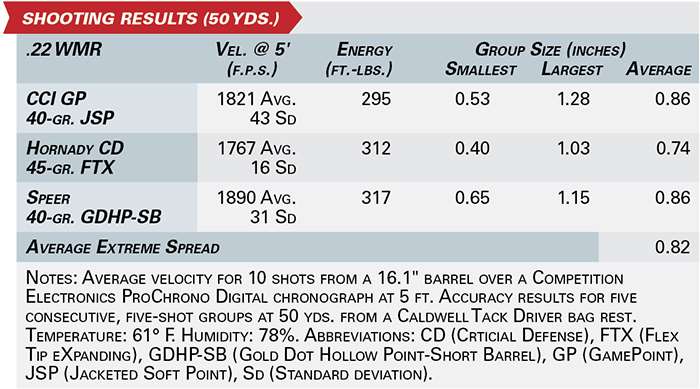
To test the CMR-30, we topped it with a Leupold 1X LCO red-dot sight and headed to the range with Champion’s Re-Stick Redfield-style sight-in targets and an assortment of personal-defense and hunting .22 WMR loads; these included Speer 40-gr. Gold Dot Hollow Point-Short Barrel, CCI 40-gr. GamePoint JHP and Hornady 45-gr. Critical Defense FTX. Firing from a sandbag rest at 50 yds., we were amazed with the CMR-30’s accuracy; in fact, all of the loads achieved at least one group approaching 1/2", and overall the three posted similar averages. But, in the end, the Hornady load edged out the others, posting an excellent five-consecutive, five-shot-group average of 0.74". During testing there were four failures to feed—two each with the Hornady and Gold Dot loads. This can be attributed to the magazine, which must be meticulously loaded per the manufacturer’s instructions.
As can be expected, the CMR-30 is a pleasure to shoot; there’s no discernible recoil and minimal muzzle flip, so shot after shot can be accurately delivered as fast as the trigger can be pulled. As well, given the terminal ballistics afforded by today’s high-performance .22 WMR ammunition, the CMR-30 is potentially a viable self-defense arm, especially for the recoil and budget sensitive. Its short overall length and 3-lb., 13-oz. weight make it highly maneuverable, and, if you can find it during this ammunition crunch, .22 WMR is generally more affordable than most center-fire chamberings.
The Kel-Tec CMR-30 deserves consideration from preppers, sustenance hunters, varminters, plinkers or personal-protection practitioners. It offers a lot of performance from a lightweight, compact package. And to think, it all started with a pistol.
Most Popular