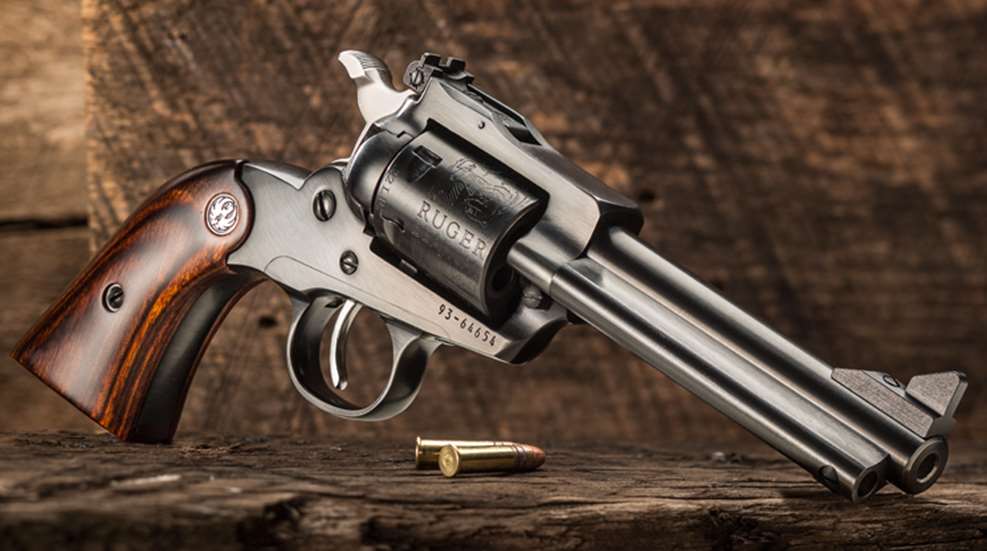
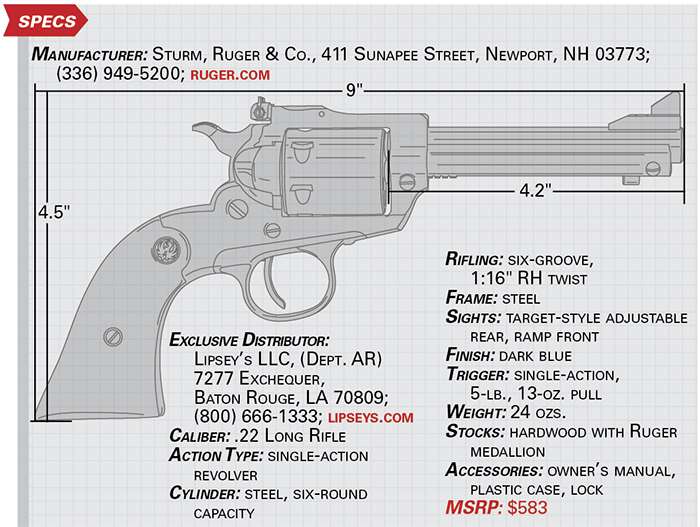
The Bearcat was introduced by Ruger in 1958. It was discontinued in the 1970s when the company transitioned all of its single-actions to a transfer-bar-safety system. Nonetheless, it was returned to production by popular demand in the 1990s with the addition of a transfer-bar safety.
Throughout its production, the Bearcat has been popular with shooters who have looked on it as a single-action kit gun. And the biggest complaint, throughout that time, has been that the little revolver did not have adjustable sights like Smith & Wesson’s double-action kit gun. Recently, Lipsey’s, of Baton Rouge, La., took those complaints to heart and worked with Ruger to design a Bearcat with an adjustable rear sight and a ramp front sight.
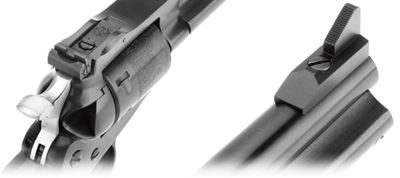 The adjustable rear sight on the new Bearcat appears in every way to be a scaled-down version of the adjustable sight found on Ruger’s Blackhawk revolvers. The frame is even built up in the area of the rear sight for added protection just as on the big-bore Ruger single-actions. The front sight has a tall ramp blade and is secured to the barrel by a screw located in the rear of the front sight base. In all other respects, this adjustable-sighted Bearcat is just like the Bearcats that shooters have enjoyed for more than 50 years.
We tested the Ruger/Lipsey’s Bearcat with three popular .22 Long Rifle loads. The Winchester .22 Match (40-gr. solid) ammunition gave the best accuracy with an average group size of 1.68", although all three loads were very similar in the accuracy that they produced at 25 yds. It was felt that the improved sight picture offered by the adjustable sights resulted in a marked improvement in accuracy over the fixed-sight version of the revolver. The highest velocity in this particular test was provided by the Remington 36-gr. high-velocity hollow-point loads, averaging 893 f.p.s.
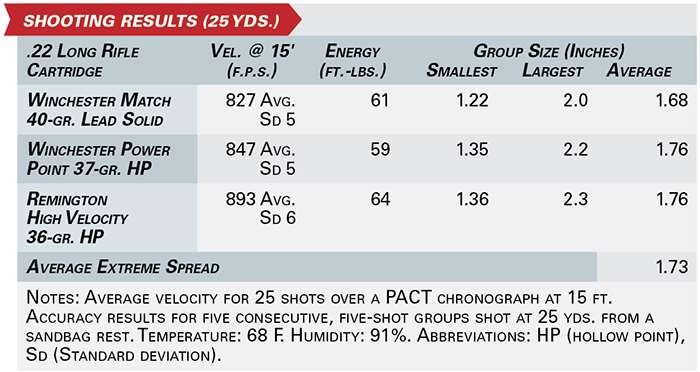
Throughout testing, the Bearcat functioned flawlessly. Timing and indexing were about perfect. The trigger pull took a bit of getting used to, though. At 5 lbs., 13 ozs. on the test gun, we felt that it was a bit too heavy for a single-action revolver. It also exhibited some creep. Regardless, we found this to be an accurate and pleasant gun to shoot.
The adjustable-sighted Ruger Bearcat is distributed exclusively by Lipsey’s and can be ordered through any Lipsey’s dealer. Adding adjustable sights to the venerable Ruger Bearcat makes it a major contender for the kit gun title—accurate, dependable and enjoyable to shoot.
Most Popular