William Batterman Ruger is best known for his innovative mind in the firearm industry. Many say he was the finest firearm designer since John Browning, and few would argue that declaration. Many Ruger gun aficionados may not be aware that in addition to his phenomenal gun-designing skills, Ruger was also a very successful industrial designer whose investment-casting business supplies precision cast parts to the automotive, aerospace and golf industries as well as general manufacturing businesses. Ruger, however, was above all else a true renaissance man.
He was a devotee of classic cars, as well as classic firearms. A gifted mechanical mind, Ruger was largely responsible for the continuing of classic firearm designs well past their original manufacturing lives. His first commercial success, the Standard Automatic Pistol, was a redesign of the famed Japanese Nambu pistol of World War II. Ruger recognized the superior ergonomics of the Nambu and made them the foundation of his first pistol. Its success is legendary, and it—in many forms—is still being manufactured 67 years later.
So in 1966 this renaissance man brought to the sporting market a single-shot rifle like few American shooters and hunters had ever seen. At the time the vast majority of American shooters wanted bolt-action rifles—repeaters—to carry on their hunting adventures. Why in the world would anyone want to handicap themselves with a single-shot rifle? The answer was two-fold: beauty and simplicity. The Ruger No. 1 took off like a wildfire and remains a steady occupant in the long-gun market some 49 years henceforth.
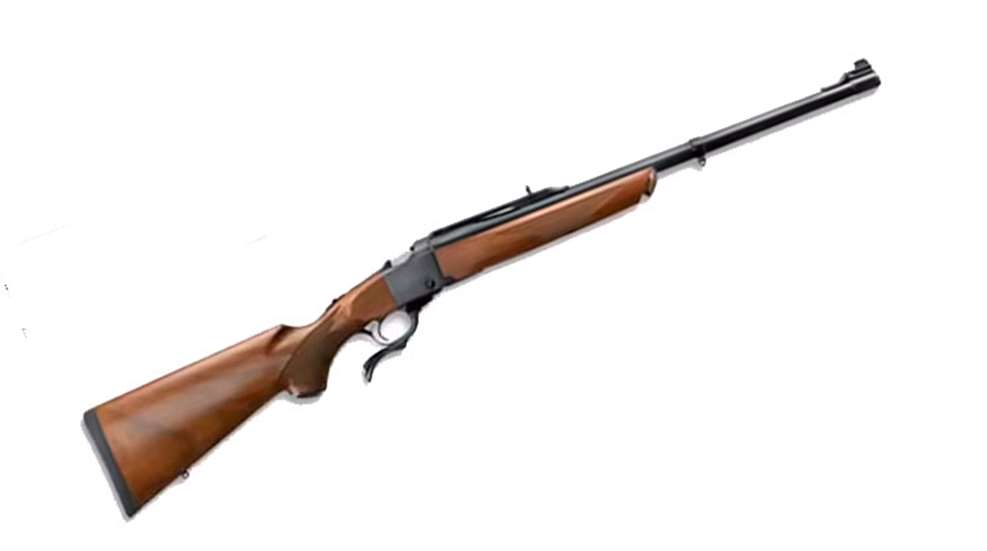
Based on the English Farquharson falling-block rifle of 1872, Ruger’s iteration features the same internal hammer, falling-block action and overall styling of the British rifle. The renowned classic stockmaker, Lenard Brownell, designed the two-piece stock for the No. 1. Ruger wanted to lighten his new single-shot rifle—during its pre-production time it was called the “Victorian”—and make it with a trimmer profile. Ruger engineers Larry Larson and Harry Sefried rose to that task by locating the hammer centrally and moving its spring onto a hanger that projects forward of the receiver and serves as a fastening point for the fore-end and the ejector spring.
Like its English predecessor, the No. 1 is bull strong. Brownell said that during its development he tried several time to blow one up but never succeeded. As such the No. 1 has been chambered in no fewer than 47 chamberings, from the .204 Ruger to the .450/400 Nitro Express. The number of wildcats and custom chamberings must be many times that factory amount.
A tang-mounted sliding safety that blocks both hammer and sear from movement takes care of most safety concerns. It is unobtrusive and operates easily with the shooting-hand thumb. If it has a fault it would be that with some models the front of the safety lever sticks above the flute in the breech block and receiver where the fired case is ejected. Sometimes the case hangs up on this projection, and one must turn the gun over if a quick reload is needed. Fortunately, it is an easy fix with a small cut-off wheel and some cold blue.
With no magazine in the receiver the No. 1 can be made with a longer barrel and still stay within the physical length of traditional bolt-action rifles. That gets a few more feet per second out of the bullet and makes for a very handy rifle to carry on the mountain. Those of us who have hunted with a No. 1 have never found its single-shot status to be an impediment in any hunting situation.
Perhaps the only fly in the No. 1’s ointment is its reputation for inconsistent accuracy. I have never had an issue with any of the three No. 1 rifles I have owned over the years. Each produced acceptable hunting accuracy, including a .22-250 Remington varminter that kept 52-gr. Hornady hollow points in less than ¾” at 100 yards all day. Others have had problems with accuracy in a No. 1. I believe that most of the problems associated with accuracy were due to barrel quality that was a problem issue for Ruger years ago. I have not seen or heard any recent problems with No. 1s.
The No. 1 has been made in several configurations, mostly differing in barrel length, weight and fore-end treatments. It remains a part of the Ruger stable, though it is down to nine model variations chambered from .223 Remington to .450/400 Nitro Express and available exclusively through Lipsey’s, the Baton Rouge, La,, distributor.
What started as a dream of Bill Ruger nearly a half century ago remains one of the most iconic sporting rifles ever made. The Ruger No. 1 is the instrument of the rifle connoisseur. It is for the person to whom the hunt is as much about the tool as the game being hunted. The No. 1 is not for the hunter for which the rifle is nothing more than a tool, like the hammer in a carpenter’s tool box. The man who hunts with a No. 1 probably enjoys hand-rolled Cuban cigars, cognac from France and dry-aged rare steaks.
Most Popular