With the rise in popularity of the repeating shotgun following World War II, side-by-sides began to fade, but in the past 20 years doubles have come back and are now adorning many bird hunters’ gun racks. But you don’t have to fly to London and commission a Purdey or a Holland & Holland. You can simply look to the Basque Region of Spain, where for a lot less money you can buy an AyA No. 2 and have a quality, hand-made shotgun.
Founded in 1917 by Nicholas Aranzabal and the Aguirre brothers, the company has used the abbreviation AyA since its founding. For generations, AyA has made what are essentially excellent copies of more expensive British-made side-by-sides and Merkel-inspired over/unders: The locks and style of the No. 2 are pure Holland & Holland.
The No. 2 is third in line behind the Imperial and the No. 1. One gives up some engraving and better wood, but it’s mechanically the same and far from a stripped model.
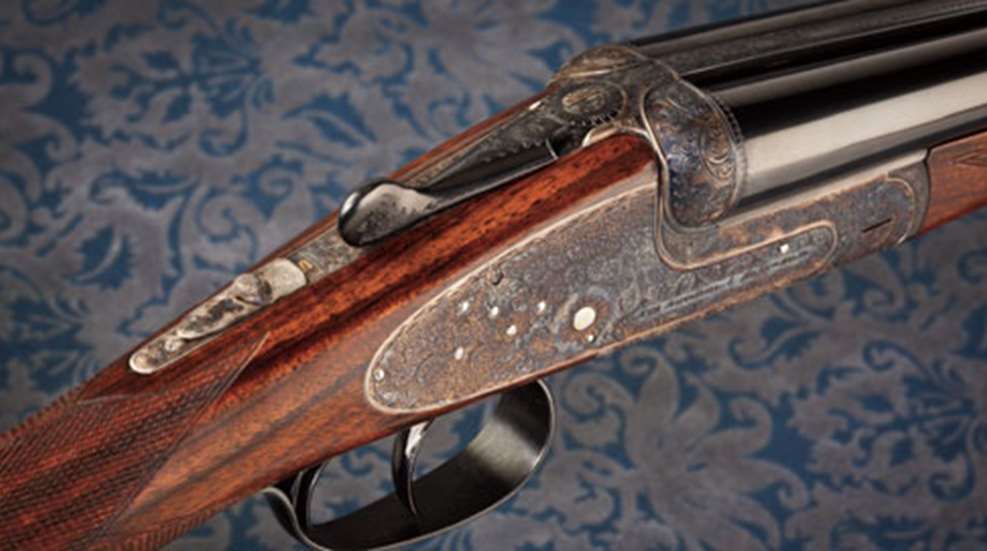
This No. 2 20 gauge is a sleek sidelock double. Sidelocks are an anachronism held over from hammer guns, but their advantages are several. The trigger pulls tend to be uniform and smooth, as they are on this No. 2. Perhaps their biggest advantage is the safety sear. Although it takes a pretty hard rap to cause a shotgun to fire when dropped, it happens. In the case of a fine sidelock, AyA’s are copies of Holland & Holland’s locks: The safety sear will hold the hammer, preventing an unintended discharge. Only when the trigger is pulled will both sears release the hammer. The locks have traditional leaf or “V” springs. This style of spring, although more prone to breaking than a coil spring, provides smoother trigger pulls and a faster lock time. If you break one, they are easy to replace provided you have a spring and a spring vise to compress the new spring as it is maneuvered into position. The exterior of the sidelock also provides a broad canvas for the engraver’s art. Unless special ordered at an additional cost, No. 2s are standard with traditional rose- and scroll-style engraving that is understated and elegant.
It’s so nicely balanced that few would not find it light between the hands. On the range we did the usual testing by shooting a number of Station 7 low skeet targets. These are simple straight-away birds, but they reveal defects in stocking or point of impact from poorly regulated barrels or an eccentric choke.
One of the peculiarities of side-by-sides is barrel flex. Over/unders are constructed like an I-beam and flex very little, but side-by-side barrels do, and that must be compensated for in stocking. Normally the comb of a side-by-side is slightly higher to offset flex, otherwise the point of impact can fall below the point of hold. AyA’s years of experience compensate well for this peculiarity. The barrels are of chopper lump construction that begins as separate forgings of the tube and the unshaped “lump” that are soldered to the opposite barrel’s lump and then machined and shaped to the hook and bolting recess. The unjoined barrels look like a meat cleaver, hence the name “chopper lump.” The barrels are topped with a typical game rib that lies between the barrels and follows their contour, terminating with a single steel bead. They lock up to the action with a double Purdey-style underbolt.
The barrels are beautifully polished and blacked, and the action and sidelock plates are casehardened in deep blues and brown hues. The trigger guard and other furniture are nicely blued or hardened. The oil-finished walnut stock has good figure, and the well-executed checkering on the grip, fore-end and butt is about 18-20 lines per inch. On the inside of the stock, the locks are cleanly inletted, and the stock appears to be well-headed up, ensuring years of service. Wood-to-metal fit throughout is excellent.
The traditional, wedge-style fore-end holds the gun together when joined and contains the selective ejectors, which are precisely timed. They simultaneously toss the fired cases as a pair to the same spot. The fore-end release is an Anson rod. Like the action, the finial is nicely hardened.
The breech face features removable bushings enabling the replacement of a broken firing pin or striker through the front of the action. Without the proper spanner and lots of luck, however, these bushings often deform and must be replaced and refitted to the breech face. It’s not work for an amateur to replace bushed firing pins.
The action was very tight, as it should be, so that it will work itself in with use. It is essential that a good lubricant, oil or grease be used, and above all the action should be closed or shut, never slammed.
In keeping with tradition, the No. 2 has double triggers. The front trigger is hinged. They provide an instant selection of choke and are extremely reliable. A single-selective trigger is available on order. Although not inexpensive, the AyA No. 2 is a bargain for a shotgun that will bring a lifetime of enjoyment.
Manufacturer: Aguirre y Aranzabal, Avenida Otaola,
Importers: AYA USA; (860) 388-3989
Action type: sidelock side-by-side shotgun
Caliber: 20 gauge (tested) also available in 12, 16, and 28 gauge and .410 bore
Trigger Pull: double triggers; front, 5 lbs., 10 ozs.; rear 5 lbs., 6 ozs.
Barrel: 28" choked R: 0.006" improved cylinder, L: 0.0125" modified, 2¾" chambers
Sights: single steel bead at muzzle
Stock: oil-finished checkered European walnut, length of pull: 14", drop at comb: 1½", at heel 2½", cast off 1/4"
Overall Length: 45½"
Weight: 6 lbs., 4 ozs.
Metal Finish: blued barrels and furniture, case-hardened action and lockplates
Accessories: None
Suggested Retail Price: $5,516 (price fluctuates with exchange rate)
Most Popular