Weight. That’s one of the reasons the United States military is so interested in the polymer-cased True Velocity ammunition. But how much a cartridge weighs—about 30 percent less than a similar brass-cased cartridge—makes little difference to most of us in the civilian world. I measured them on my RCBS scale, and the math was about right. But what does that have to do with me? No, it is the technology and performance of True Velocity Ammunition that interests me. As you can clearly see in the accompanying video, it has my attention.
You probably have heard that True Velocity is in the running for the US Army‘s Next Generation Squad Automatic Weapon program. It has a very interesting 6.8 mm TVC cartridge, recently accepted by the Sporting Arms and Ammunition Manufacturers’ Institute—we will no doubt hear more on the commercial side about that soon. But I am not directly involved in putting a belt of ammunition on a drone nor shipping containers of such belts around the world. Not my circus or monkey.
The company has a commercial vision that should and does matter to me. This is a step in the evolution of the cartridge case that is notable. Boxer-primed brass cases have ruled the roost for the better part of a century and a half, and rightly so. They work and they work great. We know how to make them, and we make them in high quantity and high quality. Nothing broken there.
We have had polymer cases before, even cases that were comprised of the propellant itself. G11, anyone? Voehre? (Look that one up). Those experiments resulted in interesting technology, but no serious commercial success.
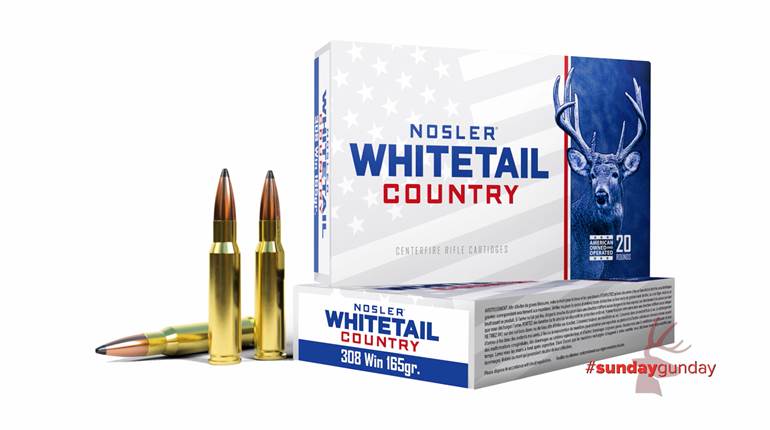
True Velocity is offering two .308 Win. Commercial loads, and I have been on the range with both of them. One is a 168-grain Nosler hollow-point boattail and the other is a 165-grain Accubond. Great bullets (you saw they were Noslers, right?) with a truly interesting case. A case that has a page and half of patents behind it.
True Velocity makes—with robots—a three-piece case in Texas. The case head is steel, which can handle more pressure than brass, while the rest of the case is polymer, made in two separate pieces. Unlike with traditional centerfire cases, with which there is nothing wrong, there are internal tolerances that can be controlled, in particular with the flash hole. Also, by molding the case, other tolerances can not only be held but can be optimized and powder charges reduced with the same velocities.
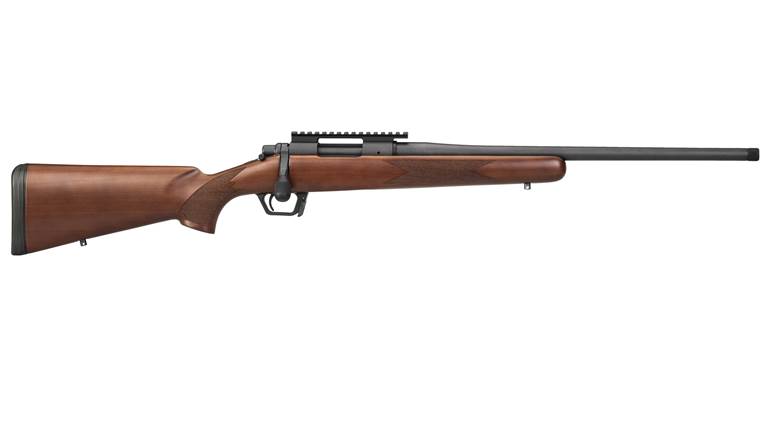
I had the opportunity to function fire the 168-grain Nosler match bullet through three different rifles. Before I would assign the story, I wanted proof of concept before devoting editorial time or resources to the project. This was over three sessions with three rifles. One was the Springfield Armory 2020 Waypoint, bolt-action, a Colt 901 semi-automatic and an old-school, scoped and accurized Springfield M1A. I did not initially have enough ammunition for an in-depth test, which will be forthcoming in the pages of American Rifleman. Commercially, the stuff was scarce when I shot it early in January, although I’m told that is no longer a problem.
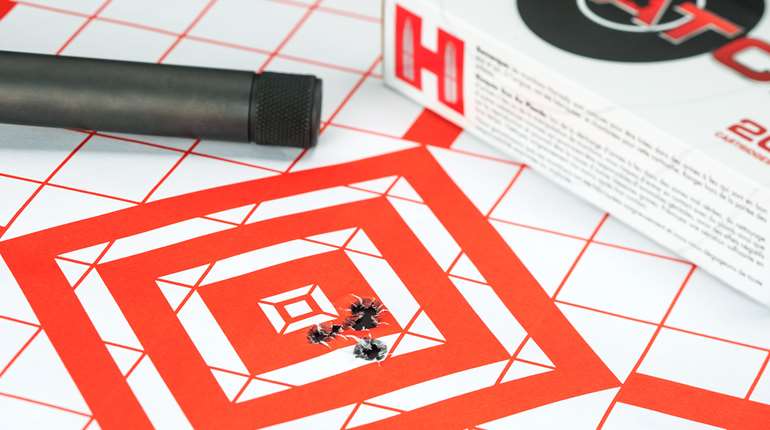
But here’s what I did note. With the Waypoint shot at a later session, my best five-shot group measured in at .348” at 50 yards. And while the Colt and M1A were more for function firing, neither of the two groups at 100 yards with either the 901 or M1A were over one minute of angle. With the M1A, it was closer to 3/4 of an inch.
Extraction was easier, as the polymer cases return to their as-molded original dimension—they only expand and contain the pressure of firing while gripping the chamber walls when pressures are at their peak. And there is lubricity to the case itself in both loading and feeding.
This ammunition delivered very low standard deviations, which is a contributor to accuracy—especially at long range—on par with top factory match loads and handloads assembled with weighed and sorted cases. Speaking of which, at the end of box of True Velocity, there are no premium brass cases waiting to be reloaded. Nope. These empty cases are headed straight for your recycling bin.
There is promise here. We will dig deeper in future more in-depth tests. This is premium-performing ammunition offered at, not surprisingly, at a premium price. I’m not giving up on or losing interest in traditional boxer-primed cases and ammunition, but I am keeping an eye on True Velocity.