Externally, Weatherby’s Vanguard Modular Chassis (VMC) rifle differs greatly from the Mark V rifles that gained the company fame back in the 1950s with blazingly fast magnum cartridges, but the new precision rifle carries on the manufacturer’s tradition of producing innovative and practical firearms.
Chambered in .223 Rem., .308 Win. and 6.5 mm Creedmoor, the VMC’s 6061 aluminum Modular Driven Technologies stock is designed to do a number of
things. Primarily, the part provides a supremely rigid frame to serve as the foundation for its Vanguard action and heavy, No. 3-contour barrel. There is no fluff, no furniture and hardly any material to impede the barrel’s cooling or influence its harmonics; to say the barrel is free-floated is understating the obvious. The stock’s integral fore-end enshrouds just enough of the bottom of the barrel to provide a rest point. The entire fore-end is skeletonized to allow airflow and to reduce weight from what would otherwise be a heavy hunk of metal.

The use of this chassis design for a tactical/target rifle makes a lot of sense because, besides hastening cooling, the fore-end absolutely will not contact the barrel regardless of how much pressure is applied, and it provides a forward stud for a bipod or a sling and holes for adding M-Lok rail attachments. The chassis is also lighter than most wood and vastly more rigid. While the fore-end doesn’t make the best platform for taking off-hand shots, target and long-range shooters will rarely have the need.
The minimalist fore-end maintains its 1.5" width all the way to the forward edge of the integral magazine well, where it angles down and rearward to become the action’s receiver. The VMC accepts AICS-pattern magazines, and the rifle comes with one 10-rounder. It’s released by a lever just ahead of the trigger guard. Two screws secure the action firmly in place via the integral recoil lug that nestles into a corresponding slot in the chassis. Strangely, the front action screw is a Torx type, while the rear requires a standard Allen wrench.
A scalloped machining cut forms the integral trigger guard, and within this rests the rifle’s excellent two-stage trigger. Once the slack is taken up, the trigger breaks at 3 lbs. Obviously, Weatherby knows the benefit of a great trigger, and focused its effort on installing a good one. The pistol grip is AR-15-spec, but the one that comes on the rifle is the rubbery, finger-groove version from Hogue.

The receiver terminates much like the receiver of an AR-15; it is wrist-less and ends in a 90-degree metal face. This face provides the anchor for the Luth-AR MBA-1 polymer buttstock.

The height of the stock’s cheekpiece can be adjusted via one oversize thumbscrew, and the length of pull of its rubber buttpad can be altered in the same way. The belly of the buttstock is injection-molded to form an underhook for the support hand while shooting.
Regardless, a chassis rifle is only as accurate as its action, and the Vanguard’s action was introduced in 1970 and has since been proven tough, accurate and relatively inexpensive. The bolt features two locking lugs and a fluted body. The push-feed bolt features a plunger-style ejector and a Remington Model 700-style extractor. All rounds we fired fed smoothly and ejected with authority. Testers were particularly impressed with how easy it was to work the bolt, and that’s important for a target rifle. The action features a two-position safety on the rear right side of the receiver and a bolt-release button on the left. It has a silver cocking indicator on the back of the bolt.
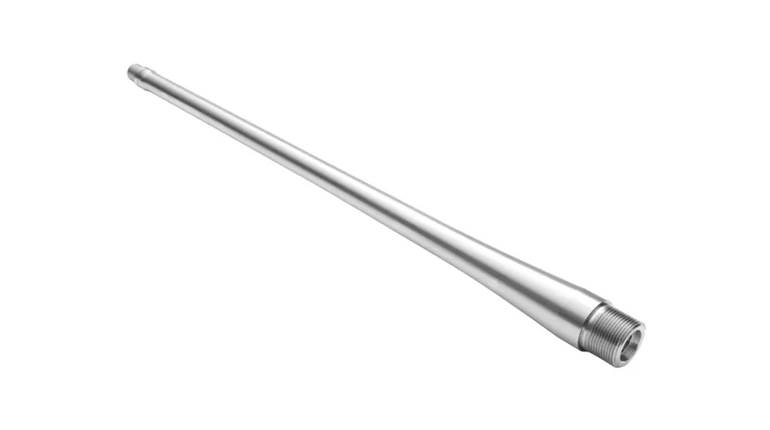
The barrel measures 20" for all three chamberings offered, and our .308 Win. test gun features 1:10" twist rifling. The button-rifled barrel measures 1.19" at its thickest and 0.75" at its recessed crown. We only wish it had been threaded at the factory for a brake or a suppressor.
The rifle recorded several sub-m.o.a. five-shot groups with Remington’s Premier Match ammunition, although it did not seem to like the Black Hills 168-gr. load. Groups did tend to shrink the more we fired it, however, indicating that the barrel would likely benefit from a proper break-in period.

All told, Weatherby’s Vanguard Modular Chassis is an interesting option for those considering the purchase of a precision rifle, and it carried in the field better than we would have expected. While the VMC may look radically different than the rest of the company’s product lineup, it’s still a Weatherby.

Most Popular