Collectors and dealers frequently confuse the FN Browning Vest Pocket, Baby Browning, Model 1905, and Model 1906 pistols by misidentifying two distinct FN Browning pistols.
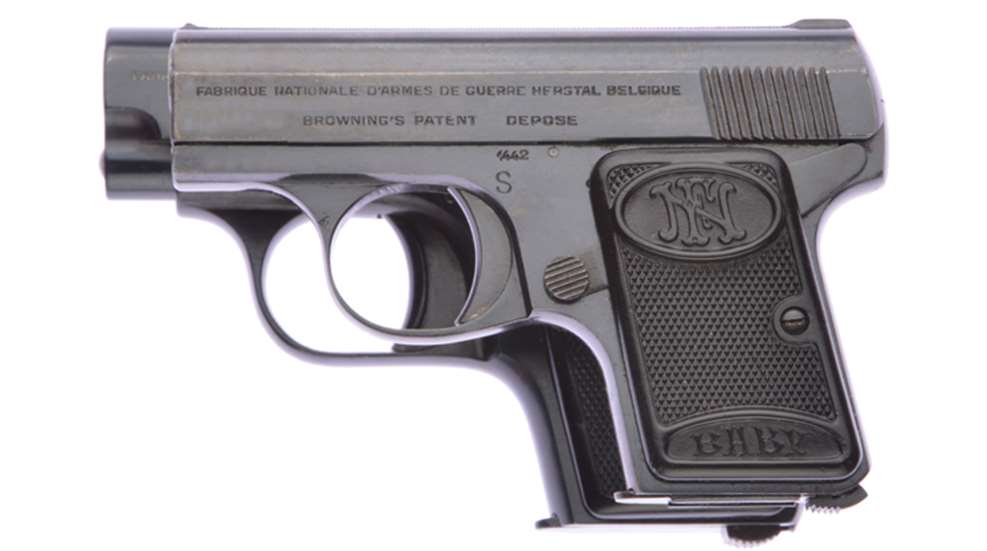
The FN Browning Model 1905, Model 1906, and Vest Pocket are all terms denoting the same model. The small pocket pistol was first patented in 1905 and production started in 1906. In the United States, it is often referred to by its patent year, Model 1905. In Europe, it is more commonly known by the year it was introduced as the Model 1906). Dealers often distinguished it from the FN Browning Model 1900 by cataloging it as Modèle de Poche (pocket pistol). The name was appropriate, as the pistol is a perfect fit for the small coin pocket of a gentleman’s vest. Vests and coats used to be standard business attire: each vest had two small pockets, one for a watch with chain and fob, another for coins.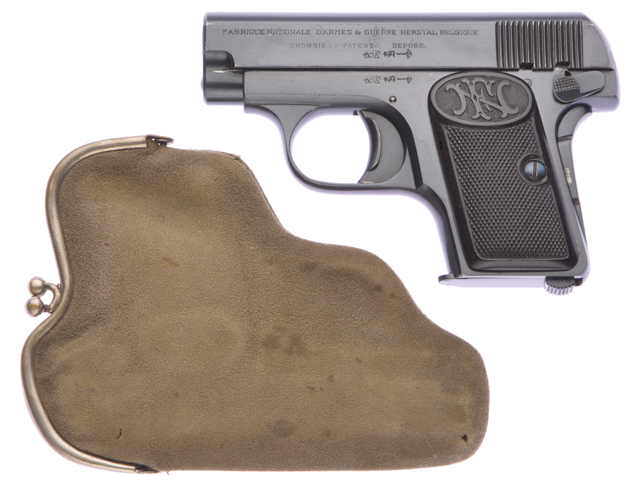
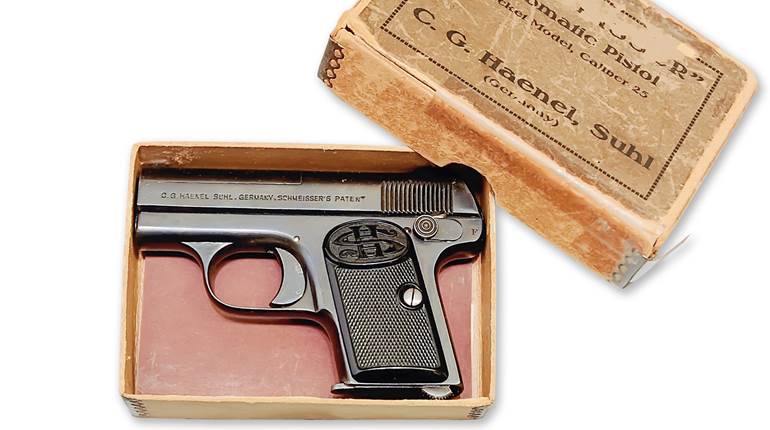
The FN Browning Model 1905 with vest pocket holster
Pocket pistols created a market for a much-needed accessory, and small fitted chamois holsters were manufactured and supplied by many outfitters. The holster kept oil from getting on business suits, and it kept coins from hitting the pistol. The clasp of these small holsters gave it the name of “coin purse holster.” With this term arose the modern misconception that these were women’s accessories. While women did use these holsters, they were predominately made to protect men’s vests.
Fabrique Nationale d’Armes de Guerre in Herstal, Belgium, did not hesitate to put the small Model 1905 on the market, expanding on the successes of the FN Browning Model 1899 and 1900 pistols. It was the third Browning pistol model manufactured at FN. This did not go unnoticed across the Atlantic. Colt’s had been trailing FN in commercial sales of Browning pistols. Colt’s quickly asked John Browning to forward his prototype. As agreed, FN forwarded the prototype to Colt’s. This was the first Browning design that would be shared by both companies. 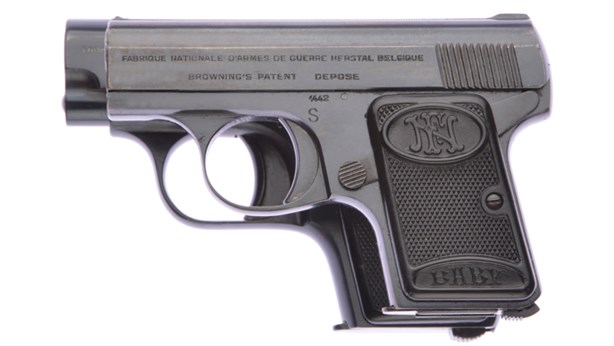
A size comparison between the Model 1905 Vest Pocket pistol (bottom) and the significantly smaller Baby Browning (top).
Colt’s followed suit and launched its version, the Model N, in 1908, and it is commonly referred to as the Colt Model 1908. Prior to that year, the cartridge was only known by its European designation of 6.35 mm, however once Colt’s got the model to market, the cartridge became known as the .25 ACP (Automatic Colt Pistol). Fabrique Nationale did not copy the Colt Model 1908 as is often reported, nor did Colt’s copy FN’s pistol. Both were conceived from the same Browning prototype.
While FN strictly adhered to John Browning’s designs, Colt’s took a more liberal approach, adding or modifying features on production pistols. Colt’s integrated the slide safety of John Browning’s earlier prototype for the Model M (Colt’s Model 1903). Fabrique Nationale took note and added a slide safety on its Model 1905. It is one of the few times Colt’s influenced FN production. The FN’s slide safety was added around 1909. Collectors refer to early pistols without slide safety as the first type, while those with slide safety are called the second type.
After World War I, a movement started in Germany to conceive even smaller pocket pistols. Pistols like the August Mann, Walther Model 9 and Menz Liliput entered the export market. It was not a serious threat to the sales of the FN Browning Model 1905, but FN’s Chief Designer, Dieudonné Saive, took on the initiative to design a smaller and slimmer 6.35 mm pistol. He conceived the model around 1927, and FN planned to start production in 1929. FN had owned the Browning trade name since 1907 and named it the “Baby Browning,” although John Browning had passed away and was never involved in the project.
At the time, the idea of small 6.35 mm pistols was trickling over to Belgium and the Robar company was also involved in developing its version, the Reduced Size Melior (Modèle Réduit) pistol. The Melior pistol beat the Baby Browning to market and was introduced in 1929. The stock market crash changed FN’s plans to put the Baby Browning in production, and the decision was made to delay it until the economy improved. Fabrique Nationale’s management was not convinced the Baby Browning would be a success, as it viewed these small pistols as nothing more than a fad. When the Baby Browning went to market in 1931, sales figures were disappointing, and the Baby was eclipsed by the steady and strong sales of the Model 1905.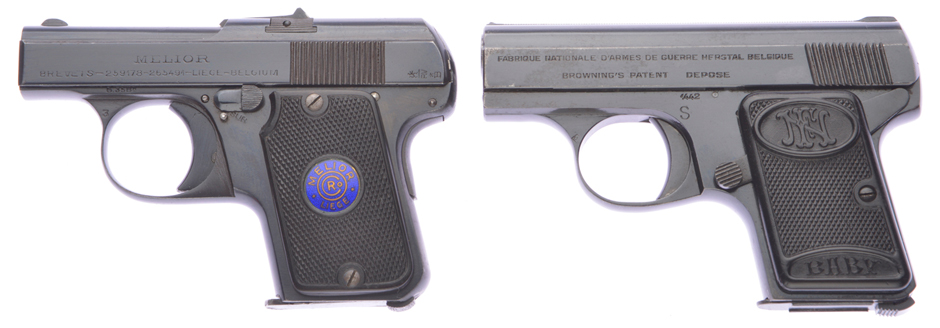
A first year production Baby Browning (1931) with its contemporary competitor, the Reduced Size Melior pistol.
From the onset the pistol was called the “Baby Browning” worldwide: It was never referred to in Europe as “le bébé” and this so-called French language term is a U.S. fabrication. FN offered the FN Browning Model 1905 and the Baby Browning until the German invasion of 1940.
After World War II, FN reintroduced both models in its catalog. It was a test to see which design would create most interest. While production of the Baby Browning started over, the FN Browning Model 1905 did not, and only a handful of pistols were assembled from pre-war parts. Demand for the old Model 1905 had dwindled. The 1950 catalog is the last year the Model 1905 is mentioned.
The Baby Browning became a sensational sales success in the United States after the Browning Arms Co. decided to carry the pistol in the 1950s. Importation ceased in 1968 due to the Gun Control Act. FN Herstal continued to produce the small pistol through the 1970s, even though its heyday was over. Production was moved to France in 1980 after FN acquired Manufacture d’Armes Bayonne (MAB), however the end for the model was near and production ceased shortly afterward. The Baby is currently made in the United States by PSA, Inc. 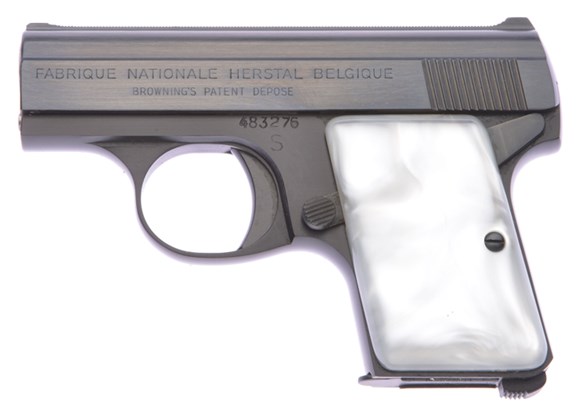
A 1975 produced Baby Browning with upgraded factory synthetic grips, near the end of FN production.
The two models do not share any parts or accessories and both have distinct historical backgrounds. Both models were predominately sold as commercial guns but were also purchased by military officers and law enforcement detectives worldwide. It is important to distinguish the models and properly identify them.
References: FN Browning Pistols, Sidearms that Shaped World History by Anthony Vanderlinden
Most Popular