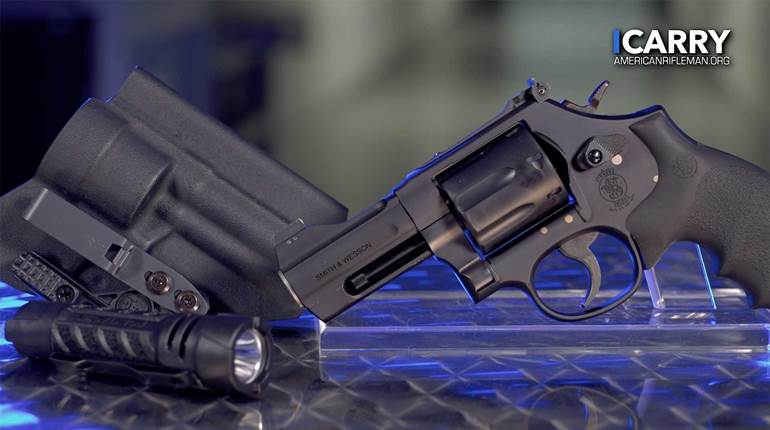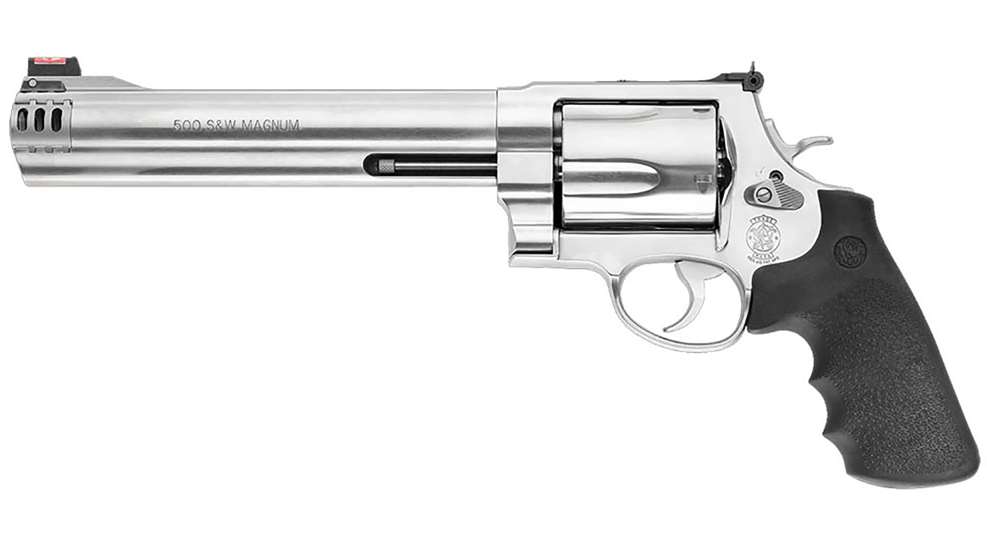
It didn’t take long for the industry to understand what it was witnessing at the 2003 Shooting, Hunting and Outdoor Trade Show. The Smith & Wesson 500 unveiled there was, and is, the biggest production revolver made, ever. It features the company’s massive X-frame, which was also new at the time. Constructed from stainless steel, and beefy in all the right places, everyone understood this five-shot handgun was meant to channel some serious energy downrange.
At the same event the company also introduced the new cartridge it chambers—the .500 S&W Magnum. The combination put Smith & Wesson back atop the “most powerful handgun in the world” throne, a title it involuntarily surrendered back in the 1960s. The company went back to reigning champing with convincing style.
Make no mistake about it, the revolver and cartridge are a powerful combination. Muzzle energy from a fired .500 S&W Magnum round measures 2,868 ft.-lbs. of energy when topped with a 300-grain bullet, comparable to a 1-oz. slug fired from a 12-ga. shotgun.
The idea for the powerhouse began in 2002, when Smith & Wesson’s Handgun Production Manager Herb Belin collaborated with Peter Pi at Cor-Bon to create the cartridge. Its 0.50" diameter made it a challenge, a story we’ve covered before, along with how a revolver capable of safely handling it came about.
Handling this kind of power isn’t everyone’s cup of tea, but sales have remained brisk since its introduction. Today there are two base models available that boil down to a choice between a 4" or 8.38" barrel. The shorter version wears red-ramp sights, while the latter is offered with a choice of interchangeable iron sights (standard or red fiber-optic HiViz).
Regardless of model, the single- and double-action revolvers and their barrels are built from stainless steel with a satin-stainless finish. Each gun ships with a pair of interchangeable muzzle compensators or brakes (available on the larger version) to tame recoil. A generous synthetic grip aids that mission.
With the 4" barrel, overall length comes in at 10.25" and it tips the scales at 55.6 ozs. MSRP is $1,409.
The longer models measure 15" and weight either 69.1 or 71.4 ozs. MSRP is $1,339 or $1,409, depending on sight choice.
Smith & Wesson also offers models from its famed Performance Center. Naturally they receive all the tuning and special touches the division is renowned for, but they also ship with a chromed hammer and trigger. Barrel lengths available include 3.5", 7.5" and 10.5". Sight options include orange ramp or fiber optic and MSRPs run from $1,639 to $1,699.
Most Popular