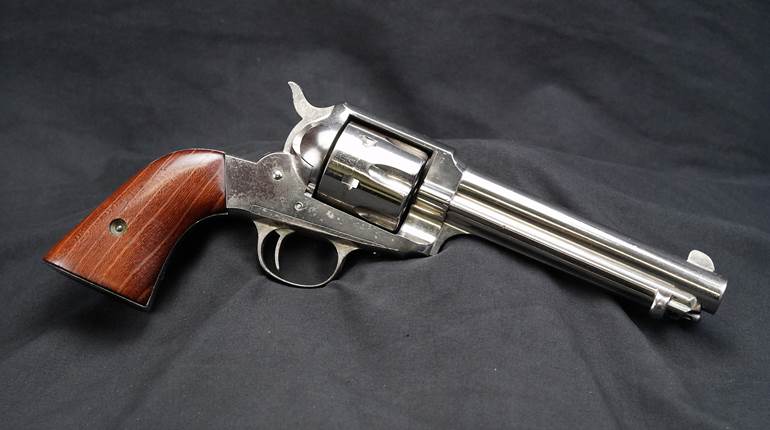
Although it looks like a stock gun, the author’s Ruger New Model Blackhawk features a half-cock loading notch, a grooved trigger and enhanced front and rear sights—all done in his quest to find the perfect single-action.
It should come as no surprise to anyone who has read my articles over the past four-plus decades that one of my all-time favorite handguns is the Colt Single Action Army. Ergonomically shaped, classic in form and function, and rugged enough to still be fired with parts missing, the Model P has not only survived the advent of double-action and semi-automatic handguns, but having been discontinued twice, was brought back both times by popular demand.
Nostalgia and durability aside, the single-action owes much of its resiliency to being adaptable to a wide variety of chamberings, ranging from .22 rimfire to .476 Eley. Plus, the same gun can easily be converted to compatible cartridges by simply swapping out fitted cylinders of similar calibers, such as a .45 Colt SAA with a .45 ACP cylinder—a service the Colt Custom Shop still offers—and that has also proven popular in Ruger’s Blackhawk with its .45 Colt/.45 ACP and .357 Mag./9 mm Luger combos. By comparison, switching cylinders in a double-action revolver is no easy task. And, of course, single-actions have no semi-automatic hiccups like stovepiped cases or failures to feed. Therefore, one could almost say the single-action revolver was perfect—but not quite.
As much as I admired the Peacemaker, and having owned and shot numerous first-, second- and third-generation guns ranging from Sheriff’s Models to Buntlines, I concluded there was room for improvement in the Model P and its clones, which started me on a perpetual search for the perfect single-action. But don’t blame me for scrutinizing one of the most recognizable and collectible handguns in the world. After all, Elmer Keith started it. On pages 102 and 103 of the second edition of his seminal book, Sixguns By Keith, there are photos of no fewer than 12 different Single Action Army revolvers that Keith had altered—primarily involving their hammers, topstraps and sights—in his ongoing quest to achieve perfection in a gun he unquestionably admired. “The S.A.A. is one of the best-balanced and easiest handled of 6-guns,” he acknowledged in the April 1929 issue of The American Rifleman, in an article entitled “The Last Word,” one of his earliest published pieces for this magazine. He then went on to describe how he felt the iconic Peacemaker could be improved.
“The regular S.A.A. back strap, while by far the best shaped of any on the market … does not come up as high in back as it should to completely fill the hand.” Keith also noted, “I had long wished for a wide trigger instead of the narrow S.A.A. one placed in the left side of the guard.” Other improvements he outlined in that article included a thicker “flattop” topstrap, adjustable front and rear sights, and a lowered hammer spur. All those attributes had merged into the very gun that was photographed in the article, and its existence was due, in large part, to another man who shared Keith’s search for the perfect single-action.
Keith’s wishful writings had previously caught the imagination of a Philadelphia gunsmith and fellow SAA-tinkerer named S. Harold Croft, who, after visiting Keith at his ranch in Durkee, Ore., offered to help Keith create his dream gun. With Keith calling the shots, so to speak, the idea for the perfect SAA took form. In addition to Croft’s gunsmithing skills, famed riflemaker Reginald F. Sedgley built up the frame, Neal K. Houchins created the sights and J.D. “Doc” O’Meara dovetailed and brazed a Bisley hammer spur onto an SAA hammer (you can’t simply drop a Bisley hammer into a Single Action Army frame, as the Bisley’s frame is deeper and the screw positions are different). The end result was the revolver described and depicted in the aforementioned article.
Astute readers will recognize it as the now-famous .44 Special/.44 Russian-chambered Keith No. 5 (so-named because it was the fifth Colt Single Action Croft had modified). A beefy, dramatically reworked SAA, Keith would end up using it extensively for the next 25 years, re-bluing it at least twice and eventually having it engraved (ostensibly to cover up years of nicks and dents) and restocked, as O’Meara’s original walrus ivory stocks had shrunk. At the time, the No. 5 was the culmination of Keith’s search for a perfect single-action, although he went on to alter numerous other Peacemakers, often with a variety of sights and lowered or offset “cockeyed hammer” spurs from the no-longer existing King Gun Sight Co. of San Francisco.
Like Keith and others after him, I had become obsessed with seeking perfection when it came to the Single Action Army, but the furthest I had ventured was having the actions professionally tuned into silky smoothness with 2-lb., 8-oz., trigger pulls and slightly tweaking the barrels in the frame to bring the guns on target (most SAAs shoot to the left). Interestingly enough, while visiting the Uberti factory in Italy, I saw this same “barrel tweaking” technique applied to single-action revolvers for Cimarron Firearms. And similar to the action work I had done on my Peacemakers, Cimarron now offers a “Cowboy Comp U.S. Action Job” for an extra charge on its Model P and Thunderer guns, which includes an improved U.S.-made mainspring and trigger-bolt spring (the parts most likely to break on a single-action revolver), adjusting the trigger pull, de-burring internal surfaces and timing the action. This “competition ready” action job is included on the company’s Arizona Ranger and Thunderstorm models.
Because they exude an Old West ambiance and simply feel good in the hand, I had my most-used Colt single-actions fitted with two-piece staghorn stocks (this was before India stopped exporting Sambar stag, causing prices to escalate dramatically). Anything more than those rather modest alterations I felt ran the risk of encroaching on the potential collectability of the classic Model P. Replicas and clones, of course, would be fair game and, in fact, a little customizing might increase their value, much as stock M1911s transformed into race guns often command higher prices.
I had long ago decided that the ideal barrel length for a Colt single-action was 4¾", as it provides the perfect combination of physical appearance and balance. Although I still occasionally pack a 7½"-barreled SAA due to its slightly greater pointability and bullet velocity, I have eschewed the 5½" barrel entirely, as it always struck me as a compromise—and I hate compromises.
That’s why I was intrigued that Keith had selected a 5½" barrel for his No. 5. Consequently, I welcomed the opportunity to personally inspect the gun at the Las Vegas Antique Gun Show, prior to its being auctioned off on March 15, 2015, by James D. Julia Auctioneers (now a division of Morphy Auctions), where it fetched a winning bid of $80,500. I found the thick, carved ivory stocks and the slightly swelled shape of the altered Bisley backstrap were a little too bulky for my medium-size hands, but then I recalled that, when I first shook hands with Elmer in 1974 at the old Guns & Ammo offices on Wilshire Boulevard in Los Angeles, his hands were slightly larger than mine.
But the No. 5 itself balanced perfectly. However, as I held it, another gun flashed into my mind: the Ruger New Model Blackhawk Bisley.
Back in 2009, while attending SHOT Show, Jason Cloessner, vice president and product development manager for Lipsey’s—one of Ruger’s largest distributors—showed me a limited run it was launching of the Ruger Blackhawk Bisley chambered in .44 Spl. and built on Ruger’s mid-size XR-3 frame. Needless to say, I bought my Lipsey’s .44 Spl. test gun with its 4 5⁄8" barrel. (The .44 Special Blackhawk proved to be so popular that it has become a regular, albeit limited, part of the Ruger line).
But after putting hundreds of rounds through it over the years, I found myself shooting it less and less, as the black-on-black front and rear sights had become progressively harder for my aging eyes to see. Plus, after so many years of shooting SAAs and their clones, I occasionally had muscle-memory issues when I started to reload my New Model Bisley by automatically attempting to pull the hammer back to a non-existent half-cock position instead of simply flipping open the loading gate to free up the cylinder. Now, inspired by Keith’s No. 5, I thought it might be interesting to try and bring my New Model Bisley a little closer to what Keith considered to be “The Last Word” in single-actions—but with a few 21st-century updates.
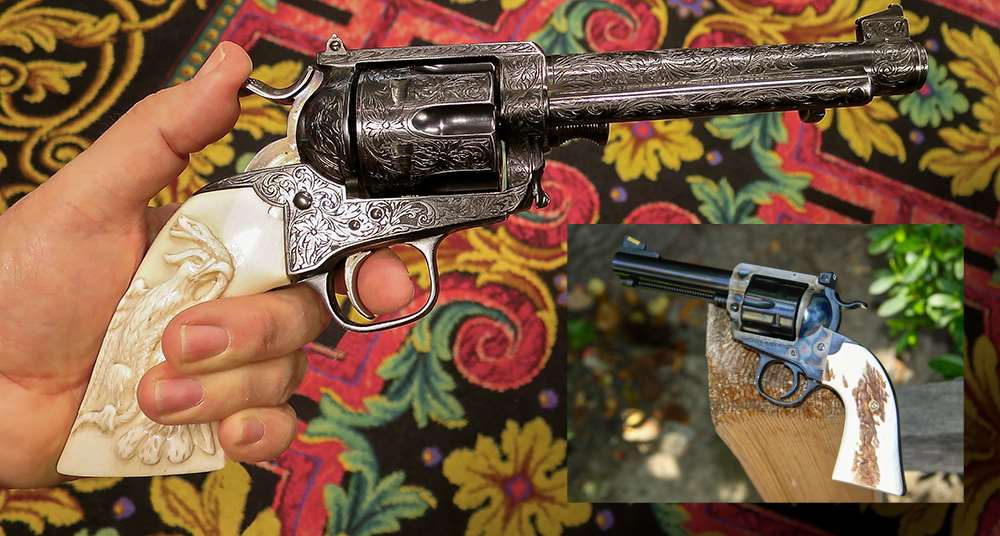
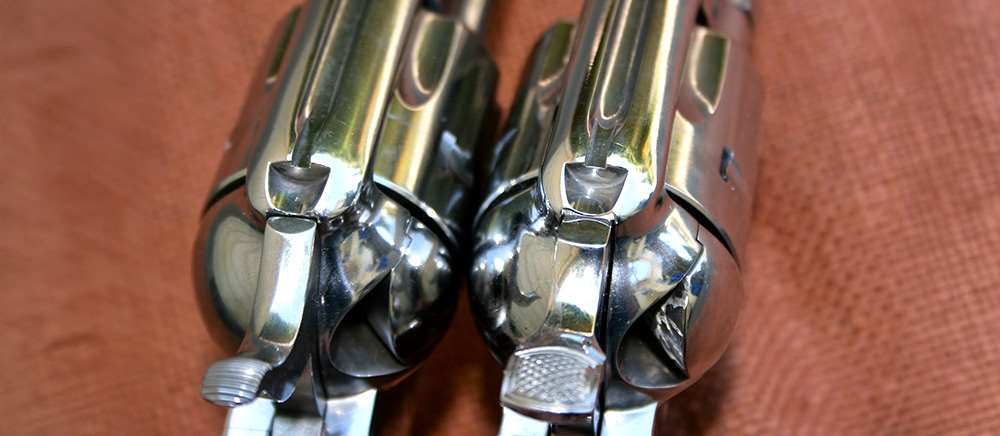
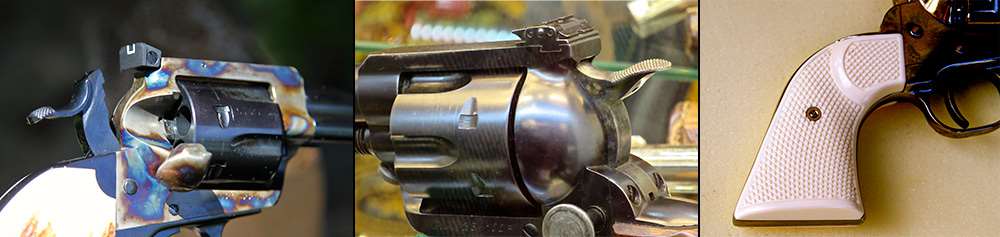
Obviously, the members of Keith’s innovative group of gunsmiths are no longer with us, but today we have some equally fine firearm craftsmen and companies. For example, for those Ruger Blackhawk Bisley owners who want to replicate Keith’s original No. 5 backstrap and trigger guard/grip frame setup, an excellent Keith No. 5 two-piece grip frame kit (purposely made slightly oversized so it will require some gunsmithing skills for installation), plus a separate Keith trigger and Bisley-style hammer, are available from Grandmasters (powercustom.com). Additionally, RW Grip Frames (rwgripframes.com) makes a one-piece brass or aluminum assembly that closely approximates the original two-piece No. 5 grip shape. But, in my case, I opted to stay with the more comfortable (for me) Ruger Blackhawk Bisley backstrap. However, I immediately contacted Hamilton Bowen of Bowen Classic Arms Corp. (bowenclassicarms.com) and ordered its Ruger Rough Country Rear Sight with a square, white-outline notch. To complement this, I had gunsmith Andy Horvath fine-tune the action to achieve a 2-lb., 8-oz., trigger pull, install a Wolff 30-oz. Reduced Power Trigger Spring, a Wolff 14-lb. Reduced Power Hammer Spring and a Wolff extra-power pin latch spring (gunsprings.com). The latter was included as added insurance against the cylinder base pin moving forward in the frame under recoil—and a less expensive option to Sedgley’s original locking, hourglass-shaped base pin on Keith’s No. 5.
I also had Horvath pair up the Bowen Rough Country Rear Sight with a thick brass front-sight ramp insert (gold was too expensive). I then contacted Randall Power at Grandmasters and ordered one of its Ruger Power Hammer & Trigger kits, so that my Ruger could be loaded via either a traditional half-cock or by flipping open the loading gate, giving me the best of both worlds. Finally, I had Horvath install a reverse pawl from Grandmasters, which enabled the cylinder to spin either clockwise or counterclockwise for quicker loading and unloading, should I inadvertently pass up a selected chamber. With the reverse pawl, there’s no need to make another complete turn of the cylinder (Ruger has since incorporated a somewhat similar “Reverse Indexing Pawl” on its New Model Vaqueros and Blackhawks). Many of the above-listed parts, with the exception of the No. 5 grip frame, are also available at MidwayUSA and Brownells, as well as from the original suppliers.
With everything installed and running smoothly, I sent my near-perfect Ruger to Doug Turnbull at Turnbull Restoration (turnbullrestoration.com) to caseharden the frame. Then, finally, Raj Singh at Eagle Grips (eaglegrips.com) fashioned a pair of elk horn stocks that, besides being distinctive looking (and less expensive than staghorn), keeps the Bisley well-anchored during recoil. However, if you have a Ruger Vaquero, a more cost-effective upgrade is the new “Reactiv Checkered” Gunfighter Grips from Eagle Grips, which feature a vastly improved flat-topped (i.e. no sharp peaks) full-coverage checkering pattern that makes the gun feel like it’s cemented to your hand.
All of these changes would be meaningless if they didn’t translate into enhanced performance. That meant my reworked Bisley had to prove itself in what became a baptism of fire. For that ultimate test, I took my tricked-out New Model Blackhawk Bisley to Gunsite Academy (gunsite.com) in Paulden, Ariz., the well-known firearm training facility started by the late Jeff Cooper that has become one of the preeminent hands-on venues for law-enforcement and military personnel, as well as law-abiding citizens who want to become more confident and proficient with their firearms.
I had previously taken Gunsite’s basic 250 self-defense-pistol course numerous times with various M1911 Government-style semi-automatics and double-action revolvers, but Gunsite had recently inaugurated a Single Action Defensive Pistol Class. I immediately signed up for what involved numerous outdoor live-fire exercises, combining natural terrain with defensive-shooting skills, which included tactical reloads (quickly replacing fired rounds to prevent ending up with an empty gun) that, with a single-action, require a little more hand coordination than simply dropping and inserting a magazine or using a speedloader. The targets we engaged ranged from 7 to 25 yards. After three non-stop days and 350 rounds of Black Hills and Hornady .44 Spl. factory ammunition, the Bisley emerged victorious and the topic of many favorable comments.
I know what you’re thinking—all of these “improvements” ended up costing me more than the gun. True, but that was the price I paid in my search for the perfect single-action, and you can’t put a price on perfection (or so I told my wife). But for those who want to start their quest for perfection on a less expensive platform, possibly combined with a reason to acquire another single-action, the new full-size Taurus Deputy, available in .45 Colt or .357 Magnum and in either 4¾" or 5½" barrel lengths, is priced less than the cost of a mid-range laptop. It sports a polished black finish and features a transfer bar, which means it can safely carry six rounds.
At the opposite end of the spectrum, I have long held a semi-proven theory that engraved guns are more accurate, as they put pressure on the shooter to do well, especially when his buddies are watching. To prove this point in my search for perfection, I gathered up my credit cards and had American Gun Works in Glendale, Calif., order a Single Action (that’s what the company calls it) from Tony Galazan’s Standard Manufacturing (a division of his Connecticut Shotgun Manufacturing Co.) with a 4¾" barrel (5½" and 7½" barrels are also available) in .45 Colt—their basic chambering—with C-coverage engraving, the only level available aside from the regular nickeled or blued and casehardened guns.
Internet rumors aside, this gun is completely made in Galazan’s New Britain, Conn., factory and all parts are CNC-machined out of solid blocks of 4140 chrome-moly steel. The guns are hand-assembled using Wolff springs and tested for timing and function. The result is a mirror-image of the Single Action Army priced on par with the Peacemaker, but, of course, without Colt’s collectability. Nonetheless, with an original owner’s lifetime guarantee, this is one of the most solidly built single-actions I have shot. Moreover, proving my theory, it shoots precisely to point of aim at 25 yards, right out of the box.
“We tweak and twist the barrel to get the point of aim correct,” Tony confirmed. “My goal was to make a single-action unlike all the other guns on the market.”
Those same sentiments could very well have been uttered by Bill Ruger or Elmer Keith, whose No. 5, by the way, was auctioned for a second time on Sept. 11, 2021, and this time by Rock Island Auction, where it fetched a whopping $253,000—which proves that the search for the perfect single-action can be rewarding in more ways than one. Elmer was fortunate in being able to have his vision of a perfect single-action turned into reality. By comparison, every gun in this article possesses one or more attributes that elevate it closer to single-action perfection. Yet I still find myself wishing someone would remake the King Cockeyed Hammer or produce a front sight with aiming serrations for different elevations or … . So, for me at least, the search for the perfect single-action continues.