Sometimes, you just need to start from scratch. Most modern sporting rifles for sale in the U.S. are based on the AR-15 design. While the AR-15 has stood the test of time and is surprisingly modular and versatile for its age, the platform has its limitations. Primary Weapons Systems (PWS), best known for its long-stroke, gas-piston AR rifles, chose to go blank slate when it came to meeting the needs of the modern rifleman. The result is the User Xchangeable Rifle (UXR), an innovative, ergonomic and modular firearm that is capable of easily switching between different cartridges and magazine formats.
The UXR action uses what PWS calls a “modified long-stroke gas system.” The bolt carrier has an extension on it, but there is a separate piston rod that moves about an inch rearward to complete the unlocking process before the bolt assembly continues to cycle under its own inertia. Its three-position gas block can be adjusted for normal, suppressed and “adverse” conditions via an access window in the front of the receiver. The square bolt carrier, with a spring-loaded recoil-management buffer at its rear, houses a seven-lug bolt that rotates via a cam pin working in a track in the carrier.
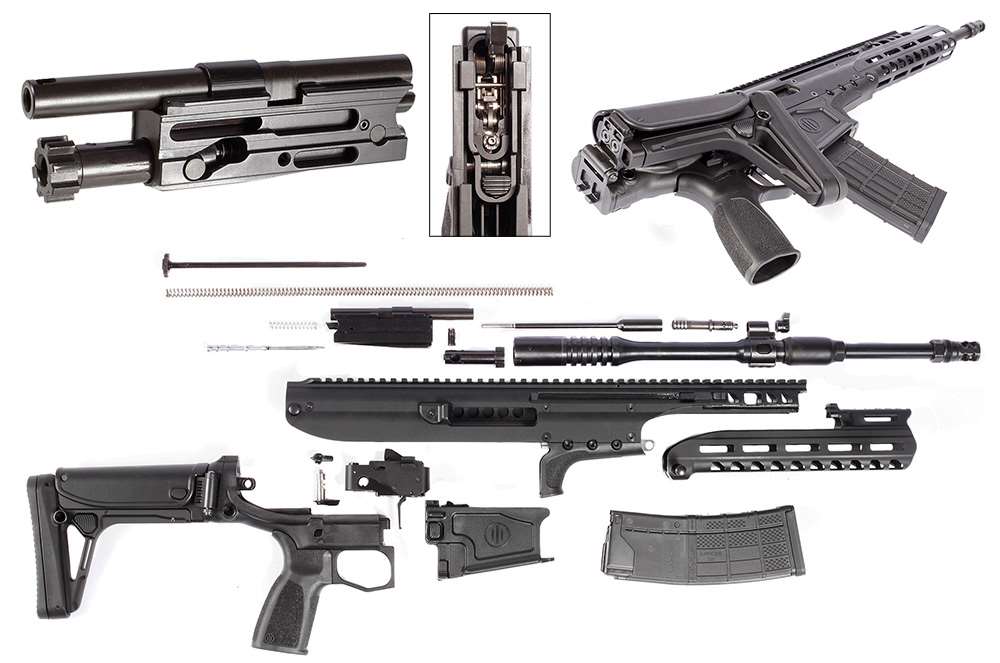
The part on an AR-15 that is unserialized and called the “upper receiver” is the serialized “main frame” of the UXR system. It is made of forged 7075 aluminum alloy and has stainless steel bolt guides and a titanium trunnion, into which the barrel mounts. On the receiver’s top is 18 inches of MIL-STD-1913 rail for mounting optics. The aluminum handguard slides into rails on the receiver and mounts securely with a captured pin. It features M-Lok attachment points at the 1-, 3-, 6-, 9- and 11-o’clock positions.
The UXR’s barrel is made of 41V50 steel with a medium profile and its muzzle is threaded to 1/2x28 tpi. PWS got its start making compensators, and the UXR uses a two-port FRC design with external threads compatible with the Rearden Atlas suppressor-mounting system. In front of the gas block is an evacuation chamber. Borrowing technology from tanks, the system consists of an additional set of gas ports surrounded by an expansion chamber. When a cartridge is fired, the chamber is pressurized as the bullet passes these ports. Once the bullet leaves the barrel, the chamber depressurizes to atmosphere, taking residual gas out of the muzzle. This device aids in reducing rearward pressure and gas into the action, particularly when the firearm is suppressed.
What would be called a lower receiver on an AR-15 is a polymer trigger housing and separate magazine well on the UXR. Though nearly all parts of the UXR are proprietary, two notable exceptions that are AR-compatible are part of the trigger housing—the pistol grip and the fire control unit (FCU), which is supplied by TriggerTech and is user-adjustable between 2.5 and 5 pounds. Despite using AR components, the FCU is contained within a metal trigger pack that can be removed from the housing once the bilateral safety has been removed. The rails on the trigger pack connect the trigger housing into the receiver. The magazine well, containing the magazine release and bolt catch, is also a separate polymer unit.
The UXR’s claim to fame is its ability to switch between cartridges, most notably between small-frame ones, like .223 Rem. and .300 BLK, and those in the large-frame category, including .308 Win. and 6.5 Creedmoor. It can also switch between magazine types, from AR-type magazines that insert straight into a magazine well to “rock and lock” magazines, like those used on AK-type rifles. The Xchange conversion involves changing the barrel (held in place by three clamping screws), the piston rod, the bolt and the magazine well if necessary. The rifle uses a universal recoil spring and bolt carrier. Parts for a specific cartridge are coordinated and clearly marked with a dot system. Conversion kits cost $600, plus $150 for the appropriate magazine well, if required. Barrels and handguards can also be exchanged for shorter versions within the same cartridge. PWS is currently offering .223 Wylde (a chamber dimension optimized for both 5.56 NATO and .223 Rem. cartridges), .300 BLK and .308 Win. rifles and conversions, with promises of future availability of other cartridges, including 6.5 Creedmoor, 7.62x39 mm, and 6 mm ARC.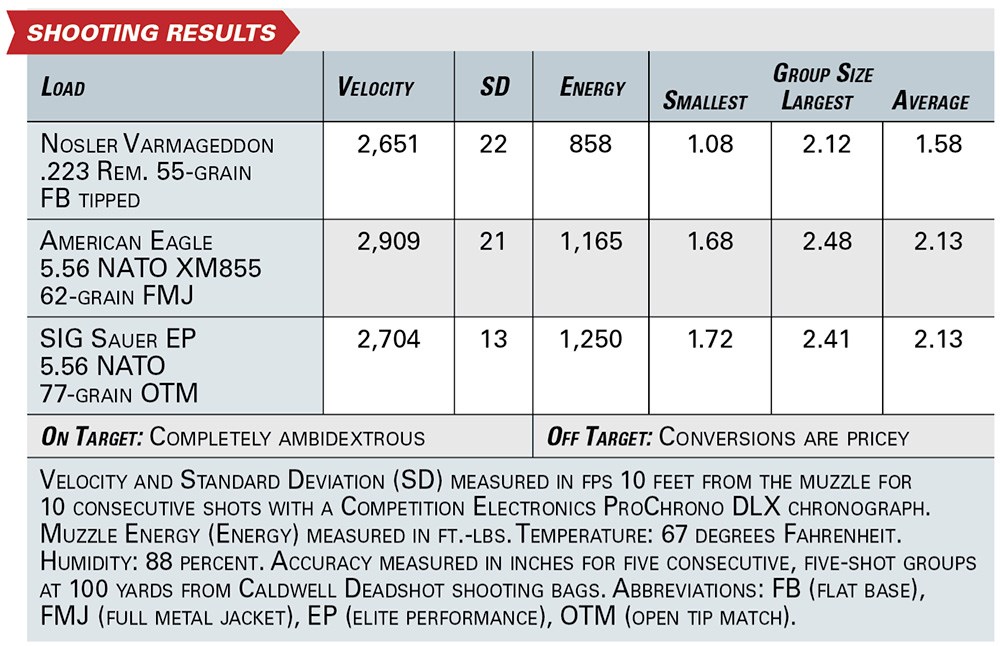
The human interface of the UXR is well thought-out and intuitive. Controls are fully ambidextrous, with a safety lever, magazine release and bolt release mirrored on each side of the rifle. All three can be reached without shifting the firing grip. The non-reciprocating charging handle is mounted forward, folding when not in use, and can be switched to either side without tools. Despite housing a gas-piston system, the handguard is slim and easy to grip, and it narrows at the forward end to provide space for a thumb over “C-clamp” hold.
As PWS expands and refines conversion options for the UXR, the system can potentially allow a single rifle to be fine-tuned for a variety of applications. With its User Xchangeable Rifle system, PWS once again proves that it is willing to think outside the box to bring more innovation and versatility to the modern sporting rifle market.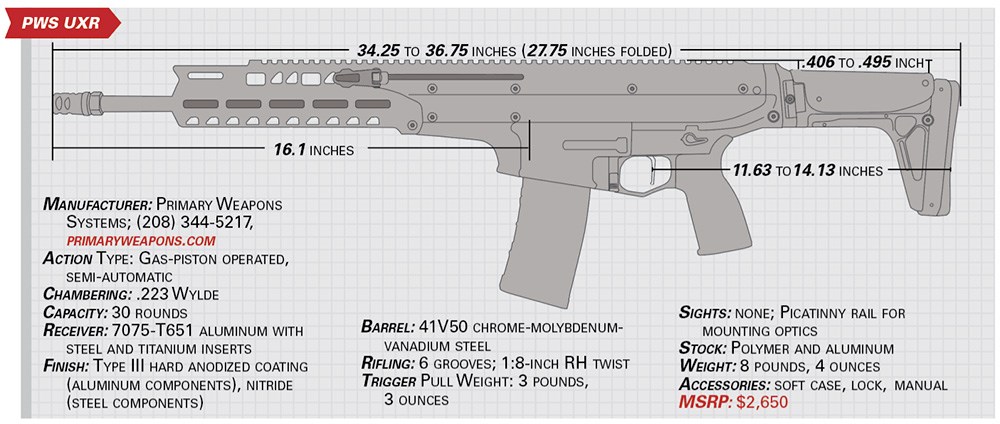
Most Popular