** When you buy products through the links on our site, we may earn a commission that supports NRA's mission to protect, preserve and defend the Second Amendment. **
In this segment American Rifleman's Editor-In-Chief Mark Keefe IV takes a closer look at one of the more recent Colt double-action revolvers released, the Cobra series.
The prototype for what would become the Colt Cobra was introduced in 2016 as the SF6 or DS2. At the time, it had been a while since Colt last produced a double-action revolver, making it the first in the reintroduction of Colt double-actions. The design is a slightly larger J-Frame-size compact revolver made of stainless steel. Chambered for .38 Spl., the Cobra features a 2" barrel that is +P rated for the .38 Spl. cartridge. The barrel is also fully lugged to house and protect the cylinder's ejector rod.
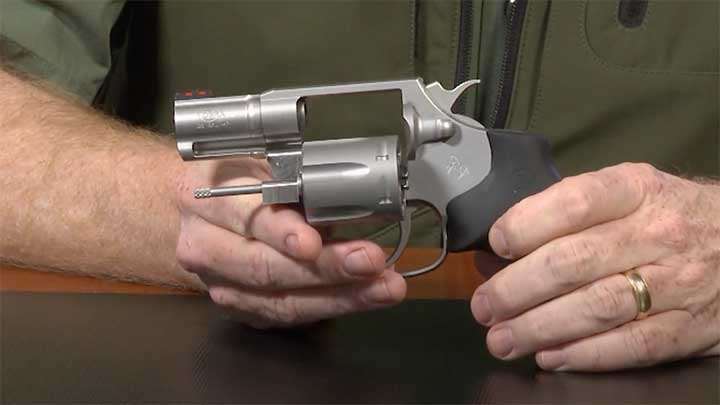
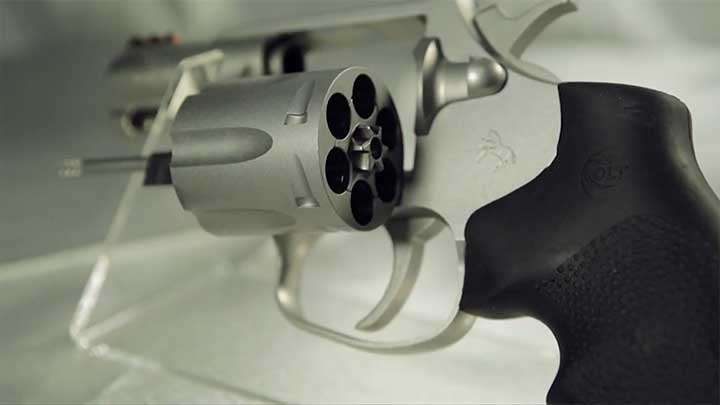
As a slightly larger J-Frame, the Cobra features a six-round capacity cylinder compared to the typical five-round capacity found on contemporary Smith & Wesson guns and other manufactures. The cylinder on the Colt Cobra rotates clockwise versus the counter-clockwise rotation found on Smith & Wesson revolvers. The cylinder release also works different from standard contemporaries in that the tab is pulled back to release the cylinder rather than pushed forward, just like on older Colt revolver designs.
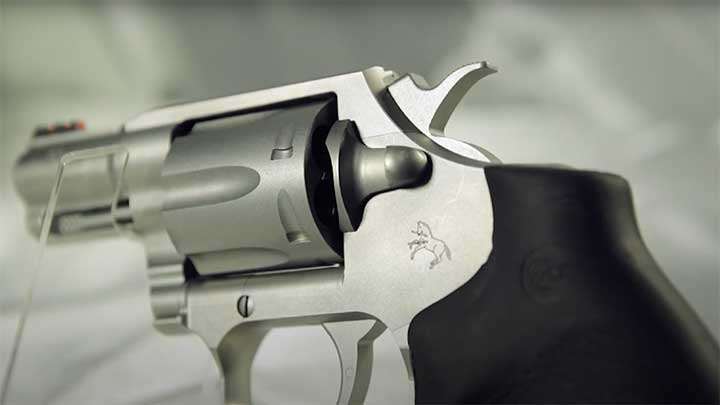
The slightly larger profile of the Cobra's J-Frame allows a higher grip compared to other offerings. this places the trigger more in-line with the index finger and results in a more consistent draw and pull. Being a double-action revolver, the trigger of the Cobra has two functions. In double-action, pulling the trigger both rotates the cylinder as well as pulls pack and releases the hammer at around 7-lbs. 3-ozs. The second function is single-action, where the hammer is manually cocked and results in lighter trigger pull close to 3-lbs.
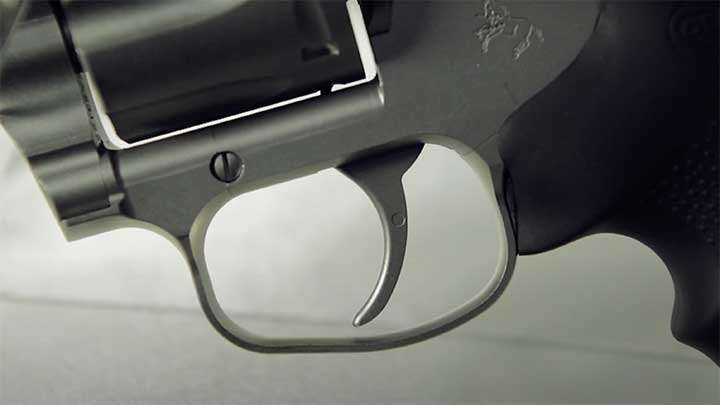
The geometry of the trigger shoe itself is re-profiled and the area inside of the trigger guard widened to allow more comfortable use with gloves or for those with larger hands. Unlike older revolver designs, the Cobra's hammer does not have the firing-pin attached to it. Rather, it uses a transfer-bar attached to the frame itself that only allows the hammer to strike the internally housed firing pin when the trigger is fully depressed.
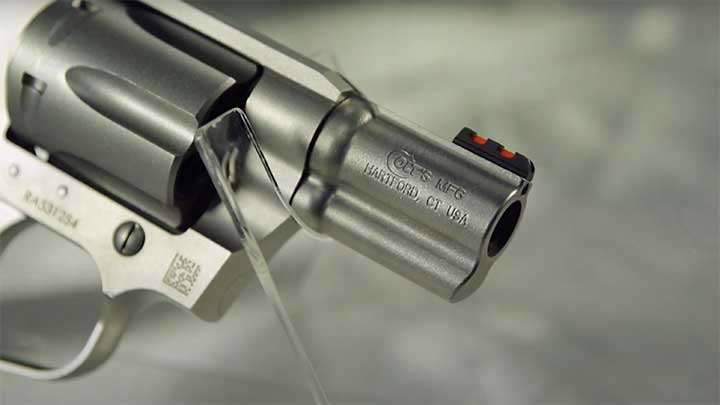
Sights on the Cobra are simple and low-profile, as it is geared more towards self-defense rather than target shooting. The rear sight is a simple grove that passes over the top of the frame. The front sight, however, features a reinforced red fiber-optic tube for increased visibility. The front-sight post is also interchangeable through the use of a small hex screw located just above the muzzle.
The grip that comes with this specific Colt Cobra is a Hogue rubberized overmold grip that offer better purchase and grip-retention. Under the grip, The Cobra uses a a double-V leaf-spring instead of the standard coil-springs found on contemporaries. The use of the leaf-spring, like the cylinder release, is another feature that links the Cobra back to the older generations of Colt revolvers.
To watch complete segments of past episodes of American Rifleman TV, go to americanrifleman.org/artv. For all-new episodes of ARTV, tune in Wednesday nights to Outdoor Channel 8:30 p.m. and 11:30 p.m. EST.
The prototype for what would become the Colt Cobra was introduced in 2016 as the SF6 or DS2. At the time, it had been a while since Colt last produced a double-action revolver, making it the first in the reintroduction of Colt double-actions. The design is a slightly larger J-Frame-size compact revolver made of stainless steel. Chambered for .38 Spl., the Cobra features a 2" barrel that is +P rated for the .38 Spl. cartridge. The barrel is also fully lugged to house and protect the cylinder's ejector rod.
The Colt Cobra with the cylinder in the open position.
As a slightly larger J-Frame, the Cobra features a six-round capacity cylinder compared to the typical five-round capacity found on contemporary Smith & Wesson guns and other manufactures. The cylinder on the Colt Cobra rotates clockwise versus the counter-clockwise rotation found on Smith & Wesson revolvers. The cylinder release also works different from standard contemporaries in that the tab is pulled back to release the cylinder rather than pushed forward, just like on older Colt revolver designs.
The Colt Cobra with the six-round cylinder closed.
The slightly larger profile of the Cobra's J-Frame allows a higher grip compared to other offerings. this places the trigger more in-line with the index finger and results in a more consistent draw and pull. Being a double-action revolver, the trigger of the Cobra has two functions. In double-action, pulling the trigger both rotates the cylinder as well as pulls pack and releases the hammer at around 7-lbs. 3-ozs. The second function is single-action, where the hammer is manually cocked and results in lighter trigger pull close to 3-lbs.
The cylinder-release on the Cobra is pulled rather than pushed to open the cylinder.
The geometry of the trigger shoe itself is re-profiled and the area inside of the trigger guard widened to allow more comfortable use with gloves or for those with larger hands. Unlike older revolver designs, the Cobra's hammer does not have the firing-pin attached to it. Rather, it uses a transfer-bar attached to the frame itself that only allows the hammer to strike the internally housed firing pin when the trigger is fully depressed.
The trigger shoe was re-profiled and the trigger-guard widened to provide more area.
Sights on the Cobra are simple and low-profile, as it is geared more towards self-defense rather than target shooting. The rear sight is a simple grove that passes over the top of the frame. The front sight, however, features a reinforced red fiber-optic tube for increased visibility. The front-sight post is also interchangeable through the use of a small hex screw located just above the muzzle.
The reinforced fiber optic front-sight of the Cobra with the hex-crew visible just above the muzzle.
The grip that comes with this specific Colt Cobra is a Hogue rubberized overmold grip that offer better purchase and grip-retention. Under the grip, The Cobra uses a a double-V leaf-spring instead of the standard coil-springs found on contemporaries. The use of the leaf-spring, like the cylinder release, is another feature that links the Cobra back to the older generations of Colt revolvers.
To watch complete segments of past episodes of American Rifleman TV, go to americanrifleman.org/artv. For all-new episodes of ARTV, tune in Wednesday nights to Outdoor Channel 8:30 p.m. and 11:30 p.m. EST.