Q. I was reading an auction catalog, and a reference was made to an American military Thompson submachine gun. It stated it was a “1928 Colt Navy overstamp, not a Savage.” The catalog made that verbiage seem important. What’s the significance of the “overstamp,” and were there other military 1928 Thompsons besides the Navy guns?
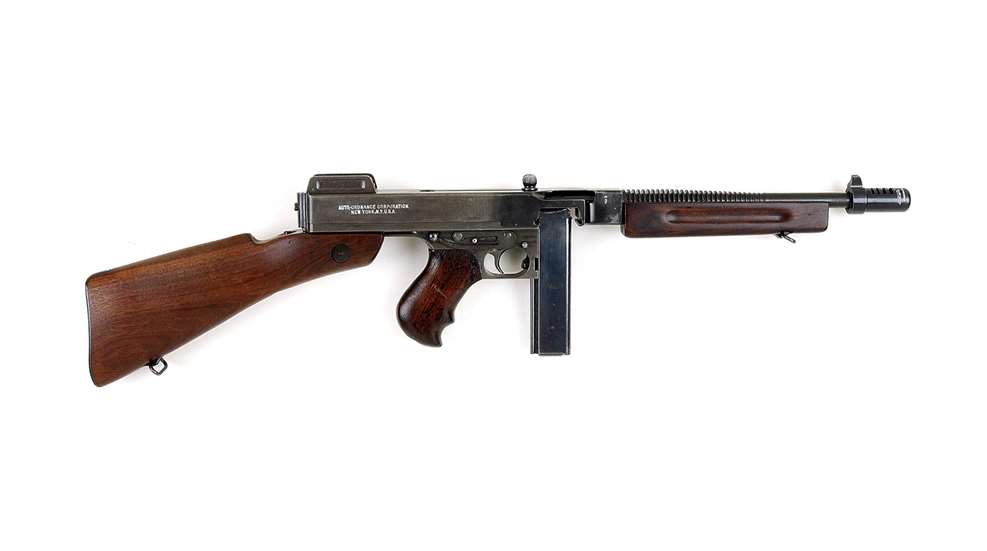
A. In 1928, the U.S. Navy made plans to officially adopt the .45 ACP Thompson submachine gun but requested a few modifications from the original Model of 1921 design. Specifically, the Navy mandated a lower rate of fire (approximately 600 rounds per minute instead of 800), a horizontal fore-grip instead of the vertical type used on the 1921 and a Cutts compensator.
This latter feature had been available by special order on Thompsons for a couple of years. It helped to hold down the muzzle during firing by deflecting the muzzle blast upward. With these changes, the “U.S. Navy, Model of 1928” submachine gun was adopted. An order of 500 was placed with Auto-Ordnance, which along with the 340 M1921 Thompsons acquired previously, was enough to satisfy the limited demands of the U.S. Navy and Marine Corps for the foreseeable future.
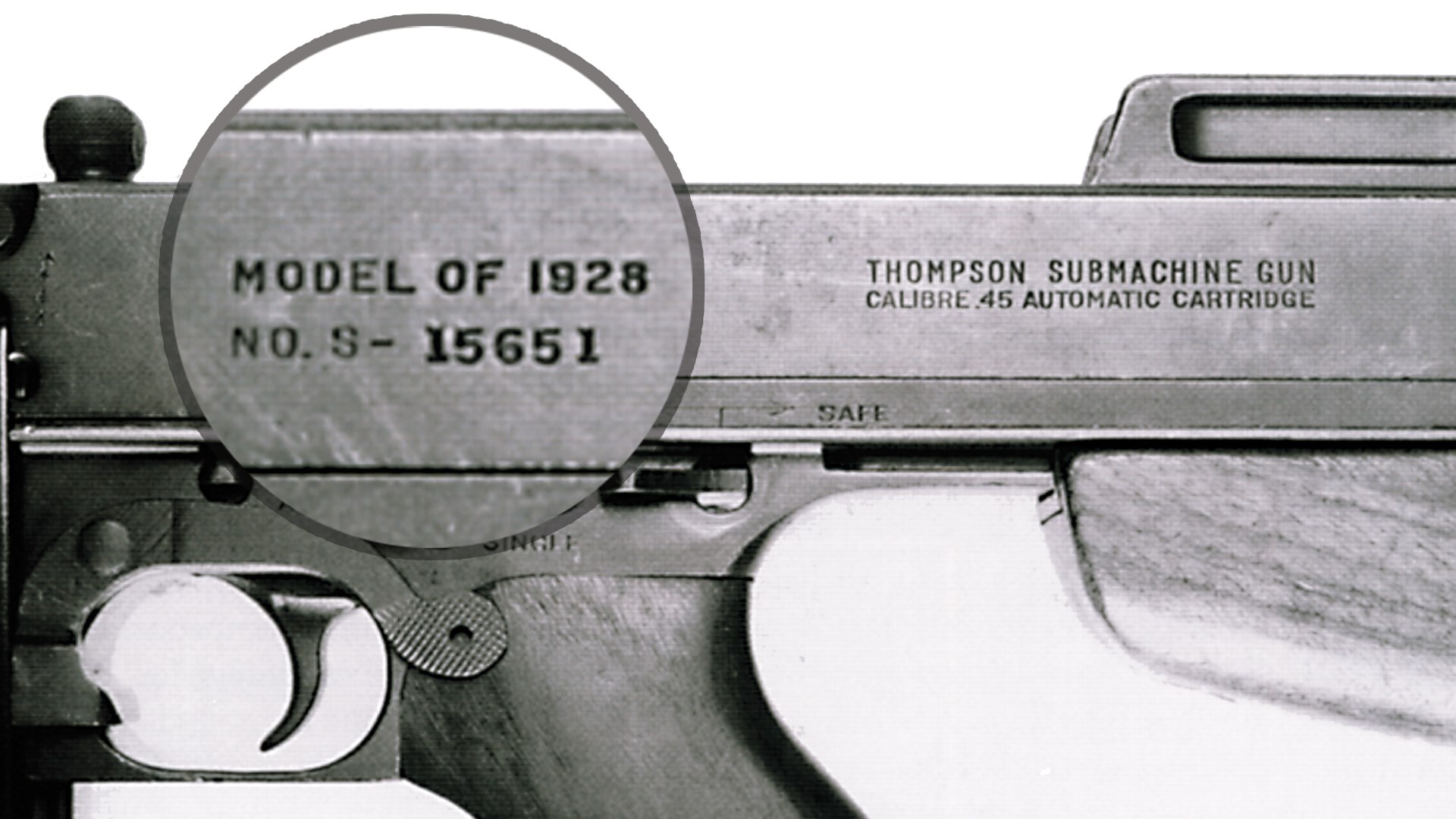
The Colt-made U.S. Navy Model of 1928 Thompsons are fairly well known. Savage’s early Thompsons were marked “Model of 1928” even though they were procured under government Model of 1928A1 contracts.
While not an extremely large number, the Navy order did a great deal toward keeping the fledgling and struggling Auto-Ordnance Company alive. It is interesting to note that the guns needed to fill the Navy order were from the original batch of 15,000 guns made by Colt for Auto-Ordnance in 1921. Indeed, these Colt-made guns were sufficient to meet the demand for Thompsons until the eve of World War II. The Model of 1921 marking had the “1” over-stamped to “8”, but, except for the addition of a heavier actuator to reduce the rate of fire and the horizontal fore-grip, the M1928 U.S. Navy Thompson retained the same features as found on the commercial Thompsons of the same era.
The U.S. Army had shown less interest in the Thompson than the Navy. It wasn’t until September 1938 that the Thompson was changed from “Limited Procurement” to “Standard” and designated as the “Submachine Gun, Caliber .45, Model of 1928A1,” and 1928A1s were made by Auto-Ordnance and Savage. Very early versions of the 1928A1 made by Savage are marked “Model of 1928,” even though they were procured under government contract as M1928A1s.
—Bruce N. Canfield
This “Questions & Answers” was featured in the March 2007 issue of American Rifleman. At time of publication, "Questions & Answers" was compiled by Staff, Ballistics Editor William C. Davis, Jr., and Contributing Editors: David Andrews, Hugh C. Birnbaum, Bruce N. Canfield, O. Reid Coffield, Charles Q. Cutshaw, Charles M. Fagg, Angus Laidlaw, Harry Hunter, Chuck Karwan, Charles E. Petty, Robert B. Pomeranz, O.D., Jon R. Sundra, Jim Supica, John M. Taylor and John Treakle.
To subscribe to the magazine, visit the NRA membership page and select American Rifleman as your member magazine.
Most Popular