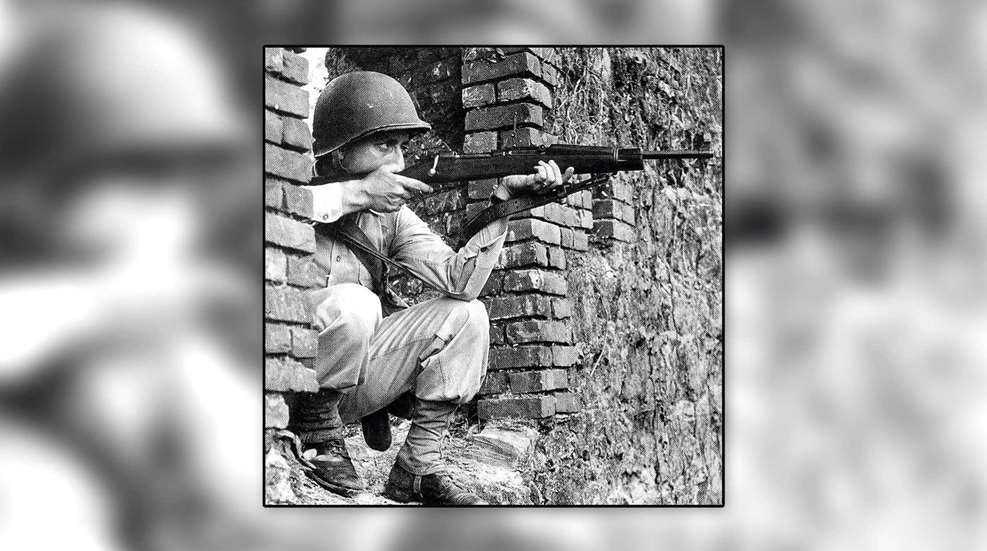
Q. Recently, I saw a period photograph of an American soldier in World War II-era equipment who was armed with what appeared to be a cut-down ’03 Springfield carbine. Was this an official conversion and did it see any combat service overseas?
A. What you saw may have been a “Bushmaster,” which was a standard ’03 rifle that had the barrel and stock cut down to make it handier as a jungle warfare arm. Government records reflect that 4,725 such rifles were converted to this type of carbine configuration under the auspices of the U.S. Army Panama Canal Department in early 1942. Bushmaster barrels were cut down to 18", and the stocks and handguards shortened correspondingly.
Judging from the extant photos, the workmanship was a bit on the crude side. The guns were utilized for training in the Panama Canal Zone by the troops of the Caribbean Defense Command, who called themselves the “Bushmasters.” These modified Springfields have been dubbed “Bushmaster” rifles by collectors because of their utilization by U.S. troops training in Panama, but this was never official nomenclature. The rifles were not used in any other theater and saw no combat use. They remained in use in Panama until replaced by M1 Carbines in late 1944.
The Bushmaster rifles on hand were ordered sent to Raritan Arsenal, where they were destroyed. According to a War Department memorandum dated May 1945, the rifles were dumped in the ocean. Surviving examples are rare, and positive identification is virtually impossible. The rifles were not in any particular serial number block, and serial numbers ranged from as low as 6383 to as high as 1467501.
The fact that there were no distinguishing features—and the fact that even the originals were rather crudely modified—means that it would be quite easy to cut down a standard M1903 to approximate the configuration of one of these arms. Therefore, it would be unwise to pay any sort of premium for an example without some sort of convincing documentation to prove or strongly suggest that the rifle is legitimate.
—Bruce N. Canfield, Contributing Editor
This “Questions & Answers” was featured in the April 2005 issue of American Rifleman. At time of publication, "Questions & Answers" was compiled by Staff, Ballistics Editor William C. Davis, Jr., and Contributing Editors: David Andrews, Hugh C. Birnbaum, Bruce N. Canfield, O. Reid Coffield, Charles Q. Cutshaw, Charles M. Fagg, Angus Laidlaw, Evan P. Marshall, Charles E. Petty, Robert B. Pomeranz, O.D., Jon R. Sundra, Jim Supica, A.W.F. Taylerson, John M. Taylor and John Treakle.
To subscribe to the magazine, visit NRA membership page and select American Rifleman as your member magazine.
Most Popular