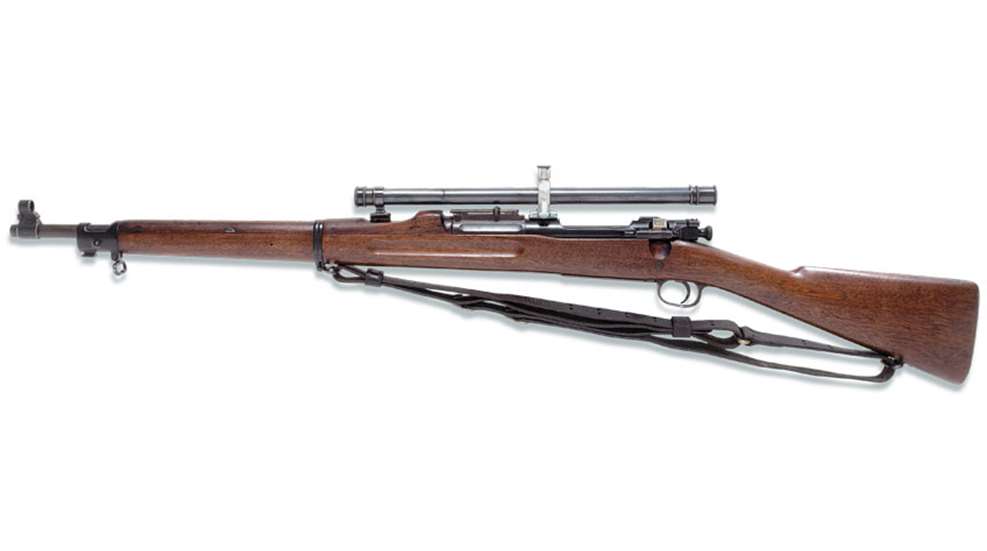
Q: I read an article in American Rifleman about the use of Winchester scopes as sniper optics during World War I. I have a Winchester A5 riflescope that I’ve been told is in very good condition—the glass is clear, and the reticle is also clear and unbroken. I’d like to know more about what I have. My father used it competitively in the early 1900s with a Winchester Model 52 rifle.
A: Your scope is a wonderful piece of shooting history. While technology has rendered scopes such as yours primitive, fragile and crude when compared to today’s marvels of precision, there remains an appreciation for the efforts of early optics designers and producers.
While not widely used by the general public, scopes were eagerly sought by target shooters of the late 19th and early 20th centuries, especially for long-range applications. Some of the early examples were longer than the barrels of the rifles onto which they were mounted. By 1900, there was much commonality in design and straight-tube appearance between the various U.S. makers, including Stevens, Malcom, Sidle and others. Stevens was especially aggressive, offering scope/mount systems advertised for model-specific Remington, Winchester, Marlin, Savage and, of course, Stevens rifles.
Winchester’s entry into the scope market made good business sense. Most of the interest in this, and similar scopes, is for the purpose of assembling period-correct pieces, rather than for their field utility. Unless you know of a person or persons in your area that might have an interest in this sort of item, it can be difficult to market. A quick check of online auction houses shows recent sales of similar Winchester A5 riflescopes ranging from $450 to $550. Winchester’s Model 52 was introduced in 1919, which fits within the production range of your A5 scope. --John W. Treakle
Most Popular