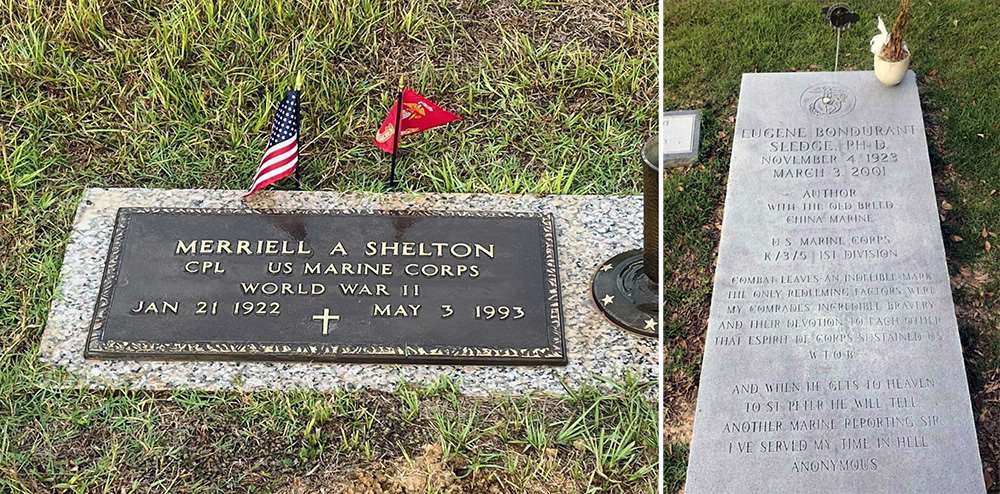
Secretary of War Pete Hegseth, in his speech to 800 assembled generals, admirals and senior enlisted at Quantico, Va., on Sept. 30, 2025, quoted Eugene Sledge from his timeless classic With The Old Breed published in 1981. In his World War II memoir, Sledge wrote, “War is brutish. Inglorious and a terrible waste. Combat leaves an indelible mark on those who are forced to endure it. The only redeeming factors are my comrades’ incredible bravery and their devotion to each other.” Those words are also inscribed on his headstone at Pine Crest Cemetery in Mobile, Ala.
Since its publication, no Marine’s library was considered complete without a copy. It seems a copy is also in possession of an Army major who is now Secretary of War. Sledge’s work is considered to be the most authoritative book on infantry combat in the Pacific during World War II. It has been, and remains, a “must-read” for Marines.
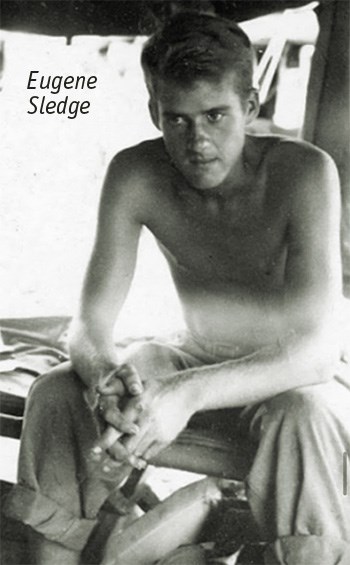 I first read it as a lieutenant while stationed at Parris Island, a second time while stationed at Camp Pendleton after the Gulf War and a third time after I retired. After each reading, I wondered if there is more to Sledge’s story; certainly, Eugene Sledge had more to share. I was right.
Like many readers, I have seen the miniseries “The Pacific.” In part, it follows the fighting exploits of Sledge and his mortar squad from K Co., 3rd Btn., 5th Marines through the bloody battles of Peleliu and Okinawa. It is more than just the recap of those battles—it is about the fighting men he served with and the close, lifelong friendships forged in combat with those men with whom he “shared the incommunicable experiences of war,” as Oliver Wendell Holmes, Jr. said in an 1895 Memorial Day speech. While watching the miniseries, I learned that the character “Snafu” (Merriell Shelton) was from Louisiana. A quick online search followed, and to my surprise, I discovered he was buried in my hometown of St. Francisville. A small world and a smaller Marine Corps.
On my next trip home to Louisiana, I visited Snafu’s grave, and, on my drive back, I stopped in Mobile, Ala., to visit Eugene Sledge’s grave. The proper thing to do—Marines. I also visited the grave of Eugene Sledge’s childhood friend, World War II Marine veteran Sidney Phillips. I later learned Eugene Sledge’s son, Henry, referred to him as “Uncle Sid.” These two Marines are buried just 30 feet apart—fitting.
Eugene Sledge’s headstone failed inspection. It did not meet the Marine Corps’ meticulously clean standard. A quick post on Facebook with accompanying photos got the matter resolved in short order. Marines stepped up from several locations around the country, and as expected, his headstone was soon cleaned—proper.
From that post, I connected with his son, Henry, via a common friend and learned he was writing a “rest of the story” book about his father’s World War II experiences on Peleliu and Okinawa. Henry shared that much of his father’s manuscript had not been published. Portions had been removed for various reasons but mainly to not make the book too long. Those pages of his manuscript are, like his book, priceless. They are maintained at Auburn University in the Special Collections Archive “closed papers” and are viewable by family members only. Henry Sledge was, of course, granted access to his father’s manuscript and from it has written the complementary piece to his father’s work. His book, The Old Breed: The Complete Story Revealed, shares those portions of his father’s manuscript previously not published and more.
It is masterfully and beautifully written and intertwines the stories and interactions he had growing up with his father. Henry literally watched his father write With The Old Breed on a legal pad while his mother typed those handwritten notes. Henry Sledge’s work includes numerous personal stories and family photos, as well as pictures from World War II not previously seen. It is detailed and personal. Henry asked questions, the answers to which only a father would share with his inquisitive son, and he shares the responses from his father in the context of their lives. Henry has graciously permitted us a glimpse into Eugene Sledge, the father and husband. The Old Breed permits the reader to feel the closeness of their relationship and how Sledge’s World War II experiences shaped both of their lives. Most importantly, Eugene Sledge did return home a changed man, but despite all of what he saw in combat, he never lost his humanity and the gentle persona of a Southern gentleman.
Henry Sledge’s book reveals “the complete story.” It is the published complement to his father’s book and is a most valued companion to his father’s original work.
—Lt. Col. Rob Barrow, USMC (Ret.) Price: $35. Contact: Simon & Schuster; simonandschuster.com.