Let’s start with the name: Harrier. Sure, the name can refer to dogs bred for hunting rabbits or to small birds of prey, but to the vast majority of us of a certain age, it refers to the super-cool British jump jet capable of vertical takeoff and landing. Despite having been designed in the late 1960s and seeing action in the Falklands in the ’80s, I’d argue the most iconic use of the Harrier jump jet would be in 1994’s “True Lies” starring Arnold Schwarzenegger. For those of us who came of age in the glorious 1980s, seeing action-hero Arnie pilot the Marine AV-8B brought together two icons: the “Pumping Iron” star himself, and the USMC’s versatile jet fighter. Thus, with a single word, Ruger has set the tone for its latest modern sporting rifle—and set it well.
Ruger also makes no bones about the origin of the rifle—it’s the first Ruger-branded product to come out of the Hebron, Ky., facility Ruger acquired in 2025 from Anderson Manufacturing. Don’t think that this is simply the latter’s product with a Ruger name added to it, though.
Ruger’s director of Media, Advertising and Public Relations, Abbey Clary, stated that, “While modern MSR-style rifles naturally share common manufacturing techniques across the industry, these are entirely new Ruger-built rifles. At its core, the Harrier stays true to what Ruger is known for: delivering a rugged, reliable rifle at an accessible price point.”
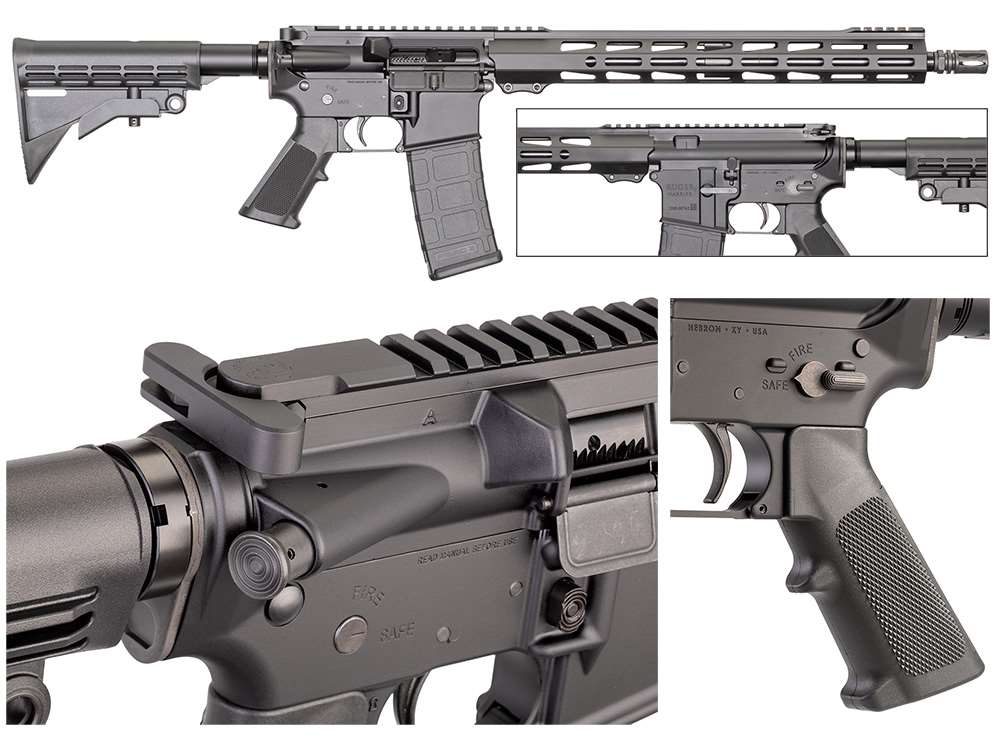
Indeed, if there’s any one thing for which Ruger firearms are known, it’s offering a well-functioning product at an “everyman” price. The new Harrier does that in spades, with two models (at the time this article was written) available at the lower end of the AR-15 price spectrum that function as one would expect a Ruger should. Clary further detailed that “the Harrier is not a carryover rifle with a new rollmark. Internally and externally, it reflects a blended evolution of Ruger’s AR-556 lineage and the all-new Harrier rifle line. Critical components and overall execution have been updated to align with Ruger’s standards for quality, consistency and performance. With the sole exception of the tension-adjustment screw in the lower receiver, none of the prior company’s design DNA remains.”
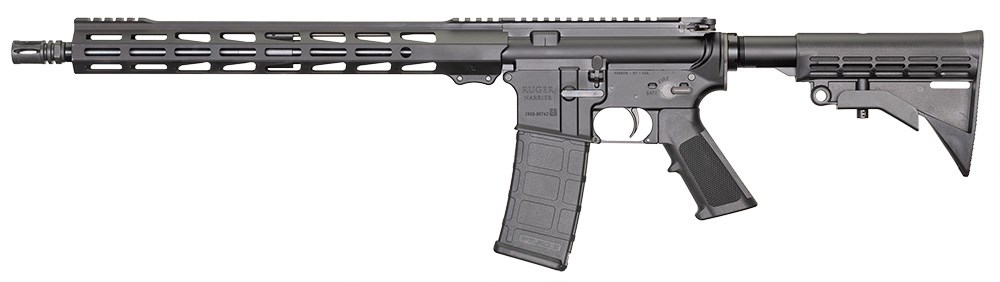
Don’t let its price define the Harrier’s place in the AR-15 world. Sure, it’s one of the most affordable AR-15-style rifles from a major manufacturer, and even compared to the, ahem, more budget-minded brands, it’s not all that pricey. That doesn’t mean that it skimps on quality or components. There’s a freefloat barrel, rather than the CAR-15-era, delta-ring handguard as might be found on a bargain-basement model. A 15-inch, M-Lok-strewn handguard with QD sling-attachment points offers plenty of room for foregrips, lights, lasers and other accessories one might want, and that’s not the end of the extras. A tension screw in the lower receiver helps reduce play between the upper and lower, while the A2 birdcage-style flash hider has flat sections thoughtfully included to allow easier removal should a sound suppressor or other muzzle device be desired.
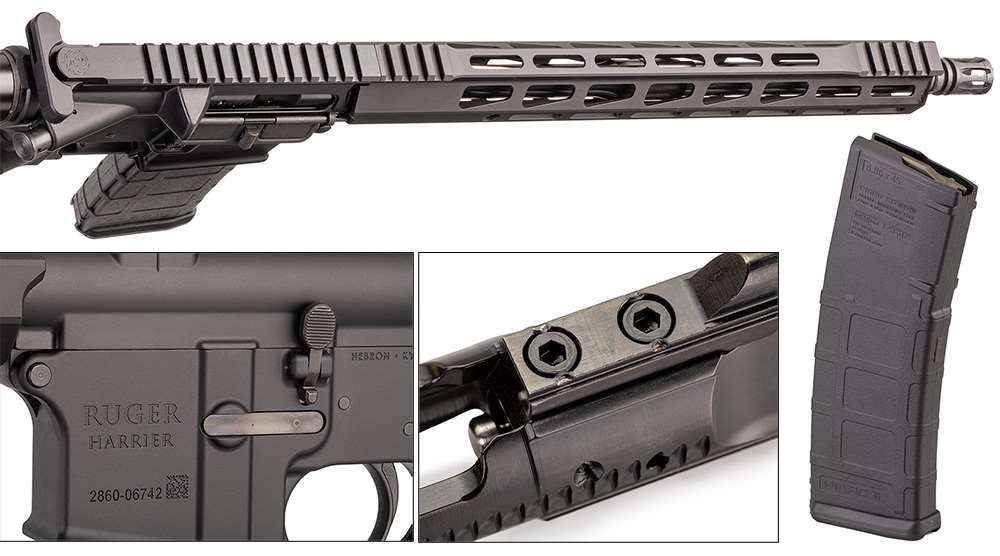
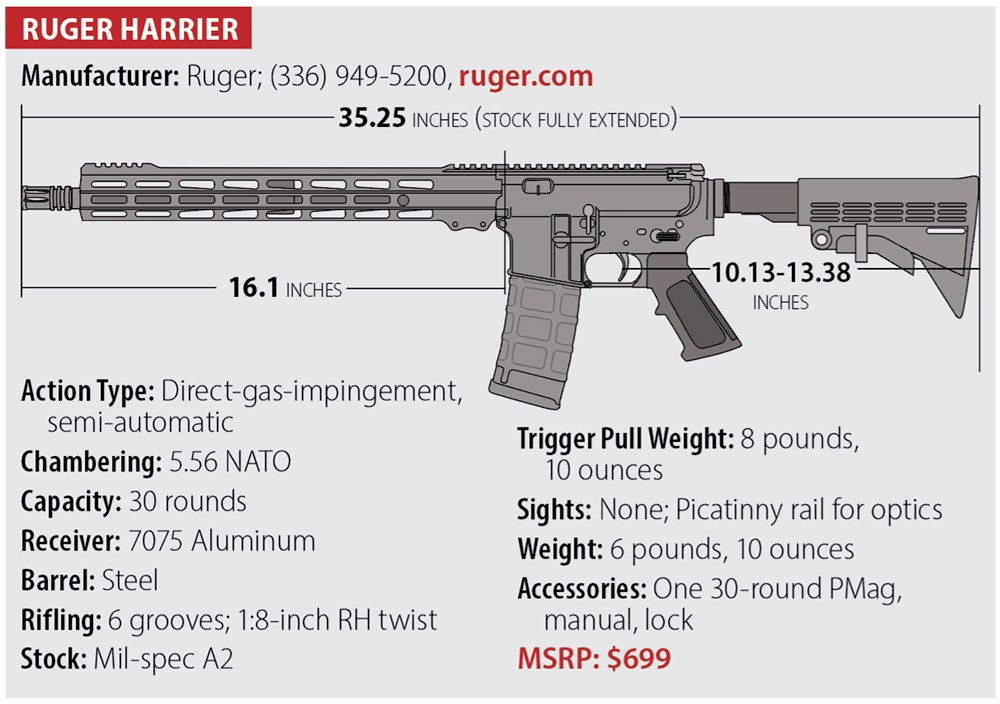
Beyond that, though, the Harrier is pretty basic—which is a good thing. There’s no ambidextrous safety selector, but the AR-15 aftermarket has dozens (if not hundreds) of options should the end user wish to change that. Other controls are similarly standard: The magazine and bolt releases are both mil-spec, as is the charging handle. Furniture-wise, the standard Harrier we received for testing has a mil-spec-style stock and A2 pistol grip, while a slightly upgraded model has, for $50 more, Magpul’s excellent MOE-K2 stock and K2 pistol grip. The bolt-carrier group is nitrided, and, yes, the gas key is staked properly, while the trigger is a mil-spec, single-stage variant with a slightly more than 8.5-pound pull weight.
With the market for AR-15-style rifles on the mature side, what’s the appeal of the Harrier? In a nutshell, it’s a great starter rifle, backup or even a framework around which one could build a semi-custom AR-15. Upgrade the controls, drop in an aftermarket trigger, put on a QD suppressor mount and you’ve got a rock-solid option for home defense, competition or simple plinking. Leave it as is, drop an inexpensive red-dot sight up top and it’ll work just fine as a basic defensive carbine. Grab a drop-in rimfire bolt and magazines, and it’s a great introduction for a new shooter to rifles—start with .22 LR, then move to 5.56 NATO once they’re comfortable with the operation. The possibilities are wide open.

Its general appeal is what gives the Harrier its greatest flexibility. Out of the box, it needs nothing except a sighting system, and this is one of the places where Ruger has elected to save money. Rather than include a set of flip-up sights that most people will either replace or, more likely, ignore in favor of a magnified or electro-optic, Ruger has left the top rail a blank canvas for whatever sights the end user wants to add. LPVO? Red dot? Irons only? It’s your call. Another area where Ruger has kept costs down is the magazine—note the singular. A lone, non-window Magpul PMag ships with the Harrier, and while I’m solidly against this practice for handguns, it’s a bit different for rifles, especially the AR-15. There are a lot of great magazine choices out there, not the least of which is the U.S.-military-proven PMag, if you want more. Also, if this isn’t your first AR-15, you most likely have a bunch of magazines you can share.
I’d like to take a quick sidebar to further highlight costs and pricing. Ruger has the Harrier with mil-spec furniture priced at an MSRP of $699. When the company released its AR-556 in 2014, the price of that entry-level AR was $749—and the AR-556 didn’t have a freefloat barrel, nor a full-length handguard to which one could easily add accessories. In the past 12 years, Ruger has added features to its AR-15-pattern rifle while actually lowering costs. That’s pretty amazing, especially considering the inflation we’ve experienced in the last dozen years. A quick look at other AR-15-style rifles with freefloat barrels and full-length, M-Lok attachment handguards shows the Harrier to be extremely competitive.
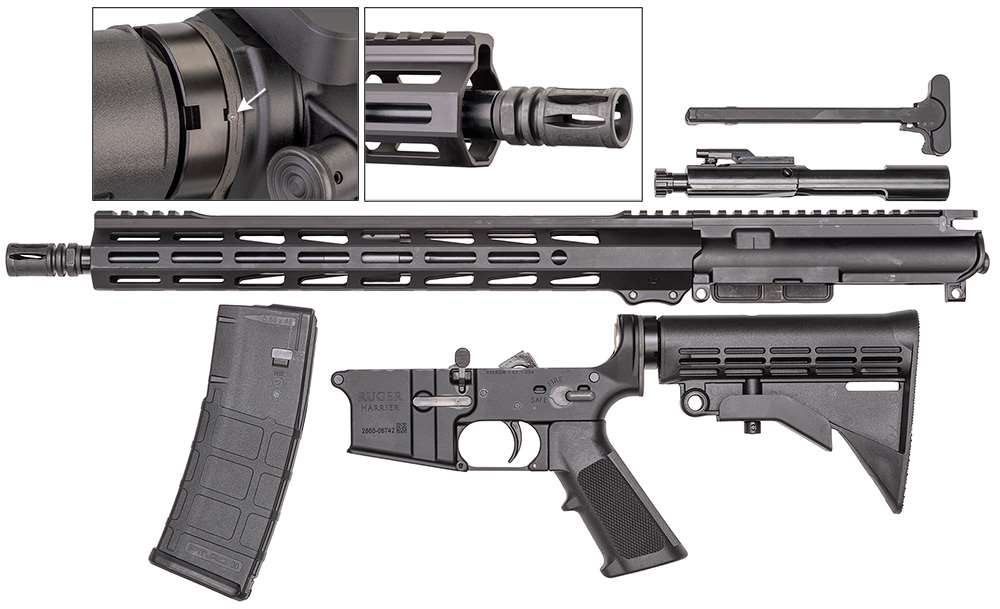
Even if you’re willing to put the work in and build an AR yourself, as I’ve done dozens of times, you’re unlikely to save a significant amount over the Harrier. Figure $50 for a stripped lower and the same for a stripped upper. Add another $50 for a parts kit, another $100 for the stock, buffer, buffer tube, spring, etc. and we’re at $250. Add in $100 for a complete bolt-carrier group, another C-note for a barrel and a third Benjamin for the handguard, and (assuming my math is right, which you should always check), we’re at approximately $550. Throw in another $50 for things like a gas block, gas tube, upper receiver parts, etc. for an even $600. You’ve saved $100 compared with just buying the standard Harrier, and that’s if you choose only the most basic options for every part. Of course, if you enjoy DIY building, that’s just a bonus, but if your motivation is purely saving money, you’re not going to save much by building rather than buying.
The heart of the Harrier, though, is what matters. I maintain the three most important components for reliability and accuracy are the barrel, bolt-carrier group and trigger; with the barrel carrying double duty for both accuracy and reliability. While it’s not particularly difficult to swap out a barrel, it does involve a few specialized tools not everyone has readily at hand. The trigger and bolt-carrier group can be upgraded easily, but neither is especially cheap, and if expense is the main reason for choosing a lower-to-mid-range AR-15, it’s better to not need to replace any of these items. The Harrier’s trigger is the one thing I’d consider changing, as it is fairly heavy, but only if I were overly concerned about accuracy. For a fighting carbine, it’s certainly up to the task.
Reliability-wise, the Harrier is, well, a Ruger. It works, plain and simple. Nearly 300 rounds of various ammunition, from bulk-pack, 55-grain .223 Rem. FMJ fodder through higher-weight-projectile, match-grade, competition-level rounds were digested without incident. Accuracy, as shown in the shooting results (note the distance was 50 yards rather than our standard 100, owing to weather conditions at our outdoor range), was reasonable for a rifle of this level, and while we’ve become accustomed to rifles easily shooting sub-MOA, it’s important to remember that such a degree of accuracy isn’t as critical in most defensive situations, where reliability rules the day.
To fully test the reliability of the Harrier, I opted for numerous magazine types. Brand-new polymer magazines from Magpul were used alongside current metal magazines, with some elderly, pre-ban (remember those?) magazines thrown in to test how sensitive the Harrier would be to magazines that have been stored for years. Spoiler alert: it worked just fine. Regardless of magazine type, the Harrier loaded, fired and ejected everything that went into it. Multiple 30-round magazines were run, quickly, to the point where the aluminum hand-guard was literally too hot to touch, and yet the Harrier just kept on running. This is far from an exhaustive test of the Harrier’s reliability, but it’s a great start.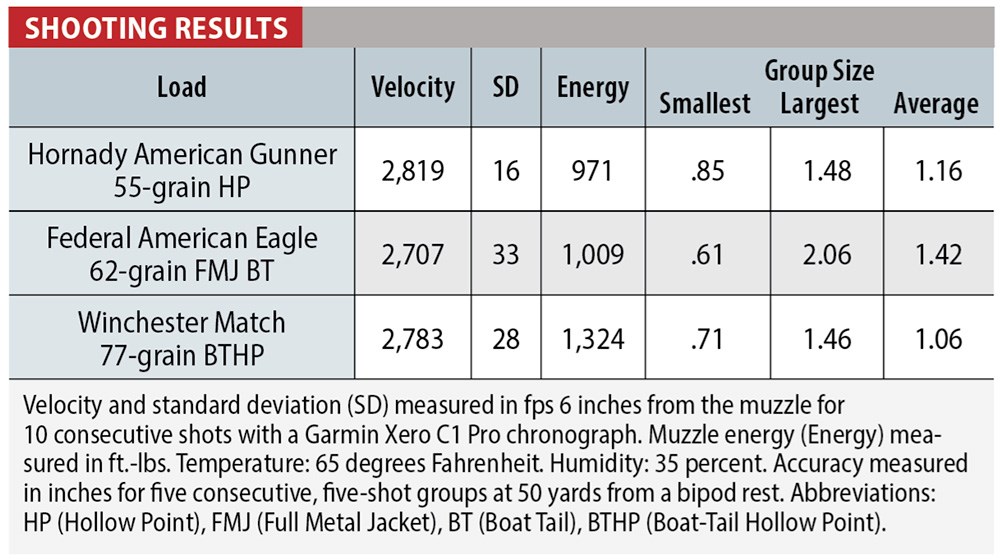
There’s a lot to be said for the familiarity of a standard AR-15 configuration, and the Harrier represents an outstanding example of an entry-level carbine. There are myriad ways to upgrade and personalize it—and, let’s be honest here, we love making things our own. However, if you want to buy it, add an optic and be done, you can do that, too.
What’s the final verdict, you might ask? A phrase I’m fond of repeating when it comes to firearms is that having more options is a good thing. With Ruger’s new Harrier, there’s another option for AR-15 enthusiasts, and it’s a solid one right out of the box. It’s reliable, reasonably accurate and won’t empty your wallet—pretty much everything for which Ruger is known.