Remington .41 Double Derringer
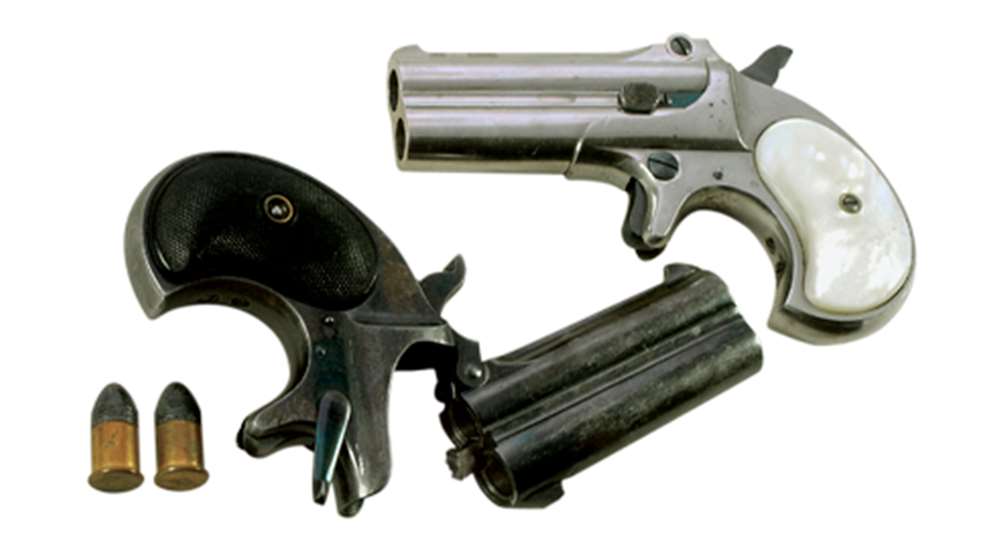
Gun: Remington .41 Rimfire Double Derringers
Condition: Nickel gun, 98 percent, NRA Antique Excellent plus; blue gun, 40 percent, NRA Antique Fine
Value: nickel gun, approximately $2,000; blue gun, approximately $800
The Remington Over-Under Double Derringer is doubtless one of the most widely recognized handgun designs. For many Americans raised on TV and Hollywood Westerns, it conjures images of smoke-filled saloons and paddle-wheel steamboats.
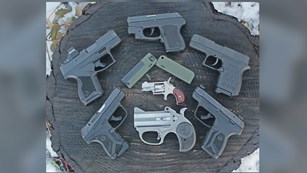
The two-shot .41 rimfire pistol enjoyed commercial success with an estimated production of more than 150,000 spanning nearly 70 years beginning just after the Civil War in 1866. Collectors recognize a number of variations over that period, but the basic design remained the same. The Remington pattern was popular enough that a number of other manufacturers have offered similar looking derringers, some still in production today, albeit with stronger designs and improved safety systems.
The firing pin shifts position when the hammer is cocked to alternate between striking the cartridge rims in the upper and lower chambers, providing two shots before reloading. The lever on the right side of the frame rotates 180 degrees forward to allow the barrels to be tipped up for loading and unloading. All but the very earliest production guns have a sliding manual extractor mounted on the left side of the barrels to aid in the removal of shells.
The gun offers a relatively large caliber close-range defensive arm in a compact package, although the now obsolete .41 rimfire short round has quite low velocity and low muzzle energy.
Both of the guns pictured are considered “Type IIs” or “Model 3s,” depending on which collector nomenclature you prefer, as identified by the wording of the barrel markings. They are the most common type, made from 1888 to 1911. It is generally not possible to estimate production dates closer than that, as these guns were made with “batch numbers” rather than “serial numbers.” This means that when the numbers marked on the guns reached “999” or “9999,” the numbering was usually started over with number “1.”
The nickel gun is in exceptionally nice condition, retaining well over 98 percent of its original nickel finish. The Blue Book of Gun Values estimates $1,500 for a 95 percent gun, and this one should bring more than that, possibly around $2,000. Although pearl grips were offered by Remington as a special-order feature, the pearl grips on this gun appear to be non-factory period replacements, being thinner than Remington pearls. The reduction in value due to replaced grips is probably balanced out by the more desirable fancy pearl material.
The blued gun, shown in the open position, retains less than half its original bright blue with the balance turned to a crisp gray to plum patina. It has the original checkered, hard rubber grips most commonly found on this model. Blue Book estimates the 40-percent gun at $800.
The hinge area at the top rear of the barrels is a weak point in the Remington design, and it’s not unusual to find these little guns with cracked or repaired hinges, which will reduce their value.
-Jim Supica
(Originally published October 2006. In the intervening years, the 40-percent condition blued gun has stayed about the same while, according to the 33rd Edition of The Blue Book of Gun Values, a 98-percent nickel gun increased to about $2,500.)