Q&A: Properly Loading a Henry

by
posted on August 4, 2014
** When you buy products through the links on our site, we may earn a commission that supports NRA's mission to protect, preserve and defend the Second Amendment. **
qanda2015_fs.jpg

I know that the Henry rifle loads differently than other Winchester-style replicas. After reading Garry James’ article “Henry’s Classic Henry” (April 2014, p. 66), it made me wonder if there is a proper way to load my replica Henry?

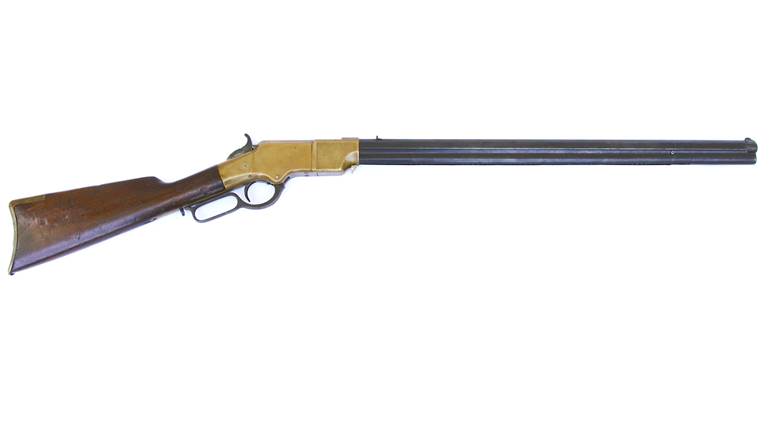
Unlike the “Improved Henry,” or Model 1866, and the subsequent Winchester lever-actions that feature Nelson King’s patented loading gate on the right side of their receivers, the Henry and its replicas are loaded by pushing a spring-powered brass tab—located under the barrel—up as far as it will go and then swiveling the top portion of the barrel/magazine tube assembly clockwise, which exposes the end of the magazine tube. Cartridges are then dropped down the tube, one by one, base first.

However, when loading the Henry, the barrel/magazine assembly should be held or tipped at a slight angle, to permit cartridges to gently slide down the loading tube, thus preventing them from dropping straight down with a force that could accidentally detonate a sensitive or projecting primer (especially prevalent in reloads, even with blunt-nosed bullets).

After loading, with the thumb still retaining the brass tab, pivot the top portion of the barrel/magazine tube assembly back to its original closed position. Then, still holding the brass tab and its spring-powered plunger with the thumb, gently lower the tab until the plunger is resting on the topmost cartridge, rather than letting it go with a dramatic “snap” that could also possibly detonate one or more of the stacked cartridges.

—Rick Hacker, Field Editor

Latest

Subsonic Ammo 101
Subsonic Ammo 101

Subsonic Ammo 101: Everything The Suppressor Shooter Should Know

Slower-than-sound rounds are an art as much as a science. For target shooting, bullet upset is not important, but if you’re using subsonic loads for hunting or self-defense, it becomes critical.

I Have This Old Gun: Model 1874 Gras Rifle

Following the Franco-Prussian War of 1870, the French military were in desperate need of a new service rifle. Their answer was the Model 1874 Gras, which was largely an update to the earlier Chassepot design.

Compact & Quiet: CMMG's ZEROED Banshee

CMMG has expanded its Banshee line of AR-style rifles with the ZEROED, a firearm that is optimized for suppressor use.

Making the A-Cut: Springfield Armory's COA-Ready Operator, TRP & DS Prodigy Pistols

Springfield has already released a COA-ready version of its Echelon earlier this year, and the new models will bring the A-Cut to the company’s hammer-fired handguns, including the 1911 Operator, 1911 TRP and 1911 DS Prodigy.

Skills Check: Snake-Eyes Drill

Our drill this month trains you to form a stable firing platform early enough to gain optimal control before the shot breaks. Timing is of the essence.

A Memorial Day Conversation With Grey Team

Grey Team was founded to help armed services members and veterans with the physiological impacts traumatic brain injuries, post-traumatic stress disorder, chronic pain and more.

Interests


Get the best of American Rifleman delivered to your inbox.