I am starting to amass a collection of pistols including Glocks, Berettas, military-model SIG Sauers and H&Ks, as well as 1911-style pistols. Most of my guns have their roots in military and law enforcement service or are clones of such guns.
I have read that many, if not all, military firearms must have part interchangeability to be accepted into military service. Does this apply to law enforcement firearms as well? Does this apply to civilian-model pistols based on the military or law enforcement versions?
How would I go about verifying that parts from one gun would fit and function on another of the same make and model? What about aftermarket parts sold as replacement parts for hard-to-get original parts?
I admit that I am a tinkerer and love to explore the mechanical features of my guns, but at the same time don’t want to get into trouble because of my own ignorance.
J.R., via e-mail
Part interchangeability in service- and duty-grade pistols for military and law enforcement applications is a given in today’s handguns. This is a requirement out of the necessity of maintaining, troubleshooting and repairing a fleet of guns used by the operating agency. The concept of drop-in parts for service pistols is not new for the military, as that was a feature of the original M1911 and the M1911A1 through its many years of military service. This concept continues today with interchangeable parts or assemblies in like-model pistols.
Part interchangeability only became an issue in the law-enforcement community when the transition from revolvers to semi-automatic pistols was taking place in the late 1980s and early 1990s. With the increased number of rounds fired in transitioning to the new semi-automatic pistols, annual maintenance and round-count inspections became more prevalent in keeping the guns in top operational readiness. Springs and small parts reached the end of their service life and needed to be replaced to keep the guns in serviceable condition. These parts were designed to be replaced without fitting, which was a requirement for revolvers.
While civilian models of the military and law enforcement guns rarely see the round count and abuse of their brethren in martial service, they should be held to the same or better maintenance standards to ensure their satisfactory function over their useful lives. This includes springs, pins and other wear items identified for periodic maintenance by the user or the manufacturer.
When determining whether parts are interchangeable amongst similar handguns, the brand, model, series and generation should all be considered. Sometimes, serial-number ranges have to be factored into the equation, because some manufacturers make in-line changes during the manufacturing process without warning the consumer.
If there is any question about part interchangeability, regardless of brand, it would be prudent to contact the manufacturer for clarification. Be sure to have the model and serial number handy when in contact with the manufacturer to ensure that you are getting the correct information.
Sometimes, for older and less popular guns, aftermarket suppliers are the only option to keep a firearm operating. The good news is that many of the parts-supply houses bought their parts from the original manufacturer after a model was discontinued and the manufacturer no longer supported or serviced the product. Reproduction parts designed to replace rare and hard-to-find parts made to the same drawings and specifications will bring life to an old and broken gun if no interchangeable ones can be found.
There are a few considerations that I would recommend following when interchanging or replacing critical parts on any firearm. A good starting point would be to visually compare the replacement part with the part to be replaced. They should appear to be the same. Small variations such as a hole drilled in the middle of the part for no apparent reason are a sign that something is different.
Once components have been replaced, a function check will determine the mechanical operability of the gun with the different parts installed. If the pistol cycles smoothly without ammunition, the next step is to load and fire a few rounds, taking note of its cycle of operation. If it feeds, fires, extracts and ejects through several rounds without abnormality, the interchange of parts was a success.
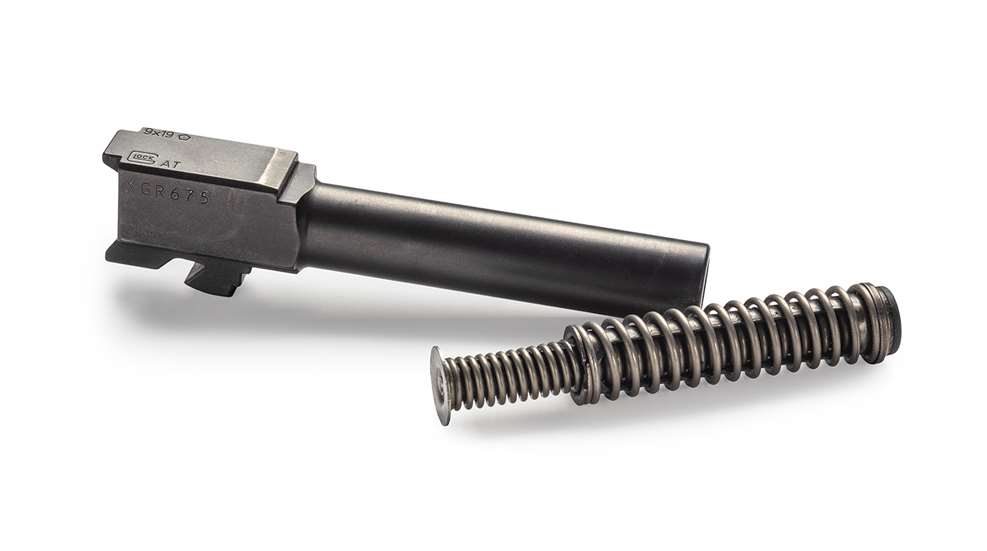
In today’s era of precision manufacturing and (post-patent) clone engineering, the part-interchange scenario overall is such that a third-generation Glock G19 pistol can be duplicated without incorporating a single Glock-made part. In fact, the new Ruger RXM pistol is an excellent example of clone engineering with magazines and major-part interchangeability at a quality level that is unsurpassable.
It’s no sin to be a tinkerer, as long as you work within your level of expertise and comfort, and reach out for help when the situation exceeds that level. Remember that there are always exceptions to the rule. That makes it important to prove your work by both dry-function check and live fire just to be safe.
Most Popular