9/18/2012
Thirty years ago the 7 mm Rem. Mag. was so popular that management at the plywood mill where I worked handed out boxes of 7 mm Rem. Mag. cartridges at Christmas instead of turkeys. That might be a slight exaggeration. But the truth remains that the 7 mm Rem. Mag. was and continues to be an extremely popular cartridge. In fact, Remington’s original magnum has maintained its standing so well that it’s difficult to believe 2012 is the 50th anniversary of the cartridge. Through those years new bullet weights and styles and propellants have continued to improve the performance of handloaded 7 mm Rem. Mag. cartridges.
Bullets & Propellants
When the guys at the mill and I first started handloading for our new 7 mms we used 175-grain bullets, and they worked fine on mule deer and elk. Choosing that bullet weight was an attempt to duplicate the 180-grain bullets we had loaded in our .30-’06 Sprg. ammunition. But when we read handloading manuals in the break room we discovered that 7 mm 150- and 160-grain bullets more closely matched the ballistics and sectional density of .30-cal., 180-grain bullets.
Those somewhat lighter bullets still carried enough weight for deep penetration. Nosler 162-grain Solid Base bullets from my 7 mm Rem. Mag. punched clear through elk, while 180-grain bullets from my .30-’06 Sprg. usually stopped under the hide on the far side.
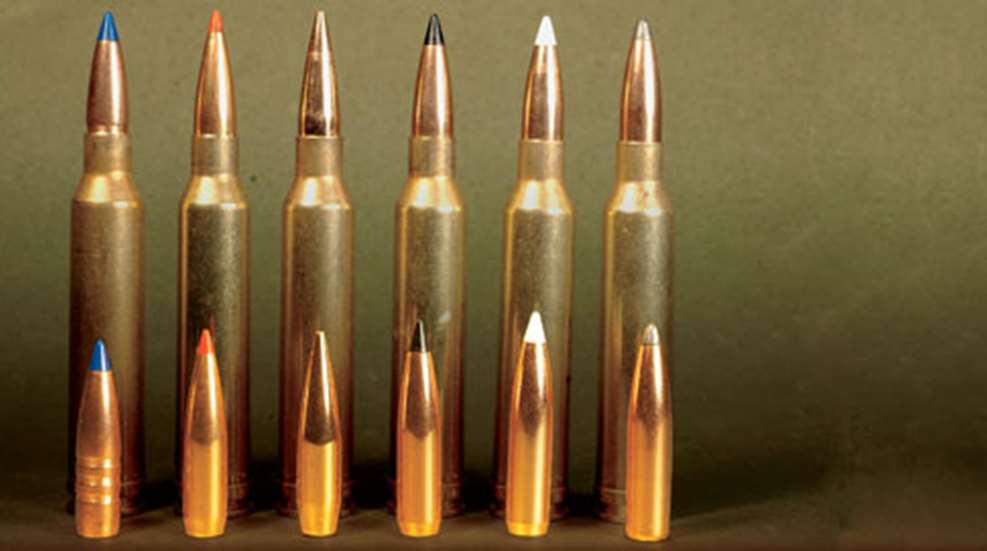
Back then the Nosler Partition was about the only controlled-expansion 7 mm bullet. Today sporting goods shelves are stacked with bullets that limit frontal upset to retain a bullet’s shank for deep penetration at the 7 mm’s often high impact velocities. Take your pick of bullets with jackets that mostly or fully separate their front and rear cores such as the Speer Grand Slam, Swift A-Frame and of course the Partition, jackets welded to lead cores such as the Hornady InterBond, Nosler AccuBond and Swift Scirocco or bullets composed of a homogenous solid like the Barnes Triple-Shock X-Bullet, Hornady GMX and Nosler E-Tip.
My 7 mm Rem. Mag. was great and dandy back when I worked at the mill. Certainly it killed elk better than my old pokey .30-’06 Sprg. But in 1985 I bought a chronograph. The 160-grain bullets that I thought were leaving the muzzle at 3,000 fps and faster actually flew not much over 2,700 fps with a maximum charge of IMR-4350. A top weight charge of IMR-4831 fired 160s only slightly faster than 2,800 fps. Suddenly my old ’06 didn’t seem so pokey.
Since then, slower-burning propellants have been introduced that produce higher velocities in the 7 mm. Magnum and Reloder 25 send off 160s at slightly faster than 3,000 fps while Reloder 22 and 25 fire 175-grain bullets about 2,900 fps.
Loading The Original “Big Seven”
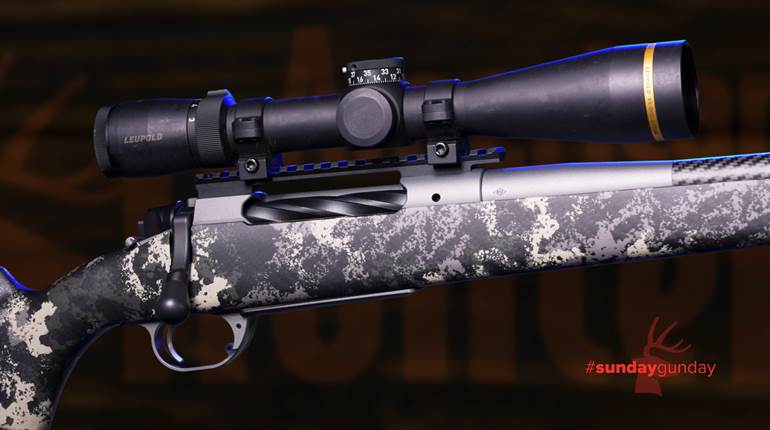
To start the reloading process I shot three 7 mm Rem. Mag. factory loads in Remington’s Anniversary Edition rifle. As the load table shows, they shot well; four, five-shot groups averaging as tight as 1.16 inches at 100 yards with velocities in excess of 2,900 fps using 160-grain bullets.
I took some measurements of five cases before and after they were fired and again after they were sized and fired a second time. Monitoring the case lengths, I found the case necks stretched quite a bit each time they were fired and sized:
Case Length Inches
New Unfired 2.490
Fired 2.495
Full-length sized 2.505 to 2.508
Trimmed 2.490
2nd Firing 2.495 to 2.497
2nd Full-length sized 2.502 to 2.506
Sizing the case necks only enough to hold a bullet might reduce this stretching. But after one or two firings brass will fail to spring back enough and a cartridge loaded with the cases will fit in the chamber only if you lean on the bolt handle like a pry bar. So pay attention to case lengths.
I also took measurements of loaded cartridges. After loading 10 cartridges apiece with Barnes Tipped Triple-Shock X-Bullets and Hornady InterBonds I put the cartridges on an RCBS Case Master Gauging Tool to measure how precisely the bullets were aligned with the center of the cases. Alas, my 30-year-old seater die positioned bullets as much as 0.010 inches off center. Since the Case Master showed run-out of case necks was next to nothing, the seater die was the problem. Cleaning accumulated gunk out of the die helped a bit.
I switched to an RCBS Gold Medal seater die with a sliding guide that held cases tightly in alignment in the die and with the bullet seating stem. That reduced bullet run-out to 0.004 inches at the most. The bullets with this lower amount of run-out shot groups a couple of tenths of an inch tighter than bullets set crooked toward the rifling.
Through the years, many cartridges have tried to oust the 7 mm Rem. Mag. as the most popular 7 mm cartridge—maybe the most popular of all magnum cartridges. But they’ve all fallen by the wayside. With new bullets and propellants continuing to improve its performance, the 7 mm Rem. Mag. should retain its position for the next 50 years.
Most Popular