It probably wasn’t the kind of endorsement that E. Remington & Sons would have preferred, but when outlaw Frank James surrendered to the governor of Missouri on Oct. 5, 1882, and handed over his 1875 Remington, he proclaimed, “the Remington is the hardest and surest shooting pistol made.”
Although owned by other frontier luminaries, including William F. “Buffalo Bill” Cody, fame remained elusive for the 1875 Improved Army Revolver, which Remington had introduced to compete with Colt’s Single Action Army. Fewer than 30,000 of Remington’s six-shot single-actions were produced during the 12-year period that ended in 1887 with the company’s bankruptcy and eventual reorganization as Remington Arms. Still, the 1875 Remington made an admirable debut with an order of 10,000 revolvers from the Egyptian government, but shipments stopped when Remington discovered that Egypt owed the company several hundred thousand dollars for previously delivered Rolling Block rifles. In 1883, however, the U.S. Department of the Interior ordered 639 nickel-plated Model 1875s for its Indian Police, which was around the same time that the Mexican government contracted for 1,000 of the revolvers.
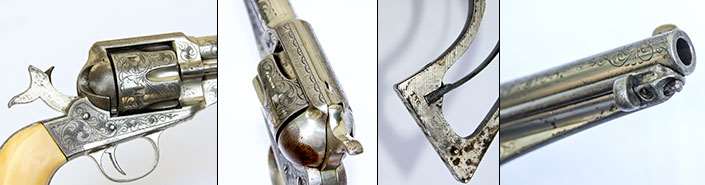
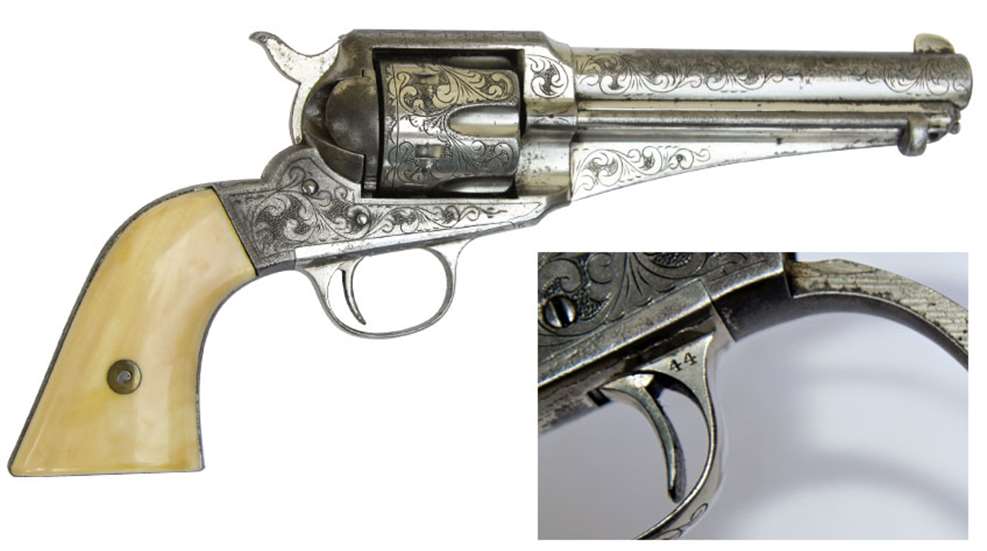
Priced at $12.50 with walnut stocks (ivory or pearl were options) and blued finish with case-hardened hammer and trigger, or in nickel finish, the revolver came with a 7½" barrel as standard, although some rare 5¾" versions exist. Often fitted with a lanyard ring, the 1875 had a slightly elongated grip compared to the Colt SAA. But its most distinguishing feature was a non-functional, under-barrel steel web, inspired by Remington’s percussion New Model Army (the web was eliminated for the short-lived and scarcer Models 1888 and 1890). Extremely accurate, the 1875 was built to such close tolerances that it would frequently bind up with fouling.
The first 13,000 Model 1875s were chambered for the proprietary .44 Remington center-fire (which could also chamber .44 Colt cartridges), but around Serial No. 16,000 the guns also started being chambered for the more popular .44-40 Win., and stamped “44” on the left, rear trigger guard bow and, later, also on the frame. Guns shipped to Mexico were chambered in .45 Colt and similarly stamped “45.”
This factory-nickeled gun has had its 7½" barrel shortened to 5½", further confirmed by an uncrowned muzzle and the positioning of an atypical front sight. The two-piece ivory stocks are contemporary to the gun, but the aftermarket engraving probably dates from the 20th century. Nonetheless, with its appealing frontier aura, this 60 percent Model 1875 is worth $3,250 to $3,750.
Gun: Remington Improved Army Revolver (also known as Remington No. 3 Revolver and 1875 Frontier)
Chambering: .44-40 Win.
Manufactured: c. 1882-1887 (Batch No. 156*)
Condition: NRA Good-Very Good (Antique Gun Standards)
Value: $3,250 to $3,750
*Note: Only the first run of guns, up to approximately 15,800, were serial-numbered. A second run is thought to have been serially numbered from 1 to 2,000. After that, all guns were consecutively numbered in batches, which explains why so many duplicate low-numbered 1875s are encountered.