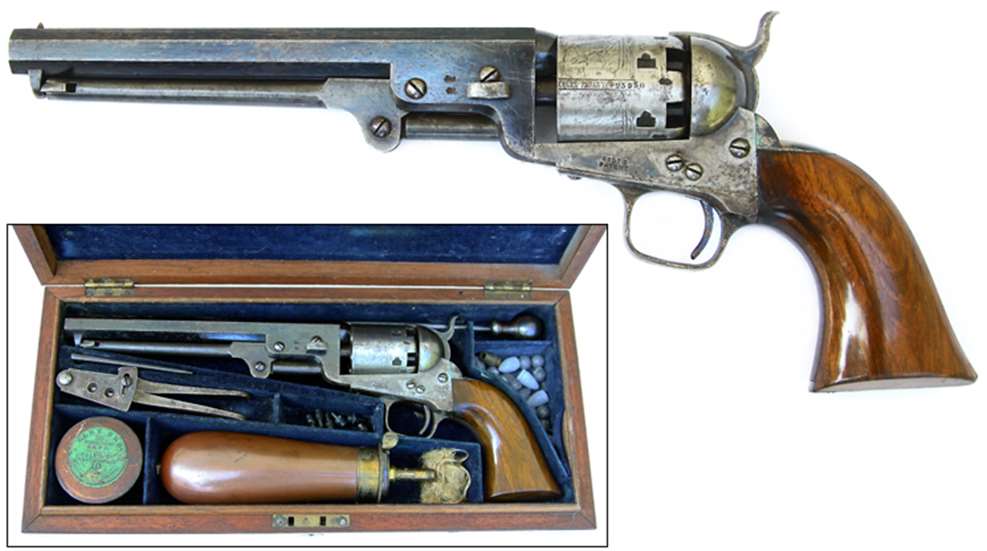
The Model 1851 Navy was one of Colt’s most popular cap-and-ball “belt pistols,” and more than 250,000 were produced between 1851 and 1873. But approximately 42,000, bearing their own set of serial numbers, were manufactured in London, rather than Hartford, Conn.—an interesting variation for collectors.
The Model 1851 Navy was introduced at London’s Great Exhibition that same year, where it garnered enough orders to encourage Colt to open a factory in London. Until machinery and workers could be established, however, Colt had parts from Hartford sent to London for assembling, finishing and proofing. It wasn’t until 1854 that the first truly “London-made” Colt Navies came off the assembly line.
That was just after the outbreak of the Crimean War. As a result, during that first year, Colt shipped more than 10,000 London Navies to Russia’s Baltic Fleet and another 9,000 pistols to British troops. Colt’s London factory soon began receiving distinguished visitors, including Prince Albert and Charles Dickens, who praised the factory by stating, “It is the only place in England where one can see the complete manufacture of a pistol, from dirty pieces of timber and rough bars of cast steel, till it is fit for the gunsmith’s case.” But in 1856, with the end of the war and Parliament urging citizens to “buy British,” orders slowed and Colt closed the London factory.
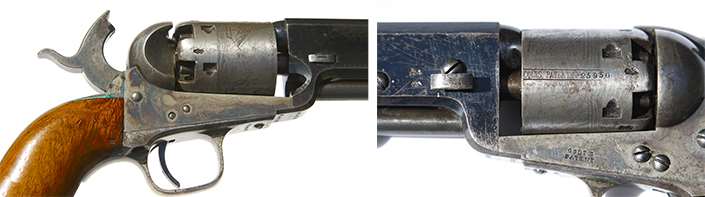
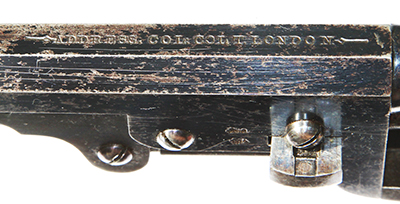 Aside from the initial 2,000 First Model London Navies assembled from Hartford-shipped parts, which featured brass backstraps and the smaller trigger guards of the Third Model Navy, the London model resembled the 1851 Fourth Model, with large, round, silver-plated or blued steel backstraps. Frames, hammers and rammers were color-casehardened; the rest of the gun was blued. Barrels were stamped “ADDRESS. COL COLT. LONDON,” with British proofmarks stamped on the cylinder between each nipple and to the left of the barrel lug. Stocks were one-piece walnut and the cylinder sported the Ormsby naval battle scene. Engraved revolvers exhibit England’s finest artistry from the time.
This cased Second Model London Navy—made in 1855—still retains much of its blued finish and color-casehardening, sports a silver-plated backstrap and trigger guard, and is marred only by scratches on one of the barrel flats and minor pitting on the frame. It obviously was kept in its fully accessorized case, which includes an extra set of nipples. By itself, this 80 percent gun would fetch $4,500, but with its original case, it is easily worth $7,500 to $8,000.
Gun: Colt 1851 London Navy (cased)
Caliber: .36
Serial No: 25950
Manufactured: 1855
Condition: NRA Fine (Antique Gun Standards)
Value: $7,500 to $8,000
Most Popular