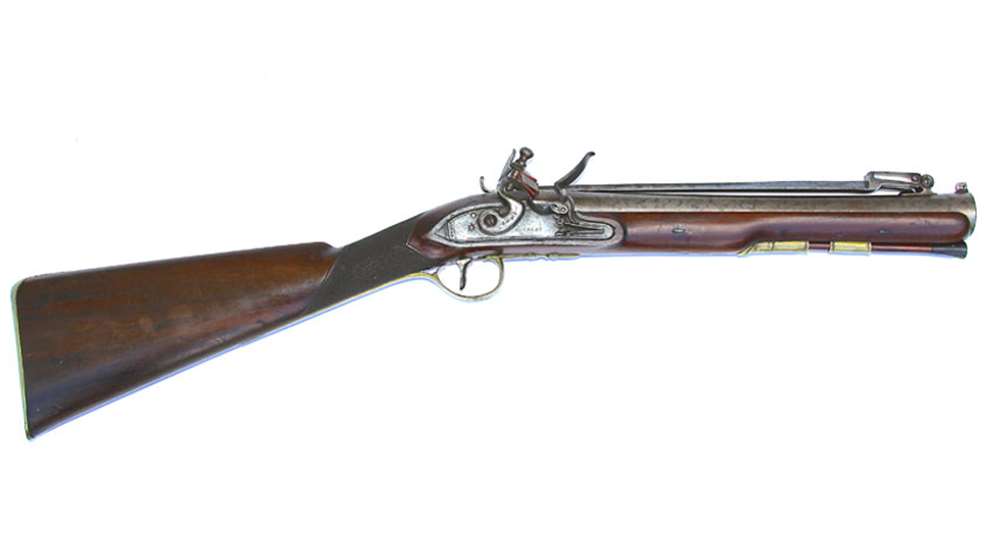
Although it isn’t readily apparent, this is a most unusual blunderbuss. The top flat of its 13"-long iron barrel is engraved “H.W. Mortimer - London - Gun Maker to his Majesty,” while the lockplate, stamped “Gourlay,” sports modest, tasteful engraving, as does the brass buttplate and acorn-themed trigger guard. But what sets this blunderbuss apart is the bold, hand-engraved inscription around the muzzle’s thick flat circumference that reads, “Happy He Who Escapes Me.”
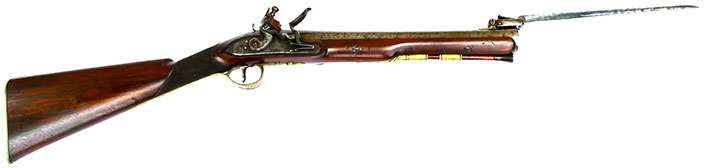
Charles Gourlay, the Scottish gunmaker who fashioned this unusual blunderbuss, was also known for crafting flintlock pistols and, later, percussion shotguns. He began his Glasgow business in 1818 at 115 Nelson St., then moved to Argyll Street in 1822, where he was joined by his brother John, as C&J Gourlay. The “H.W. Mortimer” inscription on the barrel provides a solid clue as to when this gun was made, as it refers to esteemed London gunmaker Henry William Mortimer (circa 1780-1835), and by extension, “Gun Maker to his Majesty” referred to King George III (1738-1820). Obviously, Gourlay bought at least some of his barrels from Mortimer, and that makes this one of Gourlay’s earliest flintlocks, putting its date of manufacture somewhere between 1818 and 1820.
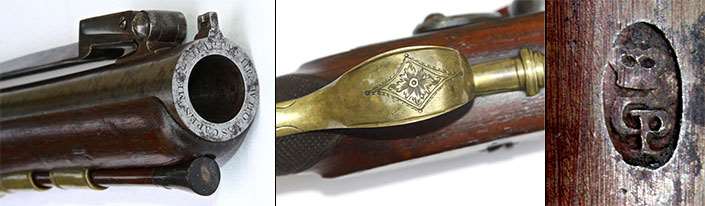
There is no readily visible proofmark, which was a requirement for British military arms of the period. However, removal of the barrel reveals a stamped British crown over the letters “GP” and another crown stamped over a “V,” which confirms British proofing. Thus, this was a civilian coach gun, likely meant to guard passengers or the Royal Mail, or perhaps carried by an individual who realized the close-range effectiveness of a blunderbuss, especially when loaded with a standard blackpowder charge of 120 grs. and 20 balls of 00 buckshot. And for backup, there was the spring-loaded bayonet, which still snaps forward and locks into place with a sound that was the early 19th century equivalent of racking a shotgun.
In its relatively pristine condition, with no blackpowder pitting, it appears this coach gun did its job protecting whomever carried it just by its presence, aided, no doubt, by the foreboding warning on its muzzle. One wishes it could talk, but even in silence, it is worth $8,000 to $10,500.
Gun: Charles Gourlay Flintlock Coach Gun with Spring Bayonet
Caliber: .88
Manufactured: c. 1818-1820
Condition: NRA Fine to Excellent (Antique Gun Standards)
Value: $8,000 to $10,500
Most Popular